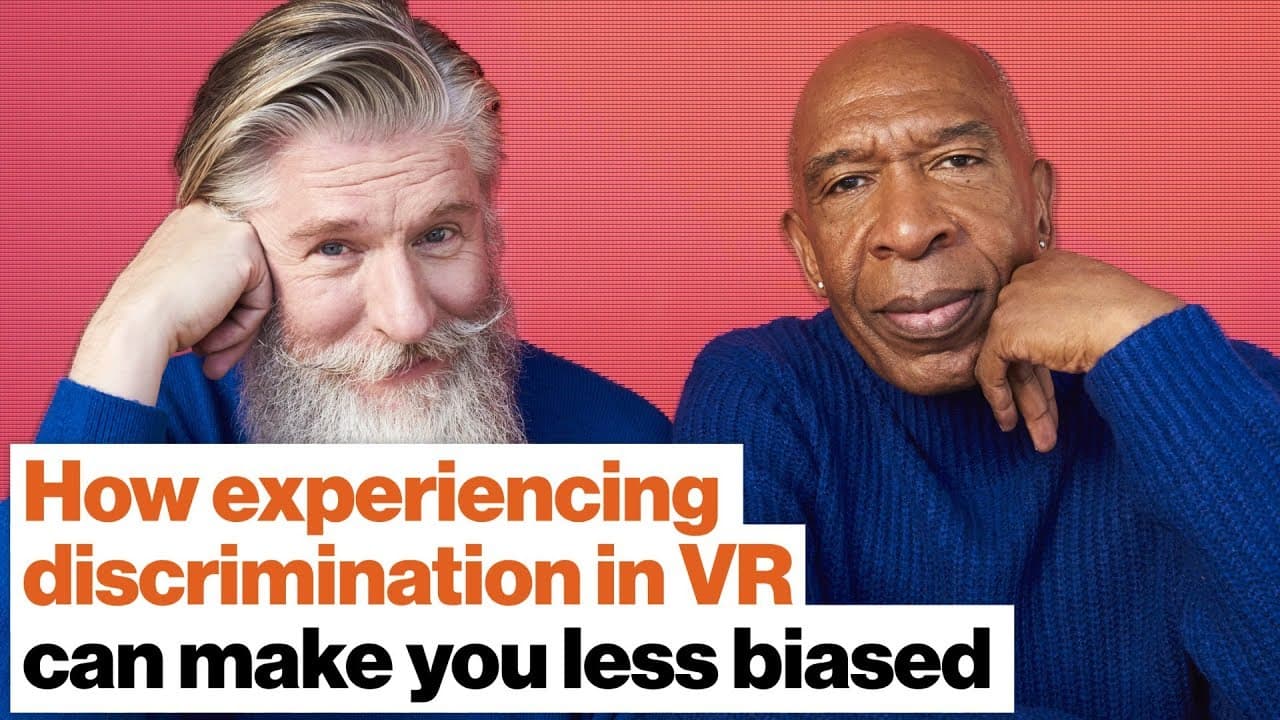
How experiencing discrimination in VR can make you less biased | Jeremy Bailenson | Big Think
TL;DR
Virtual reality allows people to experience life from different perspectives, reducing biases and increasing empathy.
Transcript
Most psychologists agree the best way to have somebody increase empathy is to engage in something called perspective taking. Imagining that you’re someone else trying to cognitively and emotionally understand some event from their perspective. It’s hard to do that. Often we don’t have the facts, meaning I don’t know what’s going on through your min... Read More
Key Insights
- 👻 Perspective taking through VR enhances empathy by allowing individuals to experience different perspectives.
- 🛟 VR can reduce stereotypes and discrimination by immersing individuals in the lives of others.
- 🛀 VR has shown to outperform traditional methods in promoting empathy and behavior change.
- ❓ Experiencing implicit bias through VR can increase awareness and understanding of societal issues.
- 👥 Virtual reality has the potential to transform attitudes towards marginalized groups.
- 🛟 VR serves as a powerful tool in fostering empathy and reducing biases.
- 🥺 Immersive experiences in VR can lead to significant shifts in attitudes and behaviors.
Install to Summarize YouTube Videos and Get Transcripts
Explore YouTube Video Summarizer or Get YouTube Transcript Extractor
Questions & Answers
Q: How does perspective taking increase empathy?
Perspective taking involves imagining oneself in someone else's shoes, which is challenging as we lack their experiences. Virtual reality (VR) eliminates this cognitive effort, allowing us to experience life from different perspectives, increasing empathy.
Q: What was the outcome of the ageism study using VR?
The ageism study using VR showed a reduction in ageist attitudes among participants. They were less likely to list stereotypical words about the elderly after experiencing life as an older person in VR, suggesting a decrease in ageism.
Q: How does VR compare to other methods of building empathy?
VR tends to outperform traditional methods like role-playing or reading about case studies in fostering empathy. Walking a mile in someone else's shoes through VR has shown to be more effective in bringing about behavior change towards others.
Q: How is VR being used to address implicit bias regarding racism?
VR is being utilized to showcase the everyday experiences of people of color facing racism. The upcoming piece, Thousand Cut Journey, immerses participants in scenarios where they experience implicit bias repeatedly to increase awareness and understanding.
Summary & Key Takeaways
-
Virtual reality helps people experience life from different perspectives, enhancing empathy.
-
Studies have shown that using virtual reality can reduce ageism and discrimination.
-
VR outperforms other empathy-building methods, leading to behavior change towards others.
Read in Other Languages (beta)
Share This Summary 📚
Summarize YouTube Videos and Get Video Transcripts with 1-Click
Try YouTube Summary with ChatGPT & Claude or YouTube Transcript Generator
Explore More Summaries from Big Think 📚


Summarize YouTube Videos and Get Video Transcripts with 1-Click
Try YouTube Summary with ChatGPT & Claude or YouTube Transcript Generator