Assume a spherical cow.
TL;DR
Physicists use simplifications and approximations to describe complex objects and phenomena, allowing for the creation of useful equations and models.
Transcript
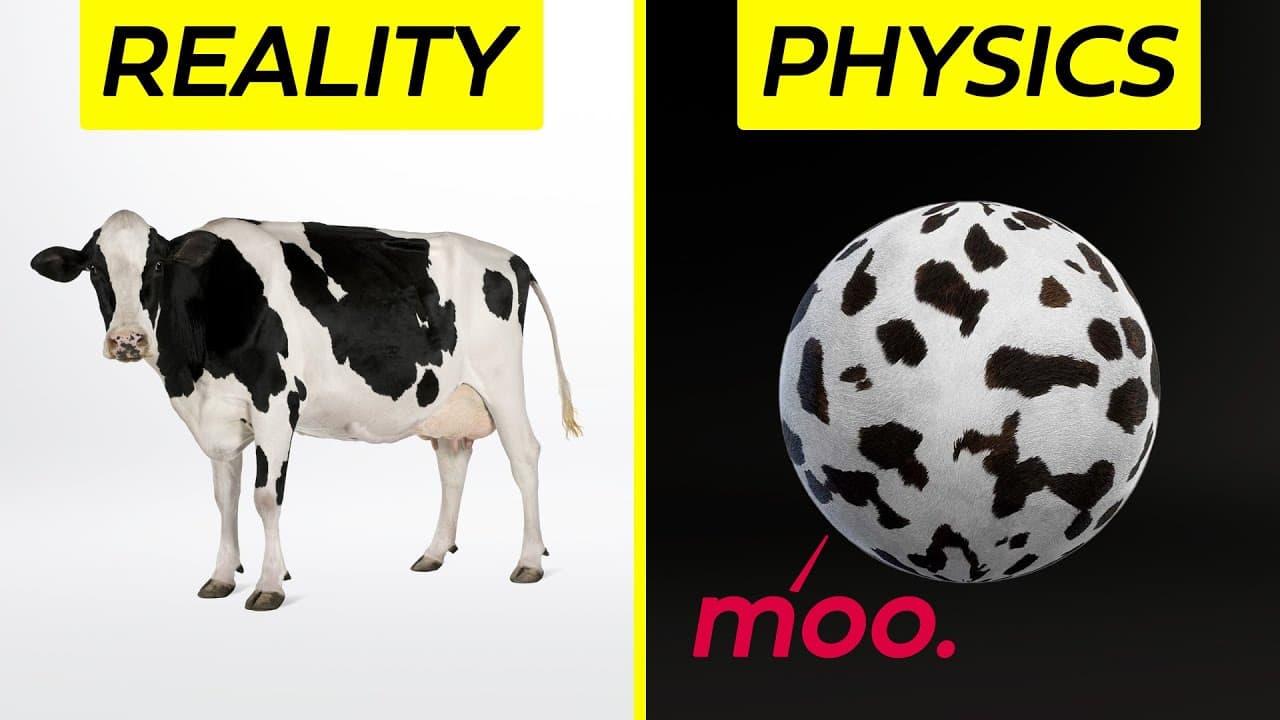
this video is sponsored by brilliant there's a joke in physics that a cow is at first approximation a sphere i mean it's a three-dimensional object it has depth width and height and it's got no sharp edges so it's kind of accurate but the main reason a cow is a sphere to a physicist is because a sphere is a really simple shape every point on its su... Read More
Key Insights
- 👻 Simplifying and approximating complex objects and phenomena allows physicists to create useful equations and models.
- 🙈 Approximations are inspired by magnitude analysis, where physicists estimate which effects are small enough to be ignored.
- 🙂 Atmospheric science and atomic physics are two fields where approximations are commonly used to study heat transfer, light absorption, and behavior.
- 💦 Physicists are aware of the complexity of the natural world and often work on adding that complexity back into their models.
- ❓ Without simplifications, the most general equations of physics would never have been developed.
- 🤩 Learning from mistakes and experimenting is a key part of the educational philosophy embraced by Brilliant, the sponsor of this video.
Install to Summarize YouTube Videos and Get Transcripts
Explore YouTube Video Summarizer or Get YouTube Transcript Extractor
Questions & Answers
Q: Why do physicists use approximations and simplifications?
Physicists use approximations because trying to describe every detail of an object or phenomenon would result in overly complex equations that are difficult or impossible to solve. By simplifying, they can focus on understanding the fundamental behavior.
Q: How are approximations used in atmospheric science?
In atmospheric science, equations used to describe the flow of the atmosphere over the Earth's surface are similar to those used to describe the behavior of water droplets splashing on the ground. The terms in the equations differ, allowing for the safe approximation of certain effects.
Q: Why is it important to approximate the behavior of a helium atom?
By approximating a helium atom to only consider how electrons interact with the nucleus and not with each other, physicists can understand how helium absorbs and emits light. This understanding is crucial in studying the behavior of stars and the universe.
Q: Why is it necessary to add complexity back to simplified descriptions?
While approximations are helpful, the complexity of real systems cannot be ignored entirely. Scientists often add complexity back to their models, considering factors like friction or small effects that were initially ignored, to create more accurate descriptions.
Summary & Key Takeaways
-
Physicists use approximations to describe objects and phenomena in the natural world, allowing for the creation of equations and models.
-
By simplifying the complexity of objects like cows or spaceships, physicists can focus on capturing the big picture and understanding fundamental behaviors.
-
Approximations are used in various scientific fields, such as atmospheric science and atomic physics, to study heat transfer, light absorption, and more.
Read in Other Languages (beta)
Share This Summary 📚
Summarize YouTube Videos and Get Video Transcripts with 1-Click
Try YouTube Summary with ChatGPT & Claude or YouTube Transcript Generator
Explore More Summaries from Simon Clark 📚






Summarize YouTube Videos and Get Video Transcripts with 1-Click
Try YouTube Summary with ChatGPT & Claude or YouTube Transcript Generator