Why it's harder for AI to open doors than play chess | Pulkit Agrawal | TEDxMIT
TL;DR
The development of physical intelligence is proving to be more challenging than language understanding in the field of artificial intelligence.
Transcript
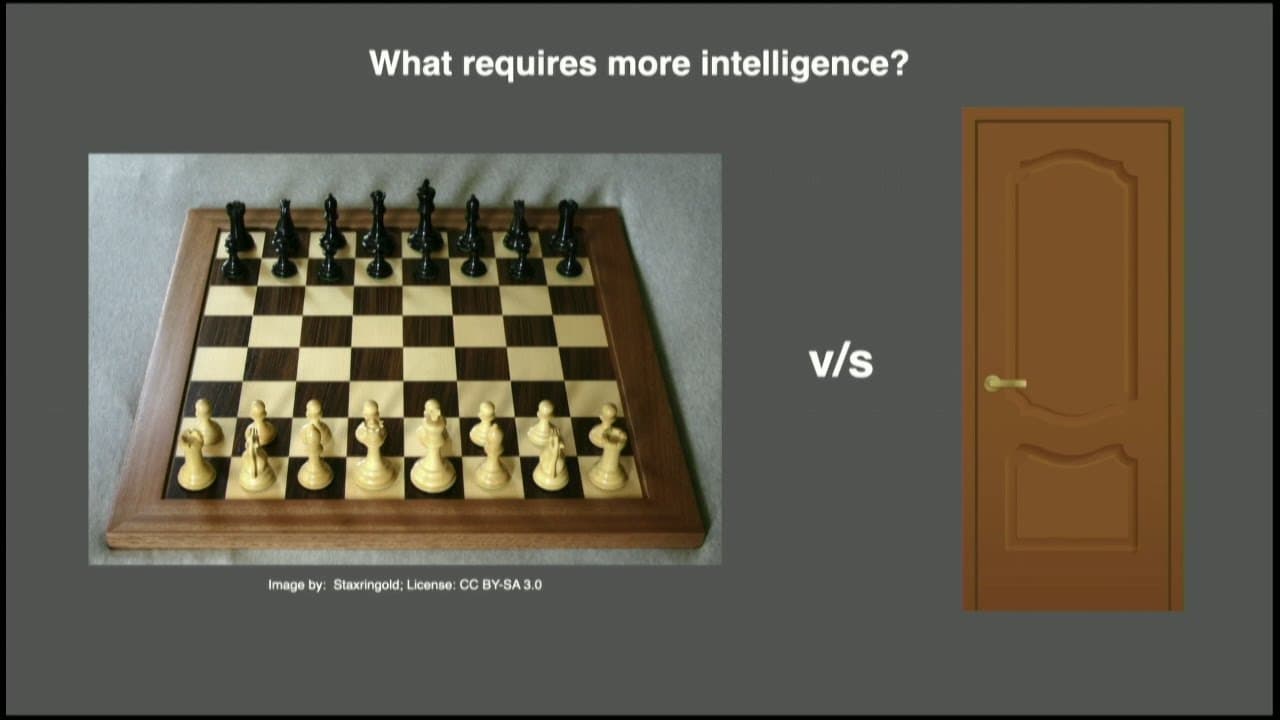
thank you so let us get started with a question what do you think requires more intelligence playing the game of chess or opening a door right I mean many times we think that chess is a matter of Genius so if chest was actually hard to do then building machines which can play chess should also be way harder than building machines which can open doo... Read More
Key Insights
- ♟️ Chess, often considered a game of genius, has been surpassed by AI systems, highlighting the difference between human perception of difficulty and actual challenges for robots.
- 📖 Physical intelligence, such as opening doors and walking, is more computationally demanding than reasoning processes like chess.
- ⌛ Evolution spent more time evolving sensory motor skills than language and reasoning, indicating the importance of physical intelligence.
- ⬛ Language understanding in AI has made significant progress, thanks to large amounts of data, but physical intelligence remains a challenge.
- 🚡 Simulations provide an efficient way to generate data for training physical intelligence, but real-world implementation requires adaptation to different terrains.
- 🎨 Developing physical intelligence requires consideration of both control algorithms and hardware design, including touch sensing.
- 🛰️ The development of physical intelligence is crucial before achieving true artificial intelligence.
Install to Summarize YouTube Videos and Get Transcripts
Explore YouTube Video Summarizer or Get YouTube Transcript Extractor
Questions & Answers
Q: Why is it more difficult to develop physical intelligence in robots compared to language understanding?
Physical intelligence requires robots to reason about the environment and generalize behaviors for various terrains, which is more complex than reasoning in language understanding tasks.
Q: How do AI systems learn language understanding?
Language models consume vast amounts of data and predict the next words based on given input. They can also generate images based on text prompts.
Q: How are simulations used in developing physical intelligence?
Simulations allow for the generation of large amounts of data quickly, enabling robots to learn behaviors like walking and manipulation. These learned behaviors can then be transferred to the real world.
Q: What are some challenges in developing physical intelligence?
Besides control algorithms, hardware design and perception also play crucial roles in building physical intelligence. Touch sensing and optimizing hand designs are areas of focus.
Key Insights:
- Chess, often considered a game of genius, has been surpassed by AI systems, highlighting the difference between human perception of difficulty and actual challenges for robots.
- Physical intelligence, such as opening doors and walking, is more computationally demanding than reasoning processes like chess.
- Evolution spent more time evolving sensory motor skills than language and reasoning, indicating the importance of physical intelligence.
- Language understanding in AI has made significant progress, thanks to large amounts of data, but physical intelligence remains a challenge.
- Simulations provide an efficient way to generate data for training physical intelligence, but real-world implementation requires adaptation to different terrains.
- Developing physical intelligence requires consideration of both control algorithms and hardware design, including touch sensing.
- The development of physical intelligence is crucial before achieving true artificial intelligence.
- The hype around embodied intelligence is beneficial, but physical intelligence needs to be prioritized for further advancements in AI.
Summary & Key Takeaways
-
Chess, a game often associated with intelligence, has been surpassed by AI systems, while simple physical tasks like opening doors remain challenging for robots.
-
Human intuition about what is difficult doesn't align with the difficulties faced by robots in developing physical intelligence.
-
Evolution suggests that sensory motor skills took significantly more time to develop than language and reasoning skills.
Read in Other Languages (beta)
Share This Summary 📚
Summarize YouTube Videos and Get Video Transcripts with 1-Click
Try YouTube Summary with ChatGPT & Claude or YouTube Transcript Generator
Explore More Summaries from TEDx Talks 📚




Summarize YouTube Videos and Get Video Transcripts with 1-Click
Try YouTube Summary with ChatGPT & Claude or YouTube Transcript Generator