How to Rank #1 on Google in Four Steps
TL;DR
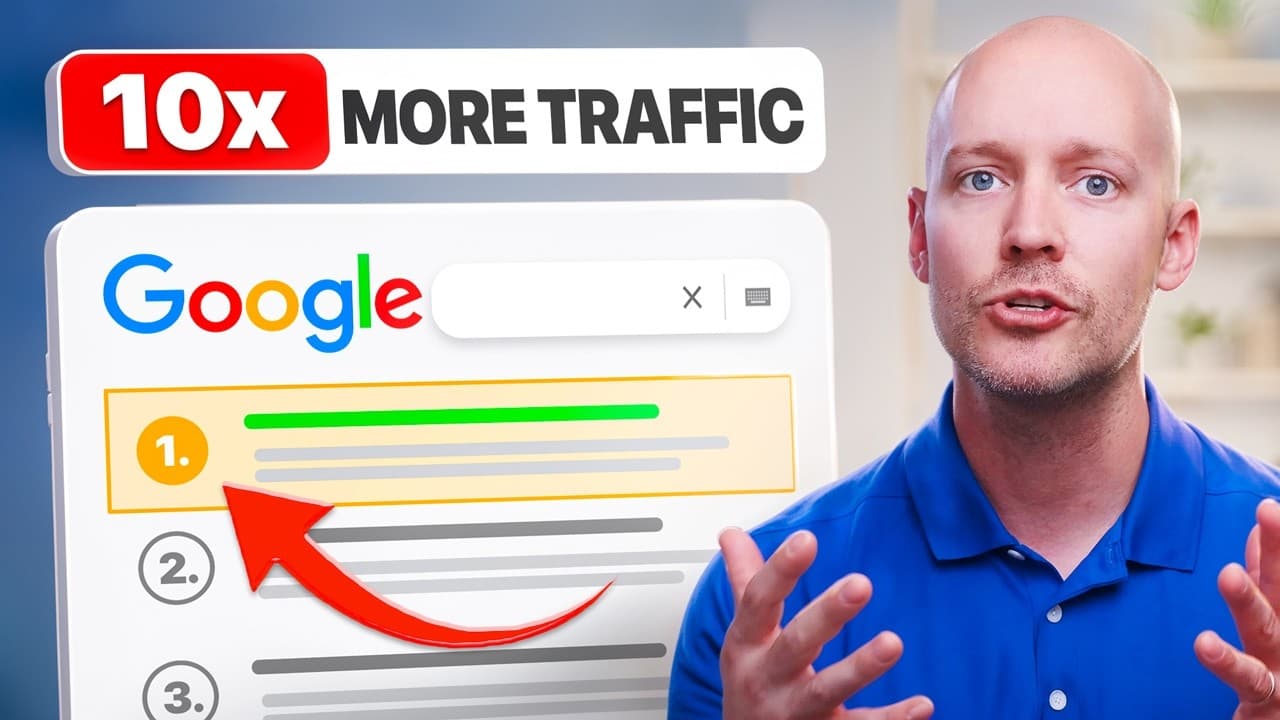
To rank #1 on Google, follow a four-step SEO blueprint: analyze your competitors’ SEO tactics, perfectly match user intent, enhance your content design, and implement engagement triggers to improve user interaction. Additionally, use Natural Language Processing (NLP) to create relevant content, prioritize human-written copy, and build a strong internal linking structure to gain Google's trust and increase organic traffic.
Transcript
recent HS research shows that 97% of web pages get zero organic search traffic from Google so what does the top 3% do differently well that's what you're going to learn right now I'll show you a proven four pillar SEO blueprint to help you rank number one in Google for example this page grew by 214% in only 30 days using this blueprint then we use ... Read More
Key Insights
- 97% of web pages receive no organic traffic from Google, highlighting the importance of effective SEO strategies.
- A four-pillar SEO blueprint can significantly increase organic traffic, as demonstrated by a 214% growth in just 30 days.
- Analyzing competitors' on-page SEO can reveal weaknesses to exploit, such as URL structure and keyword usage in titles.
- Matching user intent perfectly is crucial; content should focus on conversion rather than irrelevant information.
- Content design and engagement triggers, like videos and calculators, can enhance user interaction and dwell time.
- Natural Language Processing (NLP) can be used to create relevant content by analyzing top competitors' pages.
- Human-written content is often more effective than AI-generated content for achieving higher rankings.
- Building a strong internal link structure and creating linkable content are essential for Google's trust and higher rankings.
Install to Summarize YouTube Videos and Get Transcripts
Explore YouTube Video Summarizer or Get YouTube Transcript Extractor
Questions & Answers
Q: What is the main focus of the SEO blueprint discussed?
The main focus of the SEO blueprint is to help websites rank #1 on Google by analyzing competitors' SEO strategies, matching user intent, enhancing content design, and using engagement triggers. It emphasizes the importance of understanding and exploiting competitors' weaknesses, creating relevant content through NLP, and building a strong internal link structure.
Q: How can Natural Language Processing (NLP) benefit SEO?
Natural Language Processing (NLP) can benefit SEO by analyzing the content of top competitors and extracting relevant topics. This allows for the creation of content that is highly relevant to Google's algorithms, improving the chances of ranking higher. By using NLP, websites can cover the same topics as competitors but with better quality, depth, and differentiation.
Q: Why is human-written content preferred over AI-generated content?
Human-written content is preferred over AI-generated content because it tends to be more effective in achieving higher rankings. The video suggests that human writers can create lean and compelling copy that focuses on topic coverage rather than keyword stuffing. This approach ensures that the content is more relevant and engaging for users, which can lead to better SEO results.
Q: What role do engagement triggers play in SEO?
Engagement triggers play a significant role in SEO by increasing user interaction and dwell time on a webpage. The video suggests using elements like well-produced videos and interactive calculators to engage users. These triggers can enhance the user experience, leading to higher rankings as Google considers user signals as a variable in its ranking algorithm.
Q: How important is matching user intent in SEO?
Matching user intent is crucial in SEO as it ensures that the content aligns with what users are searching for. The video emphasizes that content should be conversion-focused and relevant to the user's needs. Providing content that matches user intent can lead to higher engagement, better user satisfaction, and ultimately, improved rankings on Google.
Q: What is the significance of building a strong internal link structure?
Building a strong internal link structure is significant because it helps Google understand the relevance and hierarchy of content on a website. By linking supporting assets to the main content page and crosslinking informational assets, websites can form a strong content cluster. This approach can improve the website's authority and trustworthiness in Google's eyes, leading to higher rankings.
Q: What strategies are recommended for creating linkable content?
The video recommends several strategies for creating linkable content, such as reverse engineering competitors' successful pages and using chat-based tools to generate link bait ideas. Linkable content should be informative, engaging, and relevant to attract backlinks. By focusing on creating content that others want to link to, websites can improve their SEO performance.
Q: How can websites differentiate themselves from competitors?
Websites can differentiate themselves from competitors by offering unique content that matches user intent and is designed with engagement triggers. The video suggests analyzing competitors' weaknesses, enhancing content design, and providing a strong value proposition to stand out. By focusing on these aspects, websites can create a competitive edge and achieve higher rankings.
Summary & Key Takeaways
-
The video discusses a four-step SEO blueprint to help websites rank #1 on Google. It emphasizes analyzing competitors' SEO tactics, matching user intent, enhancing content design, and using engagement triggers to boost user interaction and dwell time.
-
Natural Language Processing (NLP) is recommended for creating relevant content by extracting topics from top competitors. The video also stresses the importance of human-written content and building a strong internal link structure to gain Google's trust.
-
Creating linkable content and launching link-building campaigns are crucial for increasing organic traffic. The video provides detailed strategies for exploiting competitors' weaknesses and differentiating content to achieve higher rankings.
Read in Other Languages (beta)
Share This Summary 📚
Summarize YouTube Videos and Get Video Transcripts with 1-Click
Try YouTube Summary with ChatGPT & Claude or YouTube Transcript Generator
Explore More Summaries from Nathan Gotch 📚




Summarize YouTube Videos and Get Video Transcripts with 1-Click
Try YouTube Summary with ChatGPT & Claude or YouTube Transcript Generator