What Is the Connection Between Pi and Prime Numbers?
TL;DR
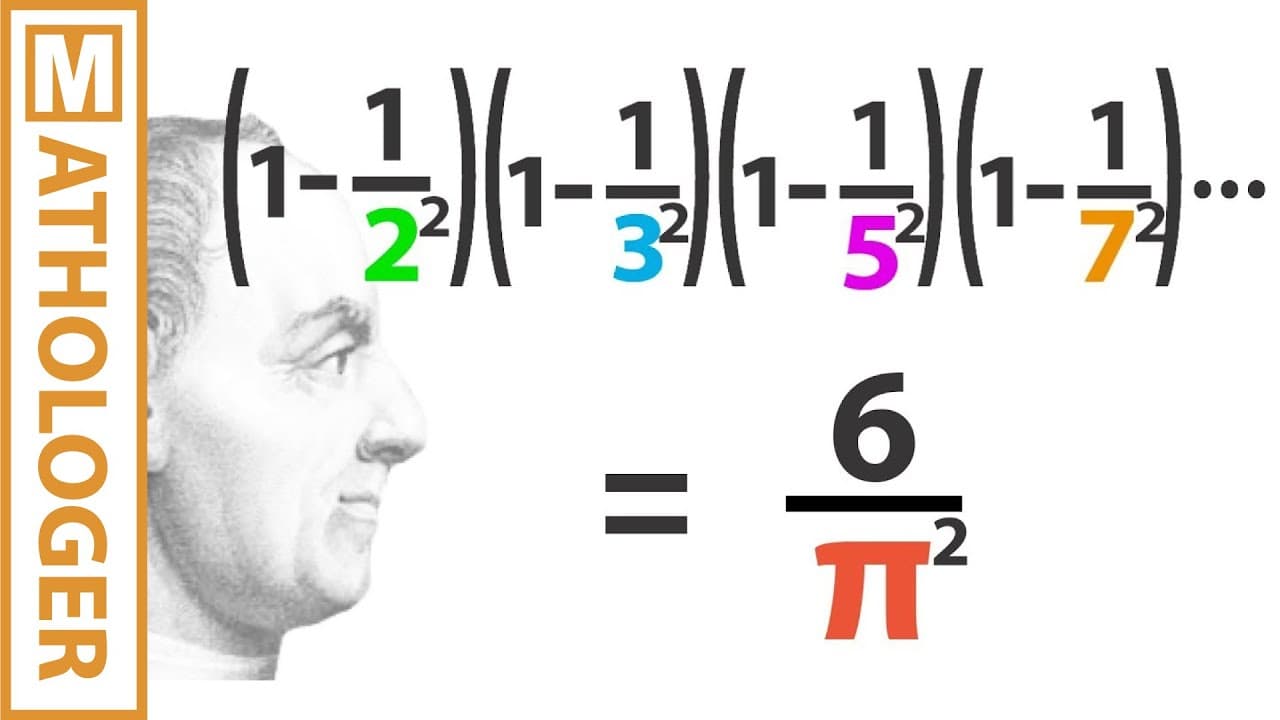
Euler's identity reveals that Pi is connected to prime numbers through the Riemann zeta function, which transforms sums of reciprocals into products. This relationship leads to important results, including proofs of the infinitude of primes and the probability that two random numbers are relatively prime, showcasing the deep interplay between these mathematical concepts.
Transcript
Welcome to another Mathologer video. Last time I showed you how the mathematical superstar Euler discovered this stunning identity up there: PI squared over 6 is equal to the sum of the reciprocals of the squares. Today I'll introduce you to the mathematical magic that allowed him to morph this infinite sum into an infinite product. And this infini... Read More
Key Insights
- #️⃣ Euler's identity can be transformed into an infinite product connecting PI and prime numbers.
- #️⃣ The Riemann zeta function, derived from Euler's identity, is a key tool in understanding the connection between PI and prime numbers.
- 🥺 Evaluating the zeta function at certain values can lead to proofs of the infinitude of prime numbers and other interesting facts about primes.
Install to Summarize YouTube Videos and Get Transcripts
Explore YouTube Video Summarizer or Get YouTube Transcript Extractor
Questions & Answers
Q: How did Euler morph the sum of the reciprocals of squares into an infinite product connecting PI with prime numbers?
Euler used a trick of multiplying the terms of the sum by different fractions and subtracting consecutive terms to get a simplified form that involved prime numbers on the left side and 1 on the right side.
Q: What is the significance of the Riemann zeta function?
The Riemann zeta function, derived from Euler's product formula, establishes a connection between PI and prime numbers. It allows for the calculation of the number of primes without having to generate all the primes individually.
Q: How does evaluating the zeta function at 1 and 2 prove the infinitude of prime numbers?
When the zeta function is evaluated at 1 and 2, the left side becomes infinite, leading to the conclusion that there must be infinitely many primes. This is because a finite number of primes would result in a finite value for the expression on the right side, which is not possible.
Q: How does Euler's product formula involving PI and prime numbers relate to the probability of relatively prime numbers?
Euler's product formula can be transformed into a probability of two randomly chosen natural numbers being relatively prime. This probability is equal to 6 over PI squared and can be used as a way to approximate the value of PI.
Summary & Key Takeaways
-
Euler's identity, PI squared over 6 equals the sum of the reciprocals of the squares, can be transformed into an infinite product that connects PI with prime numbers.
-
The Riemann zeta function, derived from Euler's identity, plays a crucial role in connecting PI with prime numbers.
-
Evaluating the zeta function at different values, such as 1 and 2, leads to proofs of the infinitude of prime numbers and other curious facts about prime numbers.
Read in Other Languages (beta)
Share This Summary 📚
Summarize YouTube Videos and Get Video Transcripts with 1-Click
Try YouTube Summary with ChatGPT & Claude or YouTube Transcript Generator
Explore More Summaries from Mathologer 📚



Summarize YouTube Videos and Get Video Transcripts with 1-Click
Try YouTube Summary with ChatGPT & Claude or YouTube Transcript Generator