Products
Features
YouTube Video Summarizer
Summarize YouTube videos
Web & PDF Highlighter
Highlight web pages & PDFs
Chat with PDF
Ask any PDF questions with AI
Ask AI Clone
Chat with your highlights & memories
Audio Transcriber
Transcribe audio files to text
Glasp Reader
Read and highlight articles
Kindle Highlight Export
Export your Kindle highlights
Idea Hatch
Hatch ideas from your highlights
Integrations
Obsidian Plugin
Notion Integration
Pocket Integration
Instapaper Integration
Medium Integration
Readwise Integration
Snipd Integration
Hypothesis Integration
Apps & Extensions
Chrome Extension
Safari Extension
Edge Add-ons
Firefox Add-ons
iOS App
Android App
Discover
Discover
Ideas
Discover new ideas and insights
Articles
Curated articles and insights
Books
Book recommendations by great minds
Posts
Essays and notes from readers
Quotes
Inspiring quotes collection
Videos
Curated videos and summaries
Explore Glasp
Glasp Story
How we grew from 0 to 3 million users
Glasp Newsletter
Weekly insights and updates
Glasp Talk
Interview series with great minds
Glasp Blog
Latest news and articles
Glasp Use Cases
Learn how others use Glasp
Build & Support
Glasp API
Access Glasp's API for developers
MCP Connector
Connect Glasp to Claude & ChatGPT
Community
Glasp Reddit Community
Students
Student discount and benefits
FAQs
Frequently Asked Questions
AboutPricing
DashboardLog inSign up

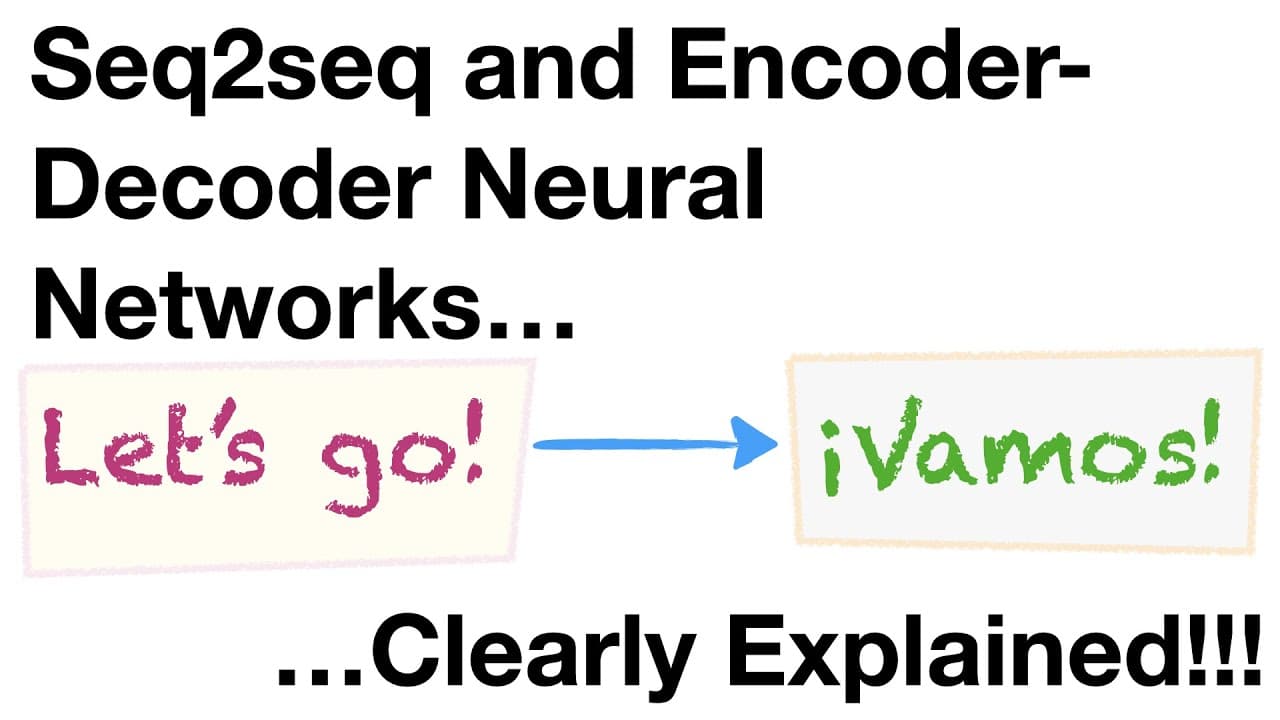
Sequence-to-Sequence (seq2seq) Encoder-Decoder Neural Networks, Clearly Explained!!!
146.1K views
•
May 7, 2023
by
StatQuest with Josh Starmer
YouTube video player
Sequence-to-Sequence (seq2seq) Encoder-Decoder Neural Networks, Clearly Explained!!!

TL;DR

Learn about encoder-decoder neural networks for sequence-to-sequence problems in machine learning.

Transcript

to encode you unroll to decode you unroll stat Quest hello I'm Josh Darman welcome to statquest today we're going to talk about seek to seek and encoder decoder neural networks and they're going to be clearly explained it's the easiest way to scale your work up in the cloud lightning this stat Quest is also brought to you by the letters a b and c a... Read More

Key Insights

  • 🌉 Encoder-decoder models bridge the gap between input and output sequences.
  • 🍵 LSTM layers handle sequential data processing efficiently.
  • 🔑 Embedding layers convert words into numerical representations.
  • 🦻 Teacher forcing aids in training by ensuring correct token input.
  • 👻 Scalability in models allows handling large vocabularies and complex tasks.
  • 💁 Context vectors capture essential information for decoding.
  • ❓ Translation tasks benefit from encoder-decoder architectures.

Install to Summarize YouTube Videos and Get Transcripts

Explore YouTube Video Summarizer or Get YouTube Transcript Extractor

Questions & Answers

Q: What is the purpose of an encoder-decoder neural network?

An encoder captures input data's contextual information, while the decoder generates output data based on this context, making it ideal for tasks like translation.

Q: How does the encoder handle variable-length inputs?

The encoder uses LSTM layers and an embedding layer to process variable-length input sequences efficiently.

Q: What is teacher forcing in training encoder-decoder models?

Teacher forcing involves providing correct output tokens during training instead of predicted tokens, aiding model convergence.

Q: What are some differences between a simple encoder-decoder model and more complex versions?

More complex models have larger vocabularies, more layers, and exponentially more parameters, showcasing scalability in neural network design.

Summary & Key Takeaways

  • Encoder-decoder neural networks help solve sequence-to-sequence problems like translation.

  • Encoder encodes input data into context vector using LSTM layers.

  • Decoder decodes context vector into output data using separate LSTM layers and fully connected layers.


Read in Other Languages (beta)

English

Share This Summary 📚

Summarize YouTube Videos and Get Video Transcripts with 1-Click

Download browser extensions on:

Try YouTube Summary with ChatGPT & Claude or YouTube Transcript Generator

Explore More Summaries from StatQuest with Josh Starmer 📚
How Does the ReLU Activation Function Work in Neural Networks? thumbnail
How Does the ReLU Activation Function Work in Neural Networks?
StatQuest with Josh Starmer
How to Calculate Maximum Likelihood for Binomial Distribution thumbnail
How to Calculate Maximum Likelihood for Binomial Distribution
StatQuest with Josh Starmer
What Are One-Hot, Label, and Target Encoding Techniques? thumbnail
What Are One-Hot, Label, and Target Encoding Techniques?
StatQuest with Josh Starmer
Sample Size and Effective Sample Size, Clearly Explained!!! thumbnail
Sample Size and Effective Sample Size, Clearly Explained!!!
StatQuest with Josh Starmer
How Does Gradient Boosting Work for Regression? thumbnail
How Does Gradient Boosting Work for Regression?
StatQuest with Josh Starmer
Alternative Hypotheses: Main Ideas!!! thumbnail
Alternative Hypotheses: Main Ideas!!!
StatQuest with Josh Starmer

Summarize YouTube Videos and Get Video Transcripts with 1-Click

Download browser extensions on:

Try YouTube Summary with ChatGPT & Claude or YouTube Transcript Generator

Apps & Extensions

  • Chrome Extension
  • Safari Extension
  • Edge Add-ons
  • Firefox Add-ons
  • iOS App
  • Android App

Key Features

  • YouTube Video Summarizer
  • Web & PDF Summarizer
  • Web & PDF Highlighter
  • Chat with PDF
  • Ask AI Clone
  • Audio Transcriber
  • Glasp Reader
  • Kindle Highlight Export
  • Idea Hatch

Integrations

  • Obsidian Plugin
  • Notion Integration
  • Pocket Integration
  • Instapaper Integration
  • Medium Integration
  • Readwise Integration
  • Snipd Integration
  • Hypothesis Integration

More Features

  • APIs
  • MCP Connector
  • Blog & Post
  • Embed Links
  • Image Highlight
  • Personality Test
  • Quote Shots

Company

  • About us
  • Our Story
  • Blog
  • Community
  • FAQs
  • Job Board
  • Newsletter
  • Pricing
Terms

•

Privacy

•

Guidelines

© 2026 Glasp Inc. All rights reserved.