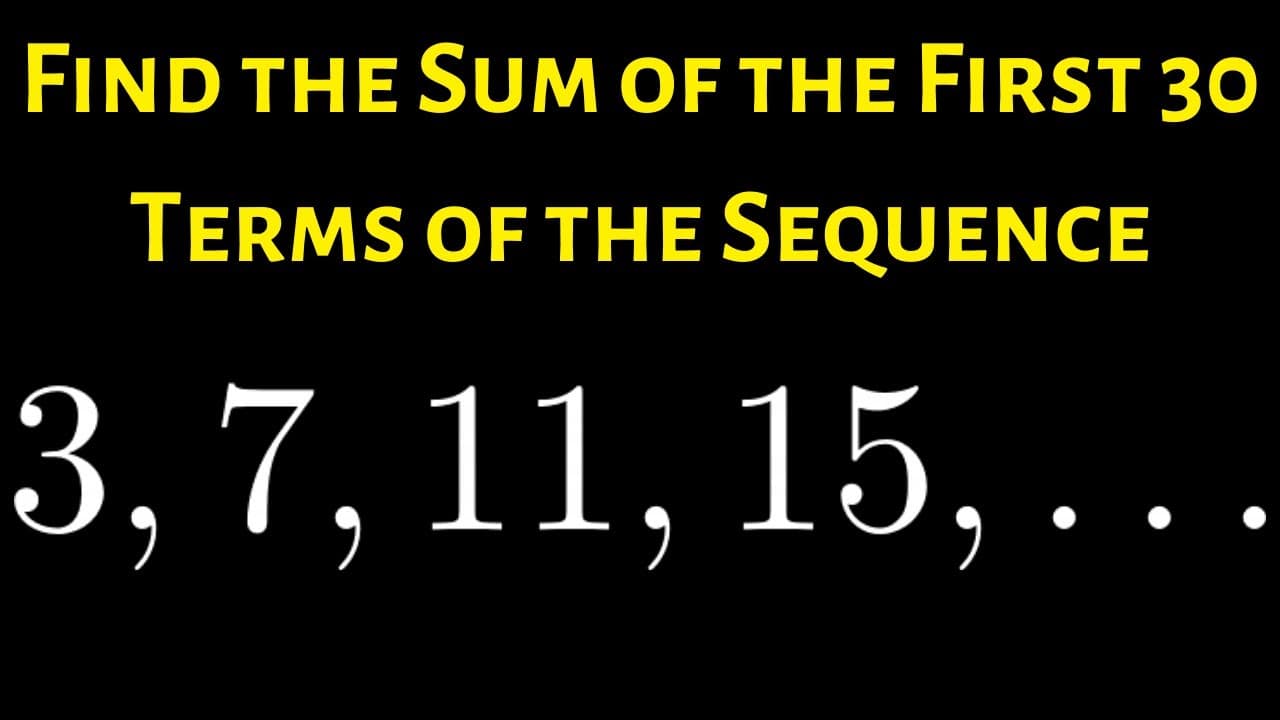
Find the Sum of the First 30 Terms of the Arithmetic Sequence 3, 7, 11, 15, ...
TL;DR
Calculate the sum of the first 30 terms in an arithmetic sequence using a formula.
Transcript
hi everyone in this problem we have an arithmetic sequence an arithmetic sequence is one in which every term is obtained except the first one is obtained by adding a number over and over again so for example um to go from three to seven we're adding 4 and then to go from 7 to 11 we're also adding 4. that number that we keep adding over and over aga... Read More
Key Insights
- 🍉 In an arithmetic sequence, the common difference is the constant value added to each term.
- 🍉 The sum of the first n terms in an arithmetic sequence is calculated using a specific formula.
- 😒 To find the nth term in an arithmetic sequence, use the formula an = a1 + (n-1) * d.
- 🍹 Understanding basic arithmetic sequence properties can simplify sum calculations.
- 🍉 The nth term involves adding the common difference (d) multiple times depending on the term number (n).
- 💭 Proper substitution of values in formulas is essential to accurately calculate sums or nth terms.
- ❓ Arithmetic sequences follow a specific pattern of constant addition.
Install to Summarize YouTube Videos and Get Transcripts
Explore YouTube Video Summarizer or Get YouTube Transcript Extractor
Questions & Answers
Q: What is an arithmetic sequence?
An arithmetic sequence is a sequence of numbers where each term is derived by adding a fixed amount to the previous term.
Q: How is the sum of the first n terms in an arithmetic sequence calculated?
The formula for the sum of the first n terms in an arithmetic sequence is Sn = n/2 * (a1 + an), where a1 is the first term, an is the nth term, and n is the number of terms.
Q: What is the common difference in an arithmetic sequence?
The common difference in an arithmetic sequence is the constant amount added to each term to obtain the next term.
Q: How do you find the nth term in an arithmetic sequence?
To find the nth term in an arithmetic sequence, use the formula an = a1 + (n-1) * d, where a1 is the first term, n is the term number, and d is the common difference.
Summary & Key Takeaways
-
An arithmetic sequence is defined as a sequence where each term is obtained by adding a constant number.
-
The sum of the first n terms in an arithmetic sequence can be calculated using a formula.
-
To find the sum of the first 30 terms, determine the common difference, the first term, and apply the formula.
Read in Other Languages (beta)
Share This Summary 📚
Summarize YouTube Videos and Get Video Transcripts with 1-Click
Try YouTube Summary with ChatGPT & Claude or YouTube Transcript Generator
Explore More Summaries from The Math Sorcerer 📚



Summarize YouTube Videos and Get Video Transcripts with 1-Click
Try YouTube Summary with ChatGPT & Claude or YouTube Transcript Generator