How to Create a Falling Sand Simulation with p5.js?
TL;DR
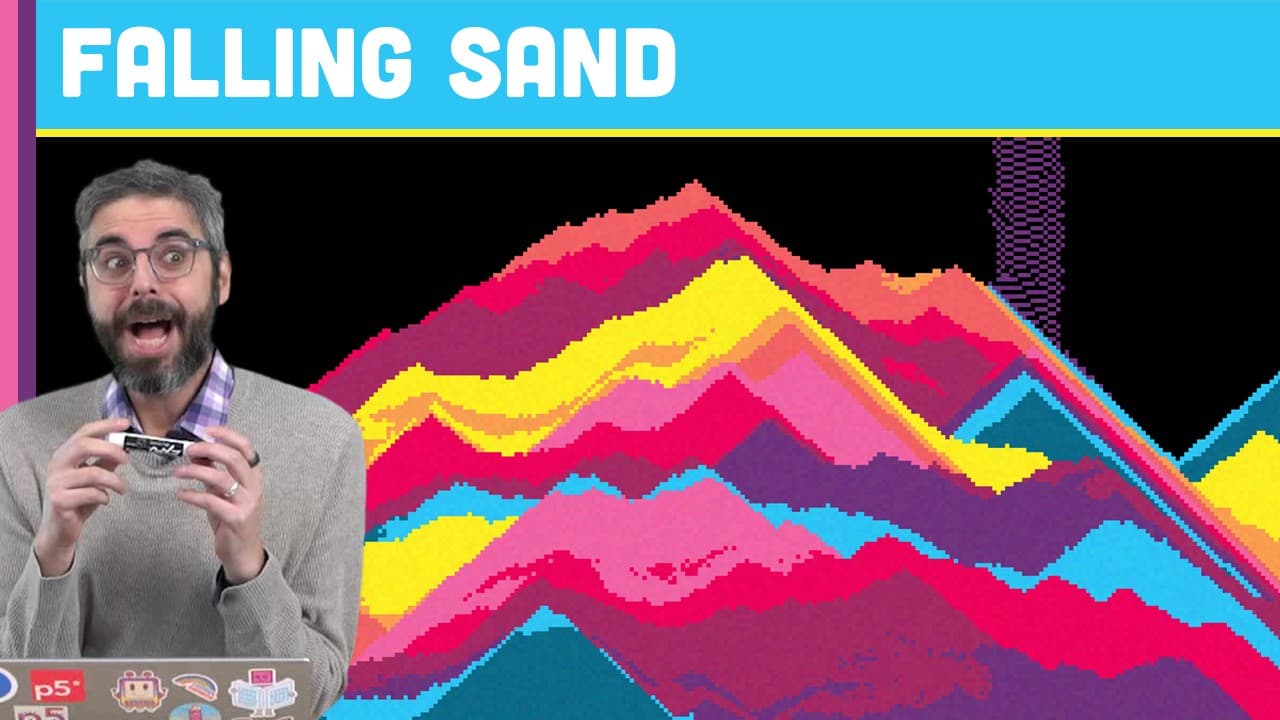
To create a falling sand simulation using p5.js, set up a two-dimensional grid where each cell represents a particle's state, either as sand or empty space. Implement logic for sand movement based on neighboring cell states, allowing for random left or right shifts as it falls. Enhance the simulation with color, mouse interactions, and optimizations for a dynamic, visually appealing result.
Transcript
[MUSIC PLAYING] I'm sorry. Am I still recording a video here? [AUDIO LOGO] A coding challenge idea that has been suggested to me many times is a falling sand simulation. And today is the day that I'm going to tackle it. Now, I have to confess, this is not the first time that I've tried to make a falling sand simulation. If you're familiar with the ... Read More
Key Insights
- 🍂 Cellular automata principles underlie the dynamic behavior of the falling sand simulation.
- 🐭 Interaction with the simulation occurs through mouse input for adding sand particles.
- 👨💻 Code optimization and refactoring are emphasized to improve the efficiency and clarity of the implementation.
- ❓ Additional features like color variation and random movement contribute to the visual appeal and complexity of the simulation.
- 🫵 The video encourages viewers to explore further enhancements, such as incorporating gravitational forces for realistic sand falling behavior.
- 🏛️ References to external resources like jason.today's blog post provide additional insights and inspiration for building similar simulations.
- 🥰 The simulation showcases the creativity and interactivity achievable through coding challenges and generative art projects.
Install to Summarize YouTube Videos and Get Transcripts
Explore YouTube Video Summarizer or Get YouTube Transcript Extractor
Questions & Answers
Q: What inspired the concept of a falling sand simulation?
The inspiration stemmed from previous coding challenges and references to games like Noita and Sandspiel, which showcase pixel-based simulations.
Q: How does the simulation handle sand movement and interactions?
Sand particles move based on rules checking for empty spaces below them and can also shift left or right if possible, creating a dynamic flow.
Q: How does the simulation incorporate color and hue changes?
By assigning a hue value to each cell and updating it over time, the simulation introduces color variation and visual interest to the falling sand.
Q: What future challenge is proposed to enhance the simulation?
Introducing gravitational acceleration for the sand particles to simulate more realistic falling dynamics is suggested as a potential future improvement.
Summary & Key Takeaways
-
The video showcases the process of creating a falling sand simulation using p5.js.
-
The simulation involves cells representing sand particles falling and interacting based on specific rules.
-
By implementing logic for sand movement and mouse interaction, a dynamic and colorful simulation is achieved.
Read in Other Languages (beta)
Share This Summary 📚
Summarize YouTube Videos and Get Video Transcripts with 1-Click
Try YouTube Summary with ChatGPT & Claude or YouTube Transcript Generator
Explore More Summaries from The Coding Train 📚



Summarize YouTube Videos and Get Video Transcripts with 1-Click
Try YouTube Summary with ChatGPT & Claude or YouTube Transcript Generator