25. Cancer 1
TL;DR
Cancer is a stepwise degeneration of normal cell behavior resulting from mutations. Targeted treatments like Gleevec inhibit specific genes to treat certain types of cancer.
Transcript
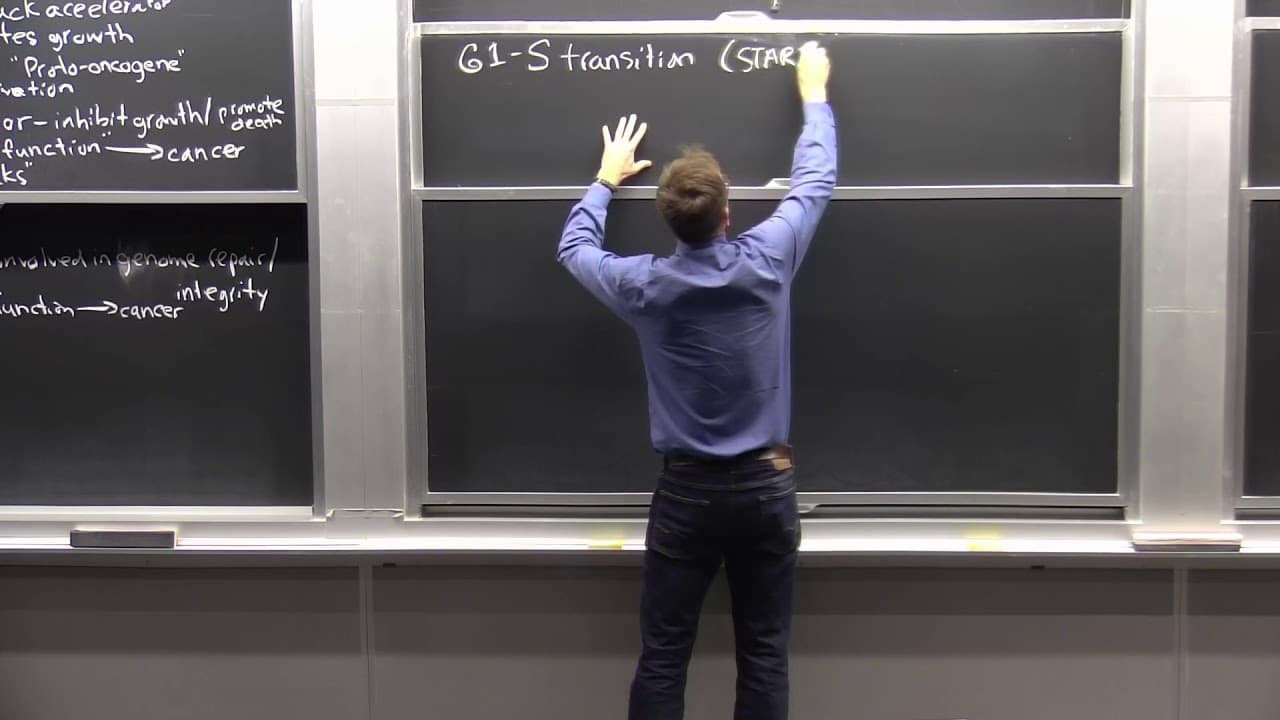
PROFESSOR: OK so on Monday we talked about how cell division is regulated at this single cell level. On Wednesday we talked about how regeneration is mediated at the level of an entire tissue. And today we're going to talk about how all of that can go wrong, OK? And when all of this goes wrong, it results in a disease, actually many different disea... Read More
Key Insights
- ♋ Cancer results from the stepwise degeneration of normal cell behavior caused by mutations.
- ❓ Proto-oncogenes promote growth and become oncogenes when mutated.
- 🥺 Tumor suppressors inhibit growth and loss-of-function mutations in them can lead to cancer.
- 🌸 Caretaker genes maintain genomic integrity, and their loss-of-function can drive cancer.
- 📡 Dysregulation of signaling pathways like Wnt can disrupt tissue homeostasis and promote cancer.
- 🎯 Targeted therapies like Gleevec inhibit specific molecules involved in cancer progression.
- 🥺 Understanding the mechanisms and pathways involved in cancer can lead to more effective treatments.
Install to Summarize YouTube Videos and Get Transcripts
Explore YouTube Video Summarizer or Get YouTube Transcript Extractor
Questions & Answers
Q: What is the difference between a proto-oncogene and an oncogene?
Proto-oncogenes promote growth and survival, while oncogenes are mutated forms of proto-oncogenes that are unregulated and constitutively active, leading to uncontrolled cell growth.
Q: How do tumor suppressors inhibit growth or promote cell death?
Tumor suppressors like Rb inhibit growth by binding to transcription factors involved in cell division, preventing gene expression. They can also promote cell death by triggering apoptosis.
Q: What is the role of caretaker genes in cancer development?
Caretaker genes maintain genomic integrity by mediating DNA repair and chromosome stability. Loss-of-function mutations in caretaker genes can lead to the accumulation of additional mutations, promoting cancer development.
Q: How does dysregulation of Wnt signaling contribute to colon cancer?
Dysregulation of the APC gene, a tumor suppressor involved in inhibiting beta-catenin, results in constitutive activation of Wnt signaling. This prevents cells from leaving the colon, leading to the accumulation of further mutations and tumor formation.
Q: What is the mechanism of action of Gleevec in treating chronic myelogenous leukemia?
Gleevec inhibits the ABL tyrosine kinase, which is constitutively active due to a gene fusion with the BCR gene. Gleevec binds to the kinase and locks it in an inactive conformation, effectively treating the leukemia.
Q: What are some targeted therapies for cancer?
Targeted therapies include small molecule inhibitors like Gleevec, monoclonal antibodies like Herceptin, and immune checkpoint inhibitors like Keytruda, which all target specific molecules or pathways involved in cancer growth.
Summary & Key Takeaways
-
Cell division, tissue regeneration, and cancer progression are all regulated at different levels.
-
Cancer is characterized by the stepwise deregulation of normal cell and tissue behavior caused by mutations.
-
Genes involved in cancer can be classified as oncogenes (promote growth), tumor suppressors (inhibit growth), or caretaker genes (maintain genome integrity).
Read in Other Languages (beta)
Share This Summary 📚
Summarize YouTube Videos and Get Video Transcripts with 1-Click
Try YouTube Summary with ChatGPT & Claude or YouTube Transcript Generator
Explore More Summaries from MIT OpenCourseWare 📚



Summarize YouTube Videos and Get Video Transcripts with 1-Click
Try YouTube Summary with ChatGPT & Claude or YouTube Transcript Generator