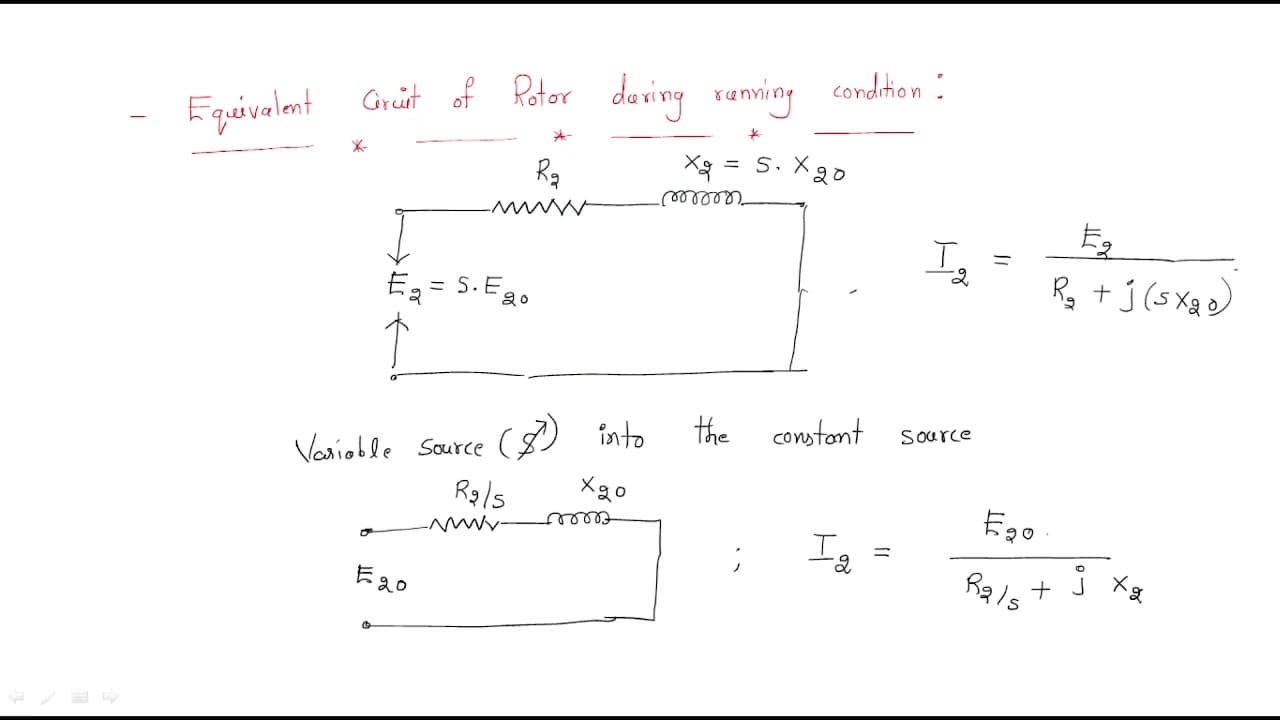
Rotor Equivalent circuit || Stand still & Running Condition | Induction motor | Lec - 29
TL;DR
Discusses how load increases affect three-phase induction motor performance.
Transcript
hello everyone in this session we will continue the continued topics of the three-phase induction motor in the last session we will discuss some conclusions of the induction motor rotor here we will make the conclusion again look at here if the load on the three-phase induction motor is increases so for example we have a three-phase induction motor... Read More
Key Insights
- 💋 Mechanical load directly influences the speed and slip of three-phase induction motors, affecting overall efficiency.
- 💋 The relationship between rotor frequency and slip is critical for predicting motor performance under load.
- 🆘 The equivalent circuit analysis helps in understanding the behavior of rotors under different operating conditions.
- 🖐️ Induced emf plays a crucial role in maintaining the performance of high-load conditions in induction motors.
- 🧑🦼 Understanding rotor resistance and reactance is essential for effective motor management and troubleshooting.
- ✋ The design and efficiency of induction motors can greatly impact industrial applications requiring high reliability.
- 🧑🏭 Factors such as rotor loss due to resistance variations need critical evaluation for better performance management.
Install to Summarize YouTube Videos and Get Transcripts
Explore YouTube Video Summarizer or Get YouTube Transcript Extractor
Questions & Answers
Q: How does increasing the load on a three-phase induction motor affect its speed?
When the load on a three-phase induction motor increases, the rotor speed decreases due to the increased mechanical load. This phenomenon is characterized by the slip, which is the difference between synchronous speed and rotor speed, with higher loads causing greater slip and thus, lower speed.
Q: What relationship exists between slip and rotor frequency in an induction motor?
The rotor frequency is directly related to the slip, defined as the difference in speed divided by synchronous speed. As slip increases with an increased load, the rotor frequency also rises, illustrating a fundamental relationship crucial for understanding induction motor dynamics.
Q: What are the effects of increased induced emf in the rotor during operation?
An increase in induced electromotive force (emf) in the rotor results from increased slip, which occurs when load rises. This elevated induced emf is necessary to maintain motor performance and efficiency, allowing the rotor to handle the higher torque demand effectively.
Q: How does the rotor's equivalent circuit change from standstill to running conditions?
The rotor's equivalent circuit varies significantly between standstill and running conditions. At standstill, it primarily consists of the induced emf, rotor resistance, and leakage reactance. During operation, these factors still apply but the induced emf is influenced by slip, modifying the circuit's characteristics to account for varying load conditions.
Summary & Key Takeaways
-
The performance of a three-phase induction motor is influenced by mechanical load, with increased load leading to variations in speed and induced electromotive force (emf).
-
When the mechanical load rises, the slip increases, causing changes in rotor speed and frequency, impacting the efficiency and power output of the motor.
-
Understanding the rotor's equivalent circuit during both standstill and running conditions is crucial for analyzing motor performance, focusing on resistance and reactance relationships.
Read in Other Languages (beta)
Share This Summary 📚
Summarize YouTube Videos and Get Video Transcripts with 1-Click
Try YouTube Summary with ChatGPT & Claude or YouTube Transcript Generator