How to Solve cos²(θ) = 1/4 for θ
TL;DR
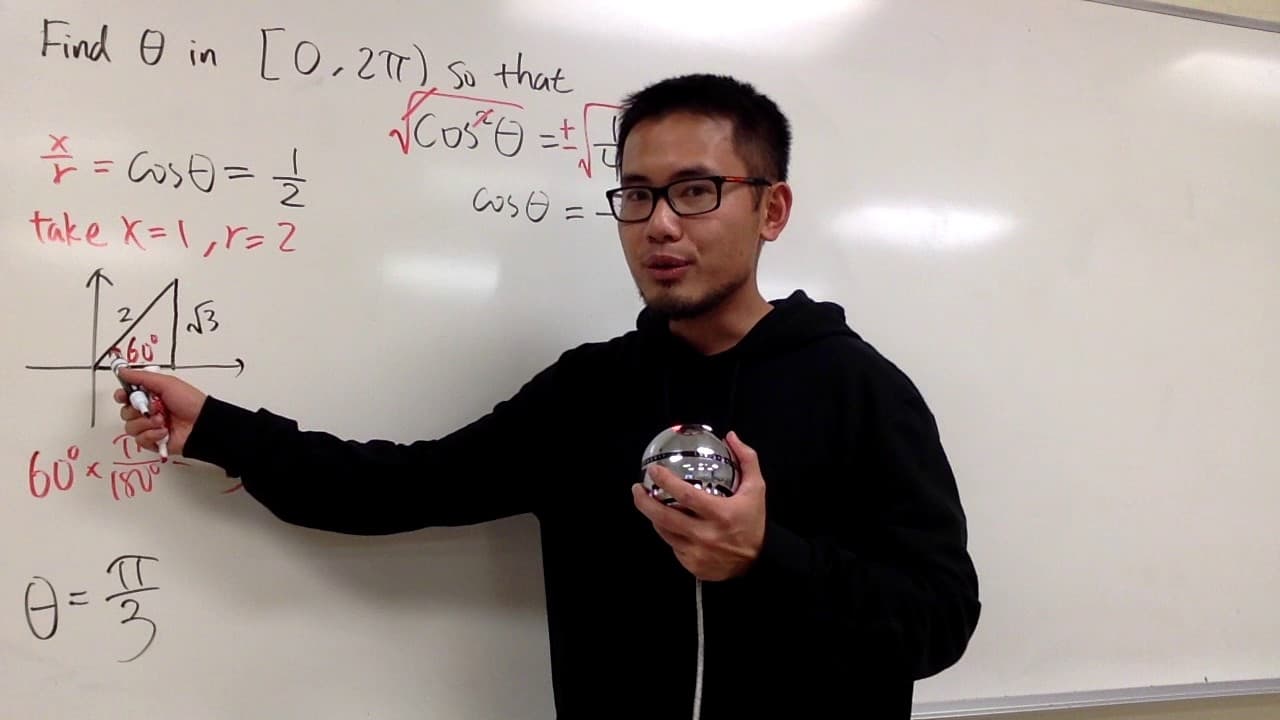
To solve cos²(θ) = 1/4, take the square root of both sides to find cos(θ) = ±1/2. This yields two sets of angles: θ = π/3 and 5π/3 for cos(θ) = 1/2, and θ = 2π/3 and 4π/3 for cos(θ) = -1/2, found using reference triangles and converting degrees to radians.
Transcript
we are going to find out the angle theta and the angle is in between of 0 to 2 pi and we also want to have cosine square say it has to be 1 over 4 this right here looks kind of unusual right because we have the square here but it's ok because just think about how can we get rid of something to the second power well we can just go ahead and take the... Read More
Key Insights
- 🫚 Taking the square root of 1/4 is necessary to solve for the values of cosine theta.
- 👻 Converting degrees to radians allows for accurate calculations in trigonometry.
- ❎ The values of cosine theta can be solved for in two different situations: positive and negative.
- 🔺 Reference triangles help determine the angle theta by using given values and trigonometric ratios.
- 🔺 The angle theta can be found using special right triangles and converting degrees to radians.
- 🍧 Having positive and negative values of cosine theta indicates different quadrants in the coordinate plane.
- ➕ It is important to include the plus/minus sign when solving for the values of cosine theta.
Install to Summarize YouTube Videos and Get Transcripts
Explore YouTube Video Summarizer or Get YouTube Transcript Extractor
Questions & Answers
Q: How do you solve for the values of cosine theta in two different situations?
To solve for the values of cosine theta, first take the square root of 1/4. In the first situation, cosine theta is equal to 1/2, and by using a reference triangle, determine the angle theta to be PI/3. In the second situation, cosine theta is equal to -1/2, and the angle theta is found to be 2PI/3 and 4PI/3.
Q: Why do we need to convert the angles from degrees to radians?
Converting the angles from degrees to radians allows us to work with the appropriate unit when dealing with trigonometric functions. By multiplying the degree measure by PI/180, we can easily convert degrees to radians, which is essential for accurate calculations.
Q: How are reference triangles used to find the values of theta?
Reference triangles help visualize the relationship between the sides and angles of a right triangle. By using the given values, such as the length of 1 and 2 in the reference triangle, and the values of cosine theta, we can determine the angle theta using trigonometric ratios and special right triangles.
Q: Why is cosine theta negative in the second situation?
Cosine theta is negative in the second situation because the x-value (or adjacent side) in the reference triangle is negative. This is due to placing the triangle in a different quadrant, which changes the signs of some trigonometric ratios.
Summary & Key Takeaways
-
The video demonstrates how to find the values of cosine theta in two situations by taking the square root of 1/4 and solving for both the positive and negative versions.
-
In the first situation, cosine theta is equal to 1/2, and by using a reference triangle and converting degrees to radians, the angle theta is determined to be PI/3.
-
In the second situation, cosine theta is equal to -1/2, and by following the same process as before, the angle theta is found to be 2PI/3 and 4PI/3.
Read in Other Languages (beta)
Share This Summary 📚
Summarize YouTube Videos and Get Video Transcripts with 1-Click
Try YouTube Summary with ChatGPT & Claude or YouTube Transcript Generator
Explore More Summaries from blackpenredpen 📚




Summarize YouTube Videos and Get Video Transcripts with 1-Click
Try YouTube Summary with ChatGPT & Claude or YouTube Transcript Generator