Wave guide Attenuators | Part-2/2 | Microwave Engineering | Lec-55
TL;DR
The video discusses different types of variable attenuators and their functioning principles.
Transcript
hi everyone in this video I am continuing the previous variable attenuator concept so in the last video I have discussed the I have started this way wave guide attenuate as and the scene what are the different types of where we get attenuous and what do you mean by we included attenuator and the types of regulatory meters like traffic reticulator a... Read More
Key Insights
- 👋 Variable attenuators are essential for effective signal management in waveguides, influencing electromagnetic wave transmission quality.
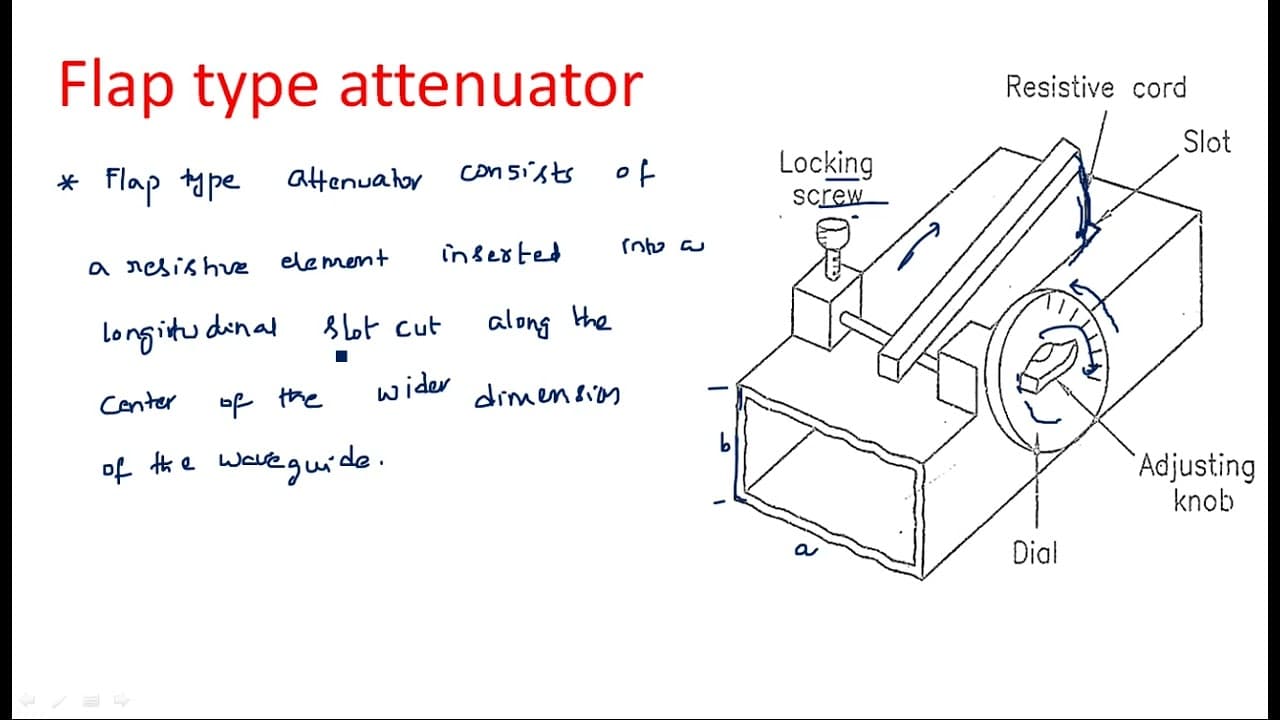
- 👻 The flap type attenuator allows for flexible adjustment of attenuation levels based on the position of the resistive element.
- ❓ Attenuation effectiveness varies significantly depending on whether the resistor is fully inserted or removed, illustrating the importance of precise positioning.
- ⚾ The vein type attenuator operates based on the concentration of electric fields, providing varying levels of attenuation through lateral movement.
- 🎮 Rotary type attenuators are specifically used in circular waveguides, offering enhanced precision in attenuation control.
- 🈸 Understanding the specific mechanisms behind these attenuators is critical for their effective application in communication systems.
- 🧡 The utility of variable attenuators is evident in a range of engineering applications characterized by the need for dynamic signal modulation.
Install to Summarize YouTube Videos and Get Transcripts
Explore YouTube Video Summarizer or Get YouTube Transcript Extractor
Questions & Answers
Q: What is the main function of a variable attenuator in waveguides?
A variable attenuator is primarily used to control the amount of electromagnetic power transmitted through a waveguide. By adjusting the position of a resistive element, different levels of attenuation can be achieved, which helps in managing signal strength and quality in various applications.
Q: How does the flap type attenuator achieve maximum attenuation?
The flap type attenuator achieves maximum attenuation by inserting a resistive chord fully into the waveguide. This insertion absorbs a significant amount of electromagnetic power, whereas removing the chord results in minimal attenuation, demonstrating the direct relationship between insertion depth and attenuation levels.
Q: What are the key differences between flap type and vein type variable attenuators?
The flap type variable attenuator uses a resistive flap that can move in and out of a slot within the waveguide, affecting attenuation based on its position. Conversely, the vein type mechanism allows lateral movement in the center of the waveguide to control attenuation based on electric field distribution, emphasizing their structural and functional variations.
Q: What role do resistor cords play in the operation of these attenuators?
Resistor cords are crucial in the operation of variable attenuators, serving as the elements that absorb electromagnetic power. Their design and placement within the waveguide determine the extent of attenuation, either when fully inserted or adjusted to various positions based on user requirements.
Summary & Key Takeaways
-
The video builds on previous discussions of variable attenuators, specifically outlining flap type, vein type, and rotary type differences in rectangular and circular waveguides.
-
The flap type attenuator uses a resistor chord that can be adjusted via a knob to control electromagnetic power absorption, providing varying levels of attenuation.
-
The rotary type attenuator is designed for circular waveguides, allowing for precision control of attenuation through the rotation of resistive veins, adapting voltage polarization as needed.
Read in Other Languages (beta)
Share This Summary 📚
Summarize YouTube Videos and Get Video Transcripts with 1-Click
Try YouTube Summary with ChatGPT & Claude or YouTube Transcript Generator