12. Molecular Orbitals (Intro to Solid-State Chemistry)
TL;DR
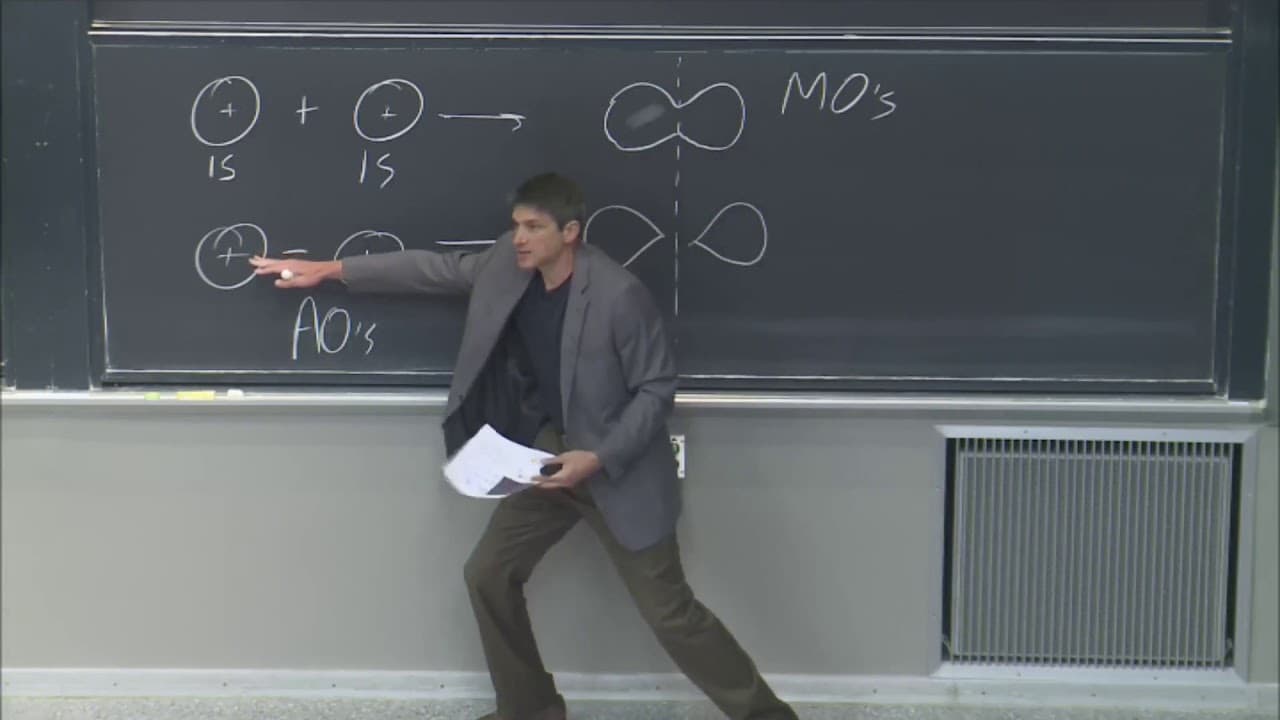
Molecular Orbital Theory explains the formation of molecular orbitals through the combination and mixing of atomic orbitals. It helps understand the bonding and properties of molecules.
Transcript
And speaking of VSEPR, that's what we did last lecture. We're going to move on today. But I want to just clarify something about VSEPR. When I was talking about this I tried to put two different concepts in the same place. And I put something in the table that shouldn't have been there. And people corrected me. I want to be sure that there is no co... Read More
Key Insights
- 🫀 Molecular Orbital Theory explains the formation of molecular orbitals by combining and mixing atomic orbitals.
- #️⃣ The number and arrangement of electron pairs determine the electron domain geometry and ultimately the shape of a molecule.
- 🫀 The energy difference and overlap between atomic orbitals determine the bonding strength and properties of a molecule.
- 🥺 Mixing of orbitals can lead to changes in energy levels and interactions, influencing the behavior and stability of a molecule.
Install to Summarize YouTube Videos and Get Transcripts
Explore YouTube Video Summarizer or Get YouTube Transcript Extractor
Questions & Answers
Q: What is the difference between the electron domain geometry and the shape of a molecule?
The electron domain geometry refers to the arrangement of electron pairs around the central atom, while the shape of a molecule takes into account both electron pairs and lone pairs. The shape can be distorted by the presence of lone pairs.
Q: How does molecular orbital theory explain the concept of paramagnetism?
Paramagnetism occurs when a molecule has unpaired electrons, which leads to a response to an external magnetic field. In molecular orbital theory, the presence of unpaired electrons in bonding orbitals contributes to paramagnetic properties.
Q: How does mixing of orbitals affect the energy levels and interactions in a molecule?
Mixing of orbitals allows for greater overlap and interaction between atomic orbitals, leading to changes in energy levels. This can result in the switching of orbital ordering and influence the properties and behavior of molecules.
Q: How does molecular orbital theory apply to heteronuclear dimers?
In a heteronuclear dimer, where atoms of different types combine, the MO diagram is influenced by the different atomic orbitals and their mixing. The electron configurations and interactions between the atoms determine the bonding and properties of the molecule.
Summary & Key Takeaways
-
Molecular Orbital Theory involves creating molecular orbitals (MOs) from atomic orbitals (AOs) through linear combinations.
-
The number of MOs equals the number of AOs used to create them, and each MO can hold a maximum of two electrons.
-
Bond order is a key concept in MO Theory, representing the number of electrons in bonding orbitals minus the number of electrons in antibonding orbitals.
Read in Other Languages (beta)
Share This Summary 📚
Summarize YouTube Videos and Get Video Transcripts with 1-Click
Try YouTube Summary with ChatGPT & Claude or YouTube Transcript Generator
Explore More Summaries from MIT OpenCourseWare 📚


Summarize YouTube Videos and Get Video Transcripts with 1-Click
Try YouTube Summary with ChatGPT & Claude or YouTube Transcript Generator