Should You Use Dollar Cost Averaging or Lump Sum Investing?
TL;DR
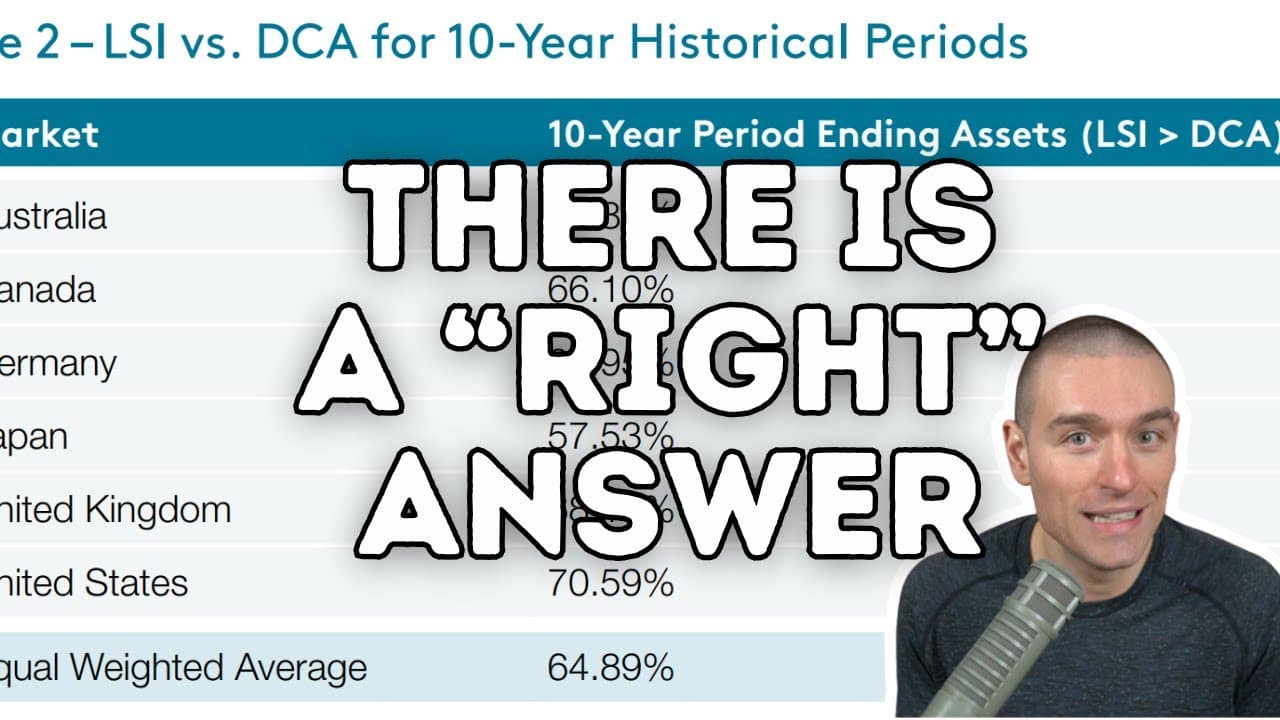
Investing a lump sum immediately is generally more optimal than dollar cost averaging, as studies show it outperforms dollar cost averaging about 65% of the time. While dollar cost averaging may help reduce regret about market timing, the cost of doing so averages around 0.38% annually, making lump sum investing a better choice for most investors.
Transcript
if you're sitting on a lump sum of cash that you plan to invest you could invest the lump sum in a risk appropriate portfolio immediately you could dollar cost average over a period of time meaning systematically investing equal parts into a risk appropriate portfolio over a set period or you could sit on your cash until what feels like a good time... Read More
Key Insights
- 👍 Dollar cost averaging is a popular strategy due to its behavioral appeal, but it has been proven to be suboptimal from a rational decision-making perspective.
- 🛀 Investing a lump sum immediately in a risk-appropriate portfolio has been mathematically shown to be more advantageous than dollar cost averaging.
- ✋ Even in the worst market conditions or at market highs, investing a lump sum outperforms dollar cost averaging.
- 😘 Waiting for a market dip before investing a lump sum generally leads to lower returns and is not a reliable strategy.
Install to Summarize YouTube Videos and Get Transcripts
Explore YouTube Video Summarizer or Get YouTube Transcript Extractor
Questions & Answers
Q: Why do people often choose dollar cost averaging over lump sum investing?
Dollar cost averaging is popular due to the behavioral appeal of minimizing regret and avoiding investing a lump sum right before a market crash. However, from a rational decision-making perspective, it has been proven to be suboptimal.
Q: Is there a cost associated with dollar cost averaging?
Yes, the approximate annualized cost of dollar cost averaging is about 0.38% over 10 years, which is higher than the fee on most index funds.
Q: Does dollar cost averaging perform better in the worst market conditions?
In the worst 10% of outcomes for lump sum investments, dollar cost averaging does have a small advantage on average. However, it still trails lump sums more than 50% of the time.
Q: Is waiting for a market dip before investing a lump sum beneficial?
No, waiting for a market decline to invest a lump sum, even at a 10% or 20% drop, underperforms on average and in most ten-year periods. It is generally more optimal to invest the lump sum as soon as possible.
Summary & Key Takeaways
-
Investors often struggle with deciding whether to invest a lump sum or employ dollar cost averaging.
-
Dollar cost averaging involves systematically investing equal parts into a risk-appropriate portfolio over a period of time.
-
However, studies have shown that investing a lump sum immediately is mathematically more optimal than dollar cost averaging.
Read in Other Languages (beta)
Share This Summary 📚
Summarize YouTube Videos and Get Video Transcripts with 1-Click
Try YouTube Summary with ChatGPT & Claude or YouTube Transcript Generator
Explore More Summaries from Ben Felix 📚




Summarize YouTube Videos and Get Video Transcripts with 1-Click
Try YouTube Summary with ChatGPT & Claude or YouTube Transcript Generator