What Are AI Agents and Their Impact on Development?
TL;DR
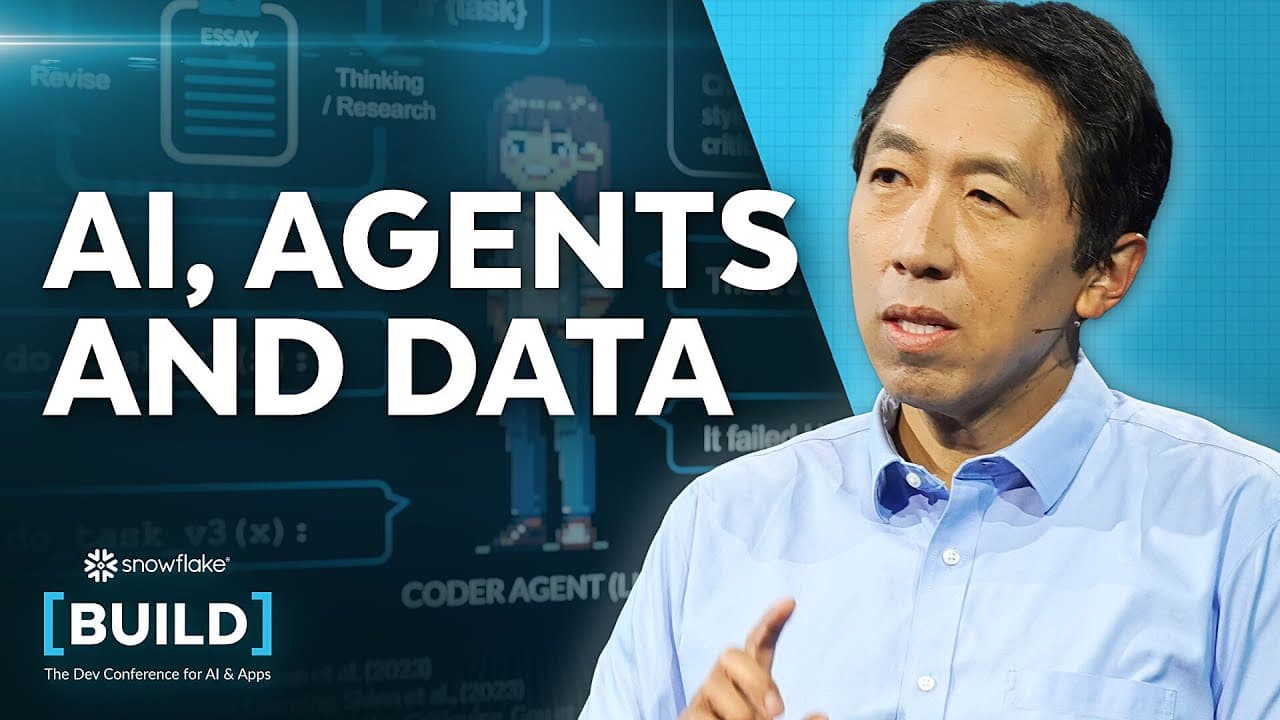
AI agents are transforming development by enabling faster and more efficient solutions. Andrew Ng highlights the significance of agentic AI workflows, which enhance problem-solving through iterative processes, collaboration, and advanced automation. As generative AI accelerates modeling, the rise of agentic orchestration layers and the focus on unstructured data are shaping the future of AI applications.
Transcript
please welcome Andrew [Applause] in thank you it's such a good time to be a builder I'm excited to be back here at snowfake build what i' like to do today is share you where I think are some of ai's biggest opportunities you may have heard me say that I think AI is the new electricity that's because a has a g... Read More
Key Insights
- Andrew Ng likens AI to electricity, highlighting its transformative potential across various applications and industries.
- The AI stack consists of semiconductors, cloud infrastructure, foundation models, and application layers, with the latter driving significant value.
- Generative AI accelerates model development, allowing teams to build prototypes and deploy applications significantly faster than before.
- Fast iteration and experimentation enable rapid invention, shifting the focus from lengthy development cycles to quick prototyping.
- Agentic AI workflows, such as reflection, tool use, planning, and multi-agent collaboration, enhance AI's problem-solving capabilities.
- Large multimodal models (LMMs) are emerging, enabling more complex tasks by processing text, images, and videos iteratively.
- Agentic orchestration layers, like Langchain, simplify building applications by coordinating agentic workflows.
- The importance of data engineering is rising, especially for managing unstructured data, as AI applications increasingly rely on diverse data sources.
Install to Summarize YouTube Videos and Get Transcripts
Explore YouTube Video Summarizer or Get YouTube Transcript Extractor
Questions & Answers
Q: What is Andrew Ng's perspective on AI's potential?
Andrew Ng compares AI to electricity, emphasizing its transformative potential across industries. Like electricity, AI is a general-purpose technology with diverse applications, making it difficult to pinpoint its utility due to its broad impact. Ng believes AI will drive significant innovation and value creation.
Q: How does generative AI impact model development?
Generative AI significantly accelerates model development by enabling rapid prototyping and experimentation. Traditional AI systems took months to build, but generative AI allows teams to create prototypes in days. This speed fosters innovation by allowing quick iteration and testing of new ideas and applications.
Q: What are agentic AI workflows?
Agentic AI workflows involve using AI agents to perform tasks iteratively, improving results through reflection, tool use, planning, and multi-agent collaboration. These workflows enhance AI's problem-solving capabilities by mimicking human-like processes, such as drafting, revising, and collaborating, leading to better outcomes.
Q: What role do large multimodal models play in AI development?
Large multimodal models (LMMs) process diverse data types, such as text, images, and videos, in an iterative manner. They enable AI systems to tackle more complex tasks by integrating information from multiple sources, improving the quality and accuracy of outcomes in various applications, including visual AI tasks.
Q: How do agentic orchestration layers aid AI application development?
Agentic orchestration layers, like Langchain, facilitate AI application development by coordinating agentic workflows. These layers simplify the integration of various AI agents and processes, allowing developers to build complex applications more efficiently and effectively, expanding the range of achievable AI-driven solutions.
Q: Why is data engineering becoming more important in AI?
Data engineering's importance is rising due to AI's increasing reliance on unstructured data, such as text, images, and videos. Effective management and processing of this data are crucial for developing robust AI applications. As AI capabilities expand, data engineering ensures data quality and accessibility, supporting AI-driven innovations.
Q: What are the four major design patterns in agentic AI workflows?
The four major design patterns in agentic AI workflows are reflection, tool use, planning, and multi-agent collaboration. Reflection involves iterative improvement, tool use allows AI to perform specific tasks, planning organizes complex tasks into steps, and multi-agent collaboration involves AI agents working together to solve problems.
Q: How does Andrew Ng view the future of AI applications?
Andrew Ng envisions a future where AI applications are more diverse and impactful, driven by agentic AI and large multimodal models. He anticipates significant advancements in visual AI and data engineering, enabling businesses to extract more value from unstructured data and expand the range of AI-driven solutions across industries.
Summary & Key Takeaways
-
Andrew Ng emphasizes AI's potential, likening it to electricity due to its wide-ranging applications. He discusses the AI stack's layers, highlighting the application layer's importance in generating value.
-
Generative AI accelerates model development, enabling rapid prototyping and experimentation. Ng introduces agentic AI workflows, which enhance problem-solving through reflection, tool use, planning, and collaboration.
-
Emerging large multimodal models and agentic orchestration layers simplify application building. The importance of data engineering, especially for unstructured data, is growing as AI's capabilities expand.
Read in Other Languages (beta)
Share This Summary 📚
Summarize YouTube Videos and Get Video Transcripts with 1-Click
Try YouTube Summary with ChatGPT & Claude or YouTube Transcript Generator