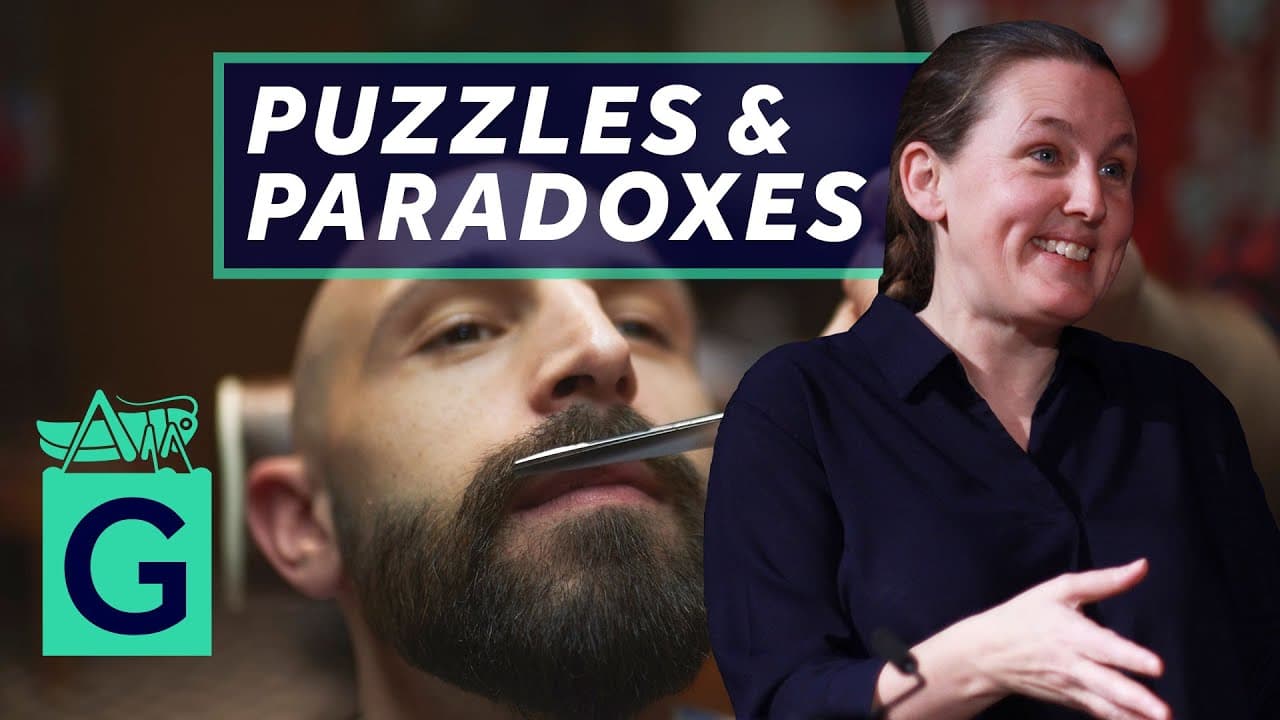
Mathematical Puzzles and Paradoxes - Sarah Hart
TL;DR
This lecture explores ancient puzzles, such as the 17 camels problem, and how they have led to mathematical discoveries and insights. It also discusses logic paradoxes, like the liar paradox, and the limitations of creating a complete and consistent mathematical system.
Transcript
so today we are going to look at puzzles riddles conundrums and paradoxes and how they can lead to fascinating mathematical ideas and discoveries we as humans are inherently curious and playful so it's no surprise that puzzles date back as far as recorded history can take us and probably further we just love entertaining our minds with a little con... Read More
Key Insights
- 🥺 Puzzles and paradoxes have a long history and have often led to mathematical discoveries and insights.
- ⌛ Mathematical puzzles can reflect the mathematical knowledge and methods of specific time periods and cultures.
- ❓ Paradoxes challenge our understanding of logic and truth, revealing the complexity of mathematical reasoning.
Install to Summarize YouTube Videos and Get Transcripts
Explore YouTube Video Summarizer or Get YouTube Transcript Extractor
Questions & Answers
Q: What is the significance of the 17 camels problem?
The 17 camels problem highlights the challenges of dividing a limited resource among multiple individuals using fractions. It demonstrates how mathematical puzzles can reflect the mathematical knowledge and methods of specific time periods and cultures.
Q: How did ancient societies solve puzzles involving fractions?
Ancient civilizations developed various algorithms and techniques to solve puzzles involving fractions. For example, Babylonian mathematics used algorithms to handle problems with fractions, even though they did not have the same understanding of quadratic equations as modern mathematics.
Q: How did Zeno's paradoxes impact mathematical thought?
Zeno's paradoxes, such as Achilles and the tortoise, raised questions about the concept of infinity and the nature of motion. These paradoxes challenged mathematicians to develop concepts like calculus to handle infinite series and resolve apparent contradictions in motion and distance.
Q: Can a complete and consistent mathematical system be created?
Godel's incompleteness theorem suggests that any consistent and complete system of mathematics will always have statements that are true but cannot be proven within the system itself. This limitation demonstrates the necessity of alternative mathematical methods and approaches beyond formal systems.
Summary & Key Takeaways
-
Puzzles, riddles, and paradoxes have fascinated humans for centuries, allowing us to entertain our minds and discover mathematical insights.
-
Ancient puzzles, like the 17 camels problem, reveal how mathematical knowledge and cultural changes have influenced puzzle solving over time.
-
The exploration of puzzles, including those involving fractions, quadratic expressions, and water jugs, showcases the mathematical knowledge and methods of different societies throughout history.
-
Paradoxes, such as Zeno's paradoxes and self-referential paradoxes, challenge our understanding of truth and logic, revealing the complexity of mathematical reasoning.
Read in Other Languages (beta)
Share This Summary 📚
Summarize YouTube Videos and Get Video Transcripts with 1-Click
Try YouTube Summary with ChatGPT & Claude or YouTube Transcript Generator
Explore More Summaries from Gresham College 📚

Summarize YouTube Videos and Get Video Transcripts with 1-Click
Try YouTube Summary with ChatGPT & Claude or YouTube Transcript Generator