22. Simplifying Neutron Transport to Neutron Diffusion
TL;DR
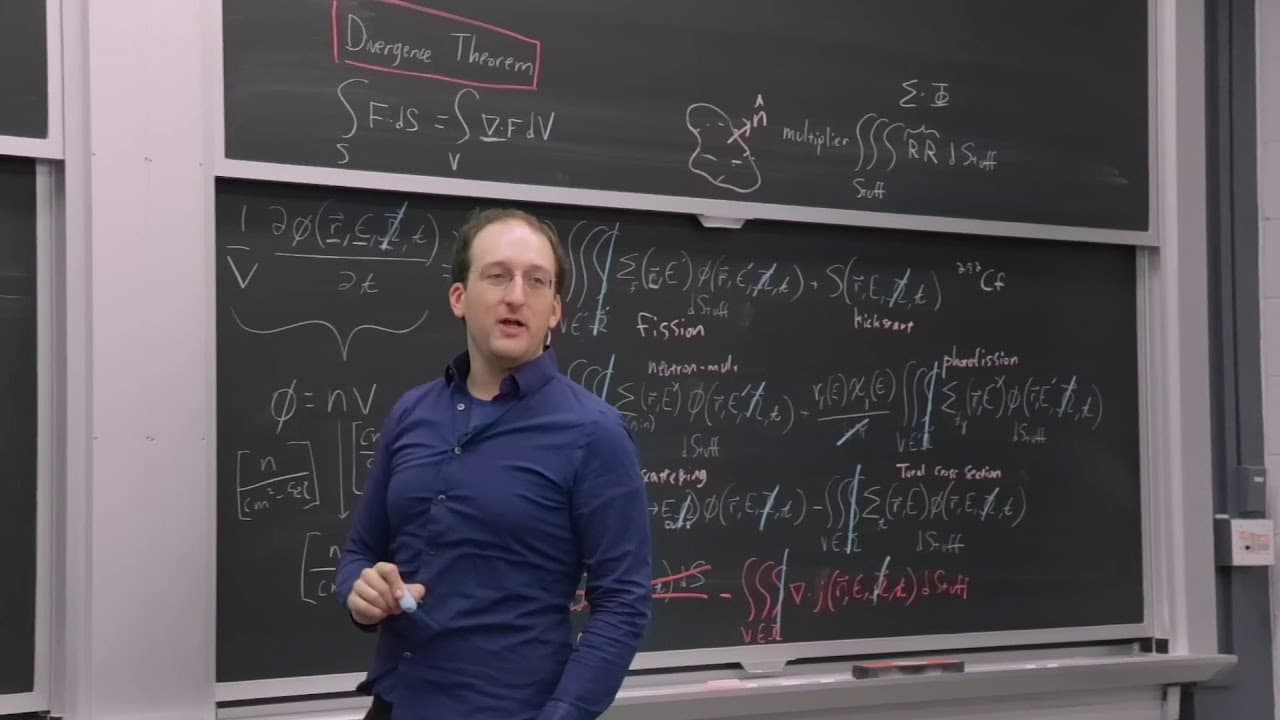
A comprehensive analysis of the neutron diffusion equation is provided, explaining how it can be simplified for reactor analysis.
Transcript
The following content is provided under a Creative Commons license. Your support will help MIT OpenCourseWare continue to offer high quality educational resources for free. To make a donation or to view additional materials from hundreds of MIT courses, visit MIT OpenCourseWare at ocw.mit.edu. MICHAEL SHORT: I think I might actually use all 16 colo... Read More
Key Insights
- 👥 The neutron diffusion equation can be simplified by assuming homogeneity, neglecting time dependence, and focusing on a single energy group.
- 😀 The gains in the equation represent fission, neutron-nin reactions, and photofission, while the losses represent absorption and leakage.
- 🌸 The criticality condition is determined by balancing the gains and losses in the neutron diffusion equation.
Install to Summarize YouTube Videos and Get Transcripts
Explore YouTube Video Summarizer or Get YouTube Transcript Extractor
Questions & Answers
Q: What simplifications can be made to solve the neutron diffusion equation?
The equation can be simplified by assuming a homogeneous reactor, neglecting time dependence, and focusing on a single energy group. These simplifications reduce the number of variables and make the equation more solvable.
Q: What are the gains and losses in the neutron diffusion equation?
The gains include fission, neutron-nin reactions, and photofission, while the losses include absorption and leakage. These terms represent the production and consumption of neutrons in the reactor.
Q: How does the criticality condition relate to the neutron diffusion equation?
The criticality condition is determined by balancing the gains and losses in the neutron diffusion equation. If the gains equal the losses, the reactor is considered critical. If there are more gains than losses, the reactor is supercritical, and if there are more losses than gains, the reactor is subcritical.
Q: How does the simplification of the neutron diffusion equation differ for different types of reactors?
The simplification depends on the specific characteristics of the reactor. For example, a light water reactor may only require a two-group approximation, while a molten salt reactor may assume homogeneity due to the dissolved fuel. The simplification strategy is tailored to each reactor design.
Summary & Key Takeaways
-
The neutron diffusion equation can be simplified by assuming a homogeneous reactor, neglecting time dependence, and focusing on a single energy group.
-
The gains in the equation include fission, neutron-nin reactions, and photofission, while the losses include absorption and leakage.
-
By balancing the gains and losses, the criticality condition can be determined, with k effective representing the number of neutrons produced over the number consumed.
Read in Other Languages (beta)
Share This Summary 📚
Summarize YouTube Videos and Get Video Transcripts with 1-Click
Try YouTube Summary with ChatGPT & Claude or YouTube Transcript Generator
Explore More Summaries from MIT OpenCourseWare 📚



Summarize YouTube Videos and Get Video Transcripts with 1-Click
Try YouTube Summary with ChatGPT & Claude or YouTube Transcript Generator