What Are Insertion Sort and Merge Sort?

TL;DR
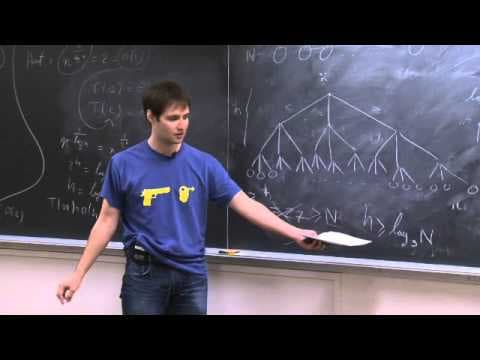
Insertion sort is a straightforward algorithm with a time complexity of Θ(n²), suitable for small datasets, while merge sort is a more efficient divide-and-conquer approach with a time complexity of Θ(n log n) but requires extra space. Understanding these differences helps in selecting the right algorithm for specific sorting needs.
Transcript
The following content is provided under a Creative Commons license. Your support will help MIT OpenCourseWare continue to offer high quality educational resources for free. To make a donation or view additional materials from hundreds of MIT courses, visit MIT OpenCourseWare at ocw.mit.edu. PROFESSOR: So today's lecture is on sorting. We'll be talk... Read More
Key Insights
- 👾 Insertion sort and merge sort are both popular sorting algorithms with different time complexities and space requirements.
- ⌛ Insertion sort is simple but has a time complexity of theta n^2, making it inefficient for large input sizes.
- 👾 Merge sort is more efficient, with a time complexity of theta n log n, but requires additional space to store the sorted subarrays.
Install to Summarize YouTube Videos and Get Transcripts
Explore YouTube Video Summarizer or Get YouTube Transcript Extractor
Questions & Answers
Q: What is the time complexity of insertion sort and merge sort?
Insertion sort has a time complexity of theta n^2, while merge sort has a time complexity of theta n log n.
Q: What is the main difference between insertion sort and merge sort?
The main difference is that insertion sort is an in-place sorting algorithm, meaning it requires minimal additional space, while merge sort requires additional space to store the sorted subarrays before merging them.
Q: Can insertion sort be more efficient than merge sort in certain scenarios?
Yes, insertion sort can be more efficient than merge sort for small input sizes or partially sorted arrays because it has a smaller constant factor and doesn't require additional space.
Q: Why is it important to consider the time complexity and space requirements when choosing a sorting algorithm?
The time complexity determines the efficiency of the algorithm, and the space requirements determine how much memory is needed. Choosing the right algorithm can significantly impact the performance of a sorting task.
Summary & Key Takeaways
-
Insertion sort is a simple sorting algorithm that can be written in just five lines of code.
-
Merge sort is a divide and conquer algorithm that sorts an array by recursively dividing it into smaller subarrays and then merging them back together.
-
Both algorithms have different time complexities, with insertion sort having a theta n^2 complexity and merge sort having a theta n log n complexity.
-
Insertion sort is an in-place sorting algorithm, while merge sort requires additional space to store the sorted subarrays.
Read in Other Languages (beta)
Share This Summary 📚
Summarize YouTube Videos and Get Video Transcripts with 1-Click
Try YouTube Summary with ChatGPT & Claude or YouTube Transcript Generator
Explore More Summaries from MIT OpenCourseWare 📚


Summarize YouTube Videos and Get Video Transcripts with 1-Click
Try YouTube Summary with ChatGPT & Claude or YouTube Transcript Generator