What Is a Confusion Matrix in Machine Learning?
TL;DR
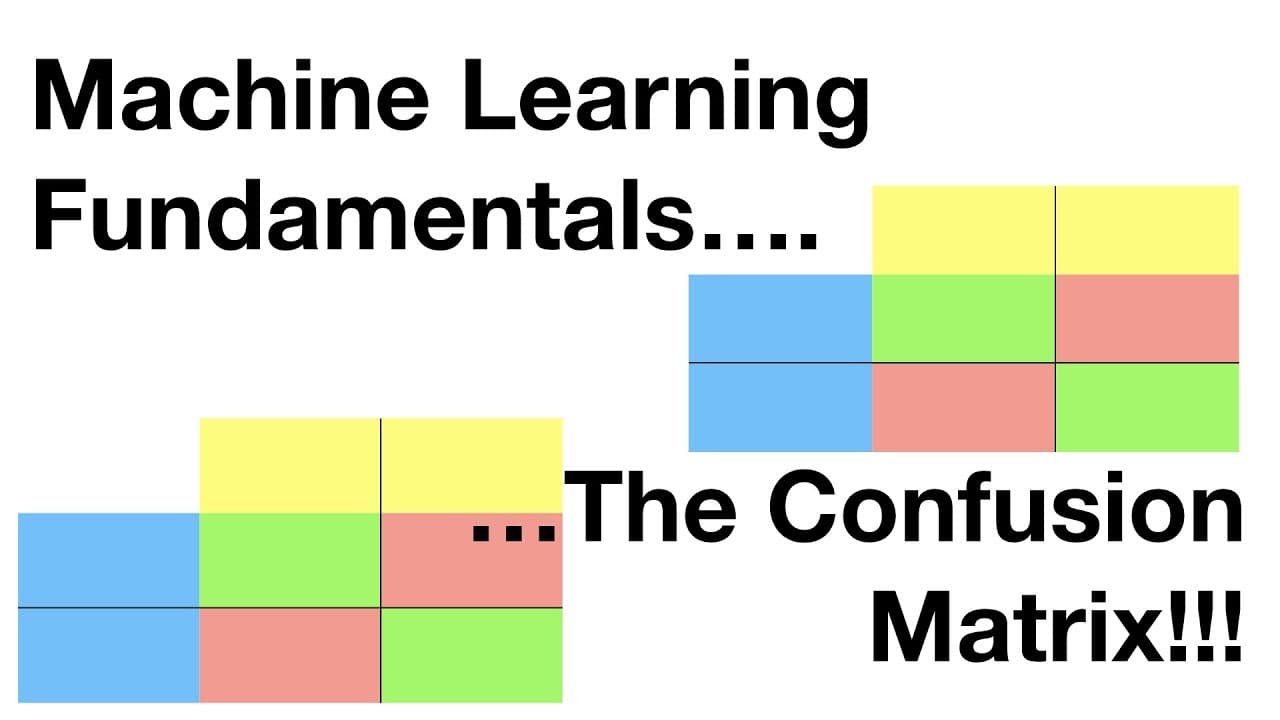
A confusion matrix is a performance evaluation tool for machine learning algorithms, summarizing the counts of true positives, true negatives, false positives, and false negatives. It helps determine the effectiveness of different models, like logistic regression or random forest, by comparing how accurately they classify outcomes, such as predicting heart disease.
Transcript
if you feel confused don't sweat it Stan Quest is here stack quest hello I'm Josh stormer and welcome to stack quest today we're going to cover another machine learning fundamental the confusion matrix and it's going to be clearly explained imagine that we have this medical data we've got some clinical measurements like chest pain good blood circul... Read More
Key Insights
- 🧠 Confusion matrices are used to evaluate the performance of machine learning algorithms by summarizing how well they predicted outcomes based on known truth.
- 🔍 The confusion matrix for a binary classification problem consists of four categories: true positives, true negatives, false positives, and false negatives.
- 🏥 The confusion matrix can be used to evaluate different machine learning methods for predicting heart disease, such as logistic regression, K nearest neighbors, or random forest.
- ✅ The numbers along the diagonal (the green boxes) represent correctly classified samples, while the numbers not on the diagonal (the red boxes) represent misclassified samples.
- 📊 Comparing confusion matrices helps determine which machine learning method performed better in predicting heart disease. In this case, random forest outperformed K nearest neighbors.
- 🎥 Confusion matrices can also be used for multi-class classification, as demonstrated with predicting favorite movies. The size of the confusion matrix depends on the number of categories being predicted.
- 🙌 A confusion matrix provides insights into what a machine learning algorithm did right and where it made mistakes.
- 🎵 To see more exciting Stat Quests, subscribe to the channel and consider supporting by purchasing original songs.
Install to Summarize YouTube Videos and Get Transcripts
Explore YouTube Video Summarizer or Get YouTube Transcript Extractor
Questions & Answers
Q: What is a confusion matrix and what does it show?
A confusion matrix is a tool used to evaluate the performance of machine learning algorithms by showing how well they predict different categories. It shows the true positives, true negatives, false positives, and false negatives for each category.
Q: How do you compare confusion matrices to determine the best machine learning method?
To determine the best machine learning method, one can compare the true positives, true negatives, false positives, and false negatives in each confusion matrix. The method with higher true positives and true negatives and lower false positives and false negatives is considered better.
Q: How does the size of the confusion matrix change based on the number of categories?
The size of the confusion matrix depends on the number of categories being predicted. If there are two categories, the matrix will have two rows and two columns. With three categories, it will have three rows and three columns, and so on.
Q: How can sophisticated metrics like sensitivity and specificity help in making decisions?
Sophisticated metrics like sensitivity (true positive rate) and specificity (true negative rate) can provide more detailed insights into a machine learning algorithm's performance. These metrics can help in making decisions by considering the trade-off between correctly predicting each category.
Answer: In summary, a confusion matrix is a valuable tool for evaluating machine learning algorithms. It helps identify the algorithm's strengths and weaknesses in predicting different categories. By comparing confusion matrices, one can determine the best performing machine learning method.
Summary & Key Takeaways
-
The confusion matrix is used to evaluate the performance of machine learning algorithms in predicting different categories.
-
It shows the true positives, true negatives, false positives, and false negatives for each category.
-
By comparing confusion matrices, one can determine which machine learning method performs better.
Read in Other Languages (beta)
Share This Summary 📚
Summarize YouTube Videos and Get Video Transcripts with 1-Click
Try YouTube Summary with ChatGPT & Claude or YouTube Transcript Generator
Explore More Summaries from StatQuest with Josh Starmer 📚


Summarize YouTube Videos and Get Video Transcripts with 1-Click
Try YouTube Summary with ChatGPT & Claude or YouTube Transcript Generator