Lecture 17: Minimizers, Orthogonal Complements and the Riesz Representation Theorem
TL;DR
The Riesz Representation Theorem states that every element in the dual space of a Hilbert space can be represented as the inner product with a unique vector in the Hilbert space.
Transcript
[SQUEAKING] [RUSTLING] [CLICKING] PROFESSOR: OK, so last time, we discussed orthonormal bases. And then we considered the concrete question of the complex exponentials being an orthonormal basis for L2 of minus pi to pi, that Fourier series actually converge to an L2 function in the L2 norm. So now, we're going to go back to a general discussion of... Read More
Key Insights
- 👾 The Riesz Representation Theorem provides a way to represent every element in the dual space of a Hilbert space as the inner product with a vector in the Hilbert space.
- 🍁 The projection map, or Riesz map, is a fundamental concept in the proof of the Riesz Representation Theorem.
- 👾 The dual space of a Hilbert space can be identified with the Hilbert space itself through the Riesz Representation Theorem.
Install to Summarize YouTube Videos and Get Transcripts
Explore YouTube Video Summarizer or Get YouTube Transcript Extractor
Questions & Answers
Q: What does the Riesz Representation Theorem state?
The Riesz Representation Theorem states that every element in the dual space of a Hilbert space can be represented as the inner product with a unique vector in the Hilbert space.
Q: How is the Riesz Representation Theorem proven?
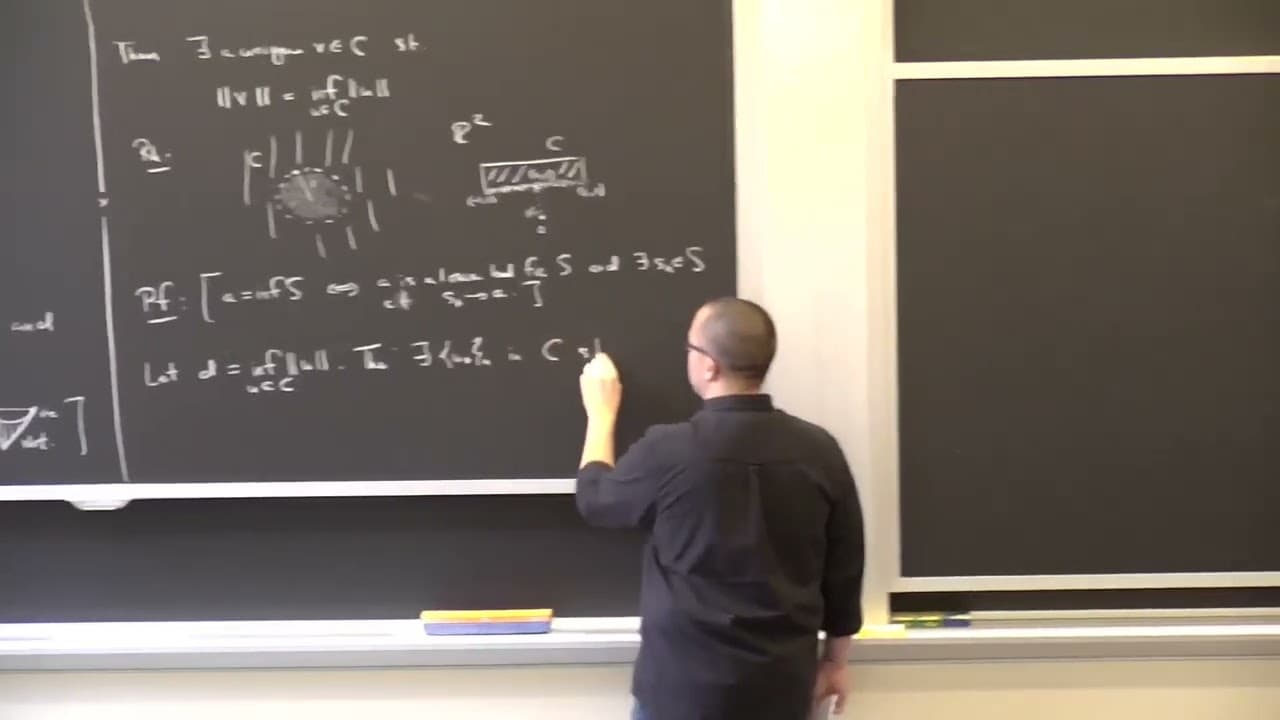
The theorem is proven by considering a set of elements in the Hilbert space that satisfy a certain property and showing that this set is non-empty, closed, and convex. This set is used to construct the projection map, which is key to the proof.
Q: What is the projection map in the context of the Riesz Representation Theorem?
The projection map, also known as the Riesz map, is a map that takes an element in the Hilbert space and returns the part of the element that lies in a particular subspace. It plays a crucial role in the proof of the Riesz Representation Theorem.
Q: How is the Riesz Representation Theorem related to the dual space of a Hilbert space?
The Riesz Representation Theorem states that the dual space of a Hilbert space can be identified with the Hilbert space itself through a unique vector that represents each element in the dual space.
Summary & Key Takeaways
-
The Riesz Representation Theorem states that for every element in the dual space of a Hilbert space, there is a unique vector in the Hilbert space such that the inner product of the vector with any element in the space gives the same value as the linear map of that element in the dual space.
-
The theorem is proven by considering the set of all elements in the Hilbert space that satisfy a certain property and showing that this set is non-empty, closed, and convex.
-
The projection map, also known as the Riesz map, is a key concept in the proof of the Riesz Representation Theorem.
-
The dual space of a Hilbert space can be identified with the Hilbert space itself through the Riesz Representation Theorem.
Read in Other Languages (beta)
Share This Summary 📚
Summarize YouTube Videos and Get Video Transcripts with 1-Click
Try YouTube Summary with ChatGPT & Claude or YouTube Transcript Generator
Explore More Summaries from MIT OpenCourseWare 📚



Summarize YouTube Videos and Get Video Transcripts with 1-Click
Try YouTube Summary with ChatGPT & Claude or YouTube Transcript Generator