Phases of Compiler | Lexical Analysis | Part -1/3 | CD | Compiler Design | Lec-02 | Bhanu Priya
TL;DR
Understanding the phases of compiler design and their functions.
Transcript
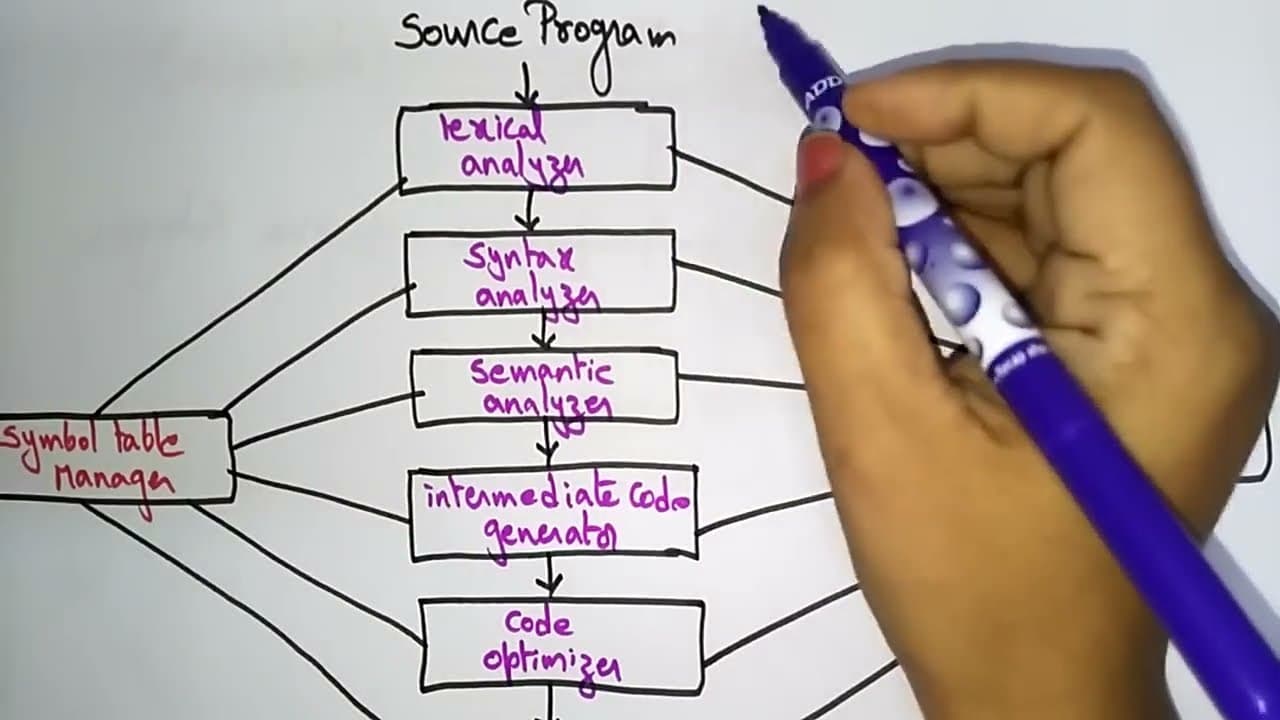
hi students uh welcome back coming to the next Topic in the compiler design was faces of compiler so in this faces of compiler we are going to learn about the structure exactly the structure of the compiler so in the previous video I explained about the language processing system so whatever the program you are taken how that program is internally ... Read More
Key Insights
- ℹ️ Compilers are structured to operate in distinct phases that systematically process source code into machine-readable format.
- 👨💻 The analysis phase emphasizes understanding the source code structure, while the synthesis phase transforms this understanding into executable machine code.
- 👨💻 Lexical analysis is crucial for breaking down source code into meaningful components, thereby enabling subsequent compilation phases to operate effectively.
- ✋ The conversion process from high-level language to machine code involves various transformation stages managed by logical interrelations of these phases.
- 💁 Each phase's output serves as the input for the next, highlighting the seamless flow of information through the compilation process.
- 🤬 Error handling is integrated into the compilation process through the symbol table manager, ensuring that issues detected in any phase can be appropriately addressed.
- 🎨 Understanding these phases provides foundational knowledge for anyone studying compiler design or programming language processing.
Install to Summarize YouTube Videos and Get Transcripts
Explore YouTube Video Summarizer or Get YouTube Transcript Extractor
Questions & Answers
Q: What are the two major phases of compilation mentioned in the content?
The two major phases of compilation are the analysis phase and the synthesis phase. The analysis phase is concerned with understanding the structure of the source code, independent of the machine architecture, whereas the synthesis phase translates the processed information into a form that is machine-dependent, focusing on generating executable code.
Q: What is the role of the lexical analyzer in the compilation process?
The lexical analyzer plays a crucial role in the first phase of compilation by reading the source code's stream of characters. It identifies and groups these characters into meaningful sequences called lexemes, which are then represented as tokens that serve as the basic elements for further processing in the compilation stages.
Q: How does the analysis phase differ from the synthesis phase in terms of dependencies?
The analysis phase is categorized as machine-independent but language-dependent, meaning it focuses on the specific characteristics of the programming language being used. In contrast, the synthesis phase is machine-dependent and language-independent, as it generates the final machine code considering the specifics of the target machine architecture.
Q: Can you describe the purpose of the symbol table manager in the compiler structure?
The symbol table manager in the compiler structure is essential for storing information about various identifiers in the source program, such as variables and functions. It facilitates easy access to this information during compilation, helps manage scope, and plays a vital role in error handling when issues arise during different phases of compilation.
Summary & Key Takeaways
-
The compilation process consists of two major phases: the analysis phase and the synthesis phase, which help in converting high-level programming languages to low-level machine code.
-
Each phase operates in a logical manner where the input representation is transformed into an output representation, involving various sub-phases that interact with a symbol table manager for error handling.
-
The first phase, lexical analysis, converts a stream of characters from source code into meaningful sequences called tokens, suggesting a structured approach to recognize programming language elements.
Read in Other Languages (beta)
Share This Summary 📚
Summarize YouTube Videos and Get Video Transcripts with 1-Click
Try YouTube Summary with ChatGPT & Claude or YouTube Transcript Generator