L24.2 Symmetrizer and antisymmetrizer for N particles (continued)
TL;DR
Permutation operators in quantum mechanics rearrange and interact with other operators in specific ways, leading to symmetric and antisymmetric states.
Transcript
PROFESSOR: We can go a step forward now. So we're trying to understand these operators. And the next claim is that if you multiply an arbitrary upward permutation operator times S, or you multiply on the other side, it's the same. And in fact, it's just S. On the other hand, if you multiply by a permutation operator A, it is still the same as multi... Read More
Key Insights
- 🦾 Permutation operators rearrange lists of operators, making them important in quantum mechanics.
- 🎅 Multiplying permutation operators with S or A results in specific outcomes, such as rearrangements or epsilon alpha 0 times A.
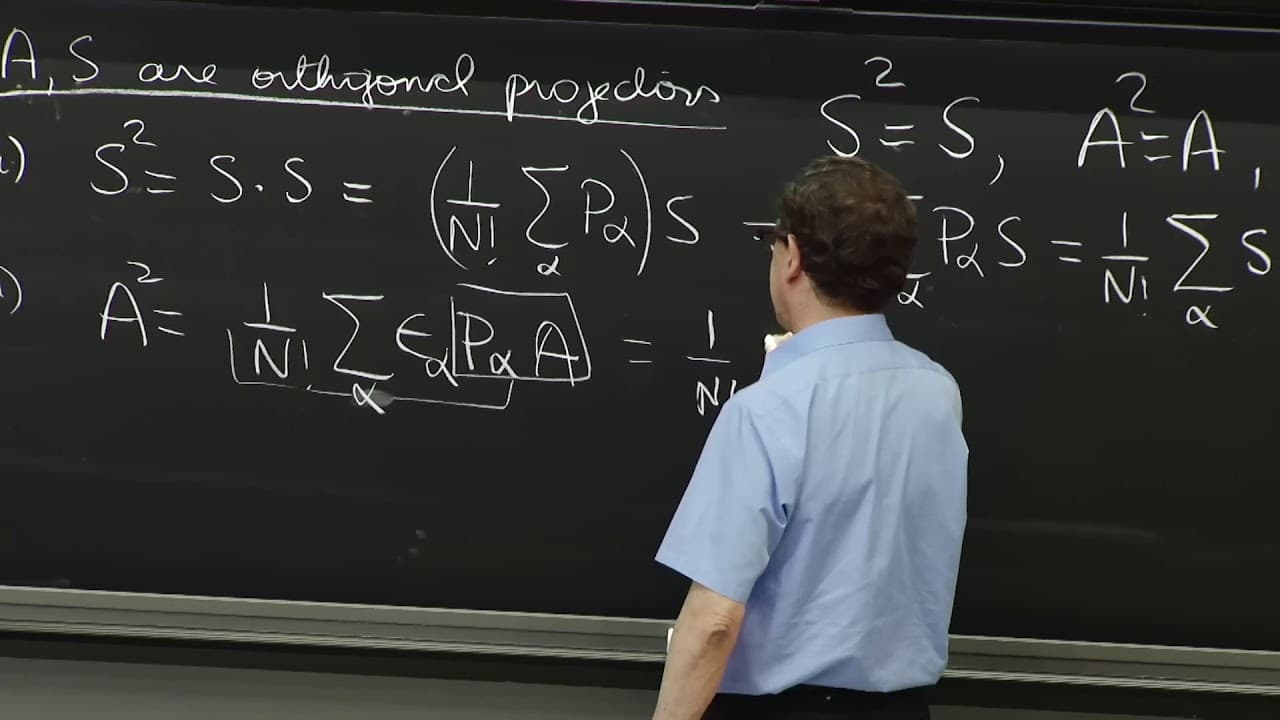
- 🎅 S and A are orthogonal projectors, with S squared equaling S and A squared equaling A.
- 🛀 Symmetric and antisymmetric states have no overlap, as shown by AS and SA equaling 0.
Install to Summarize YouTube Videos and Get Transcripts
Explore YouTube Video Summarizer or Get YouTube Transcript Extractor
Questions & Answers
Q: How do permutation operators interact with other operators in quantum mechanics?
Permutation operators can be multiplied with other operators, such as S or A, resulting in either the same operator or a rearranged list of operators.
Q: What is the difference between multiplying a permutation operator with S versus A?
When multiplying a permutation operator with S, the result is just S. However, when multiplying with A, you get epsilon alpha 0 times A, where epsilon alpha 0 is a factor related to the number of transpositions.
Q: How do S and A act as orthogonal projectors?
S and A are orthogonal projectors because they both square to themselves (S squared equals S and A squared equals A). Additionally, AS and SA equal 0, showing that symmetric and antisymmetric states have no overlap.
Q: What is the significance of S and A in quantum mechanics?
S takes a state to a symmetric state, while A takes a state to an antisymmetric state. These operators are useful for representing particles and their properties.
Summary & Key Takeaways
-
Permutation operators can be multiplied with other operators in specific ways, resulting in either the same operator or a rearranged list of operators.
-
Permutation operator P alpha 0 rearranges the list of all permutation operators, while P alpha on S and A acts as S or epsilon alpha 0 times A, respectively.
-
S and A are orthogonal projectors, with S squaring to S and A squaring to A. Additionally, AS and SA equal 0, indicating that symmetric and antisymmetric states have no overlap.
Read in Other Languages (beta)
Share This Summary 📚
Summarize YouTube Videos and Get Video Transcripts with 1-Click
Try YouTube Summary with ChatGPT & Claude or YouTube Transcript Generator
Explore More Summaries from MIT OpenCourseWare 📚


Summarize YouTube Videos and Get Video Transcripts with 1-Click
Try YouTube Summary with ChatGPT & Claude or YouTube Transcript Generator