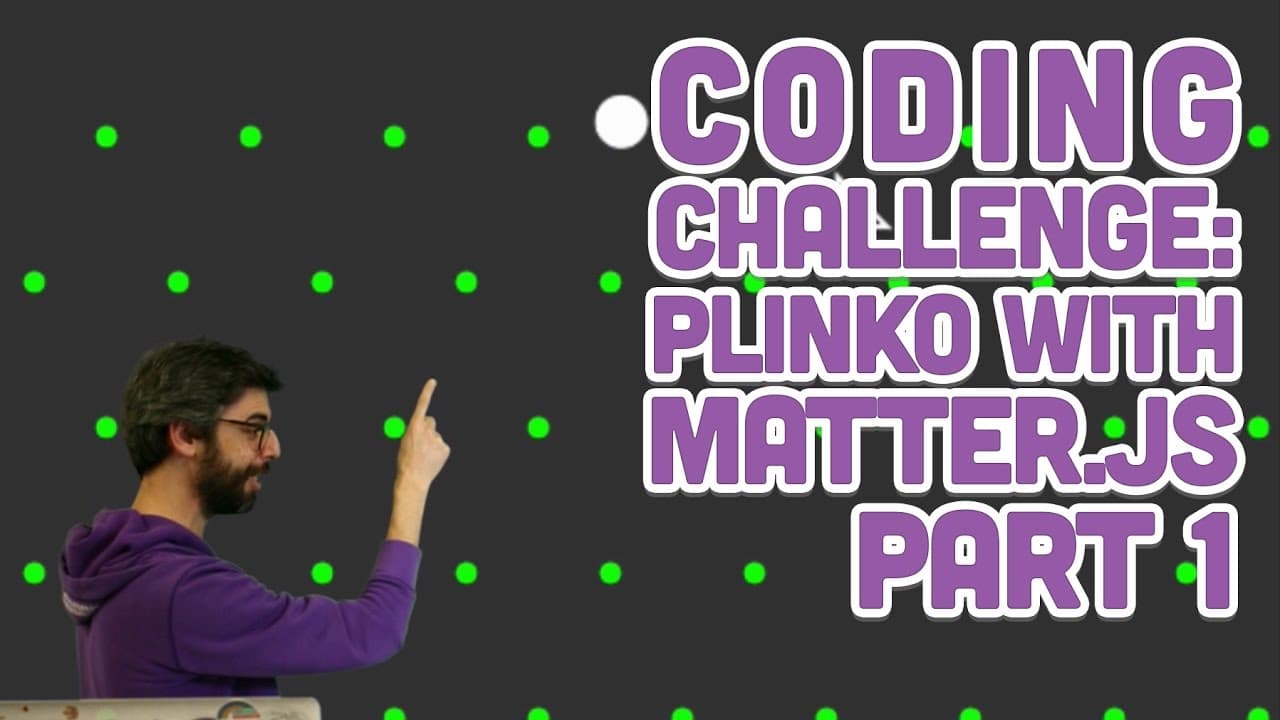
Coding Challenge #62.1: Plinko with Matter.js Part 1
TL;DR
Building a Plinko simulation using a physics engine with bouncing objects falling into slots.
Transcript
oh all aboard it's right anything here on the Coty train and I am here ready to create a coding challenge and today's coding challenge is going to be AI never mind never mind all this nonsense Plinko so I'm going to attempt to make Plinko I'm using a physics engine known as matter AF what is Plinko you may ask good question I don't really entirely ... Read More
Key Insights
- 🚒 Utilizing a physics engine like matter.js enhances the realism of particle interactions in the Plinko simulation.
- 👻 Adjusting restitution and friction parameters allows for fine-tuning the behavior of objects for more accurate physics simulations.
- 🎮 Controlling the position and properties of stationary pegs plays a significant role in defining the behavior of particles in the simulation.
- 🤨 Alternating the layout of pegs in rows helps introduce randomness and variation in particle paths.
- 😒 The use of loops and conditional statements simplifies the process of creating a grid-like structure for the Plinko simulation.
- ❓ Experimenting with different parameters and layouts can further enhance the realism and visual appeal of the Plinko simulation.
- 👨💻 Planning and organizing the code structure are essential for efficiently implementing complex simulations like Plinko.
Install to Summarize YouTube Videos and Get Transcripts
Explore YouTube Video Summarizer or Get YouTube Transcript Extractor
Questions & Answers
Q: What is the purpose of creating a Plinko simulation in this coding challenge?
The aim is to replicate the game of Plinko, involving balls falling through rows of pegs to simulate physics interactions and random paths.
Q: How is the physics engine, matter.js, utilized in this coding challenge?
The matter.js library is used to create and manage physics bodies for the falling particles and stationary pegs, enabling realistic interactions like bouncing and collisions.
Q: What role do restitution and friction play in adjusting the behavior of particles and pegs?
Restitution affects the elasticity or bounciness of the objects, while friction controls how much resistance the objects have when moving, crucial for realistic physics simulation.
Q: How does the code alternate the arrangement of pegs to create randomness in the particle paths?
By offsetting the position of stationary pegs in alternating rows, a 50% chance for particles to take different paths is introduced, adding randomness to the simulation.
Summary & Key Takeaways
-
Creating a Plinko simulation using a physics engine called matter.js.
-
Explaining the concept of Plinko with rows of stationary pegs where balls fall and bounce.
-
Developing particles falling from the top while creating stationary pegs to catch them.
Read in Other Languages (beta)
Share This Summary 📚
Summarize YouTube Videos and Get Video Transcripts with 1-Click
Try YouTube Summary with ChatGPT & Claude or YouTube Transcript Generator
Explore More Summaries from The Coding Train 📚





Summarize YouTube Videos and Get Video Transcripts with 1-Click
Try YouTube Summary with ChatGPT & Claude or YouTube Transcript Generator