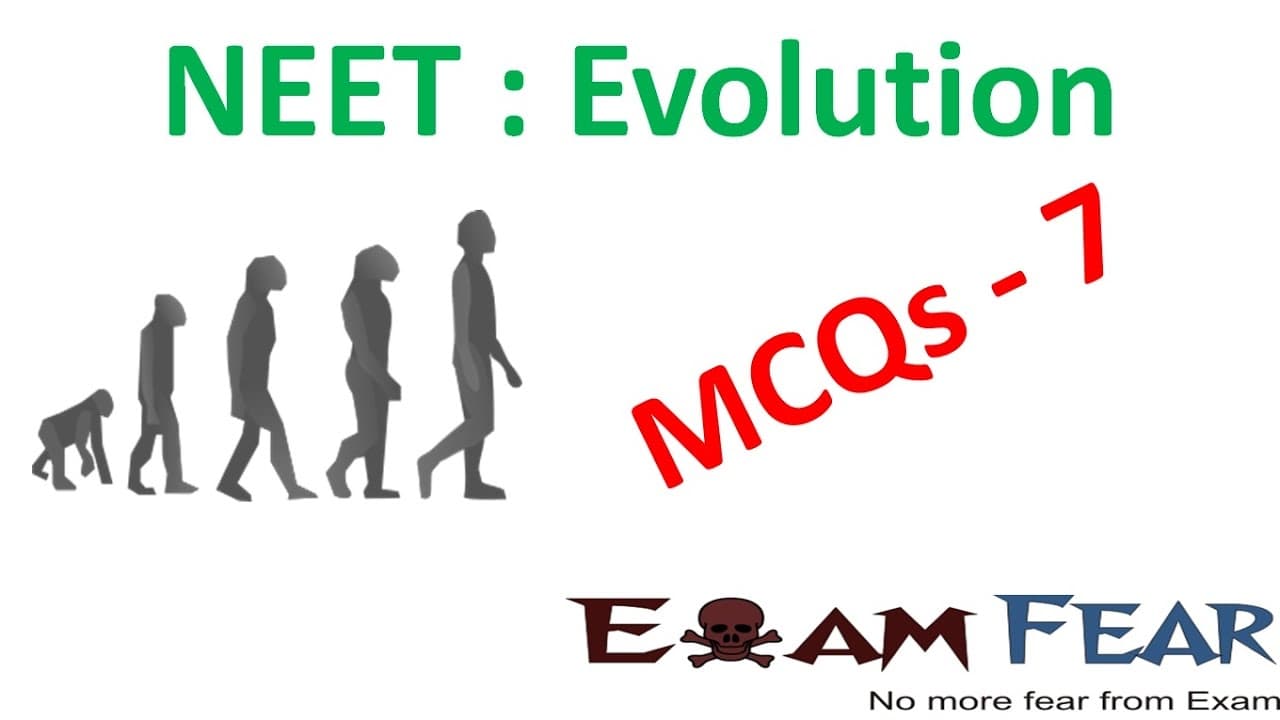
NEET Biology Evolution : Multiple Choice Previous Years Questions MCQs 7
TL;DR
This video provides insights into convergent evolution, parallel evolution, the theory of inheritance, adaptive radiation, the composition of the early atmosphere, and the concept of homeostasis.
Transcript
he'll open this video are neat evolution is brought to you by advance Viacom normal fear from a question of authority paternalism is adaptive divergence adaptive divergence of widely separated species adaptive convergence of widely different species adaptive convergence of closely related group so parallelism is basically another name for parallel ... Read More
Key Insights
- ❓ Convergent evolution occurs when unrelated species develop similar traits due to similar environmental pressures.
- 💁 Parallel evolution is a form of convergent evolution that occurs in closely related species.
- 🤑 The theory of inheritance based on germ plasm states that only inherited traits can be passed on, not acquired ones.
- 🔂 Adaptive radiation is a type of divergent evolution where a single species diversifies into multiple species.
- 🖤 The early atmosphere had a reducing composition, lacking oxygen during the origin of life.
- ♻️ Homeostasis is the ability of organisms to maintain a stable internal environment.
- ❓ Hummingbirds are an example of adaptive radiation, diversifying rapidly to fill various ecological niches.
Install to Summarize YouTube Videos and Get Transcripts
Explore YouTube Video Summarizer or Get YouTube Transcript Extractor
Questions & Answers
Q: What is convergent evolution?
Convergent evolution is the development of similar traits in unrelated species as a result of adapting to similar environments. For example, deer and horses both have two-toed feet for running, despite not being closely related.
Q: How is parallel evolution different from convergent evolution?
Parallel evolution occurs when closely related species develop similar traits independently. It is a form of convergent evolution, but the organisms involved are more closely related than in typical convergent evolution.
Q: What is adaptive radiation?
Adaptive radiation is a type of divergent evolution where a single species diversifies into multiple species in different habitats. This allows for the colonization of new areas and the evolution of specialized traits.
Q: What was the composition of the early atmosphere during the origin of life?
The early atmosphere had a reducing atmosphere, consisting of simpler molecules like hydrogen, nitrogen, water, methane, ammonia, and carbon dioxide. Oxygen was absent during this time.
Q: What is homeostasis?
Homeostasis is the ability of organisms to maintain a stable internal environment despite external changes. It ensures internal equilibrium, such as maintaining a constant body temperature, regardless of external temperature variations.
Summary & Key Takeaways
-
The video discusses convergent evolution, which occurs when unrelated species develop similar traits to adapt to their environments.
-
It also explains parallel evolution, which refers to convergent evolution in closely related species.
-
The theory of inheritance is explored, with a focus on germ plasm and the debunking of the idea that acquired traits can be inherited.
-
The concept of adaptive radiation, where a single species diversifies into multiple species in different habitats, is explained using the example of hummingbirds.
-
The composition of the early atmosphere is discussed, highlighting the absence of oxygen during the origin of life.
-
Homeostasis, the ability of organisms to maintain internal equilibrium, is defined and explained.
Read in Other Languages (beta)
Share This Summary 📚
Summarize YouTube Videos and Get Video Transcripts with 1-Click
Try YouTube Summary with ChatGPT & Claude or YouTube Transcript Generator
Explore More Summaries from LearnoHub - Class 11, 12 📚

Summarize YouTube Videos and Get Video Transcripts with 1-Click
Try YouTube Summary with ChatGPT & Claude or YouTube Transcript Generator