CMOS | 2-input NAND and NOR gates | Layout diagram | VLSI | Lec-34
TL;DR
This video explains how to create layout diagrams for NAND and NOR gates using CMOS technology.
Transcript
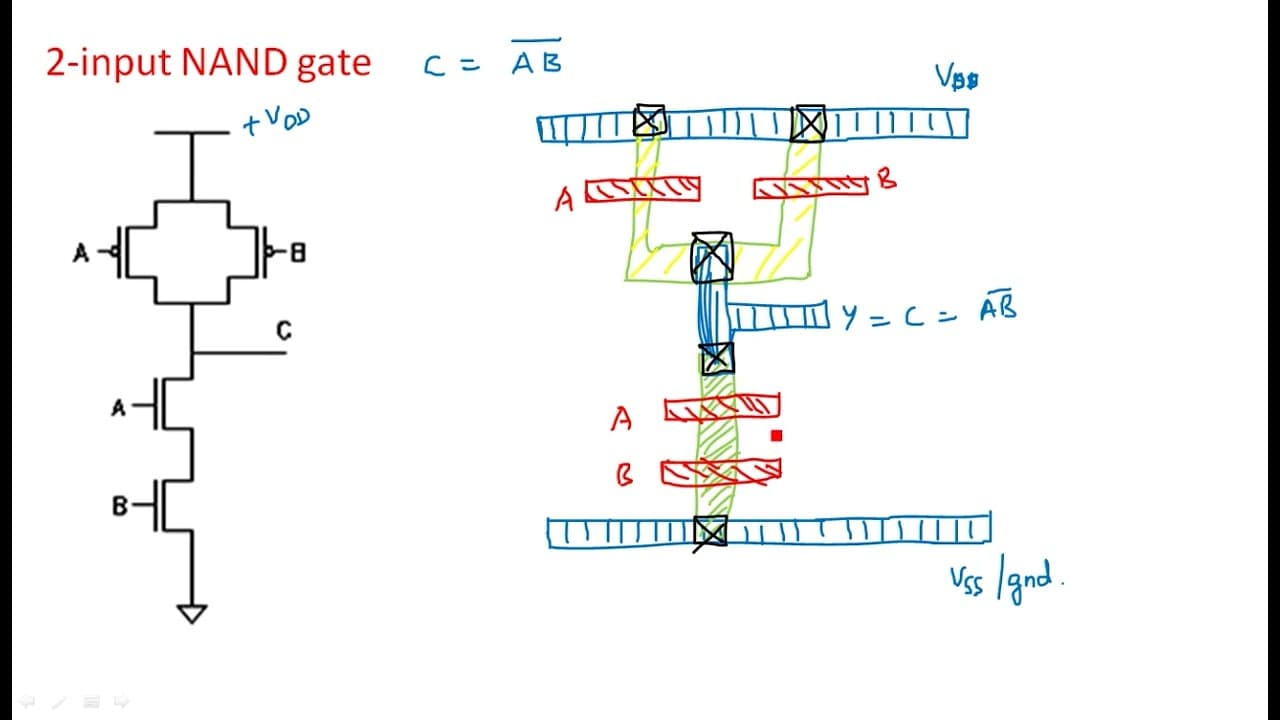
hi everyone in this video I am going to give you the idea how to draw the layout diagrams for the nand and nor Gates okay we know nand and nor gates are their basic Universal Gates so which are used to design any type of logical functions uh to call it to call it to call as Universal functions okay now how to draw the CMOS in what a SEMA circuit di... Read More
Key Insights
- 👷 CMOS technology employs PMOS and NMOS transistors for constructing logical gates, making them integral for digital circuits.
- 🔬 The layout of NAND gates features two PMOS in parallel and two NMOS in series, while NOR gates exhibit the opposite configuration.
- 🦻 The design emphasizes color coding for clarity, aiding in differentiating between various components of the circuit.
- 🫥 Voltage supply lines (VDD and VSS) need to be laid out correctly to promote effective operation of the logic gates.
- 🫥 The thickness and spacing of metal lines are crucial for minimizing resistance and capacitance in circuit layouts.
- 🎨 Understanding the layout representation promotes a better grasp of logic gate functionality and semiconductor design principles.
- 🔨 Diagrams are essential tools for visualizing complex circuit relationships, enhancing both learning and practical application.
Install to Summarize YouTube Videos and Get Transcripts
Explore YouTube Video Summarizer or Get YouTube Transcript Extractor
Questions & Answers
Q: What are NAND and NOR gates considered in logic design?
NAND and NOR gates are termed universal gates because they can be used to create any other type of logic function. This capability allows them to form the basis of complex logic circuits used in digital electronics, streamlining the design process, as a single type of gate can perform a multitude of operations.
Q: How do you represent the PMOS and NMOS transistors in the layouts?
In the layout diagrams, PMOS transistors are typically represented using yellow lines with green borders, indicating their P-type diffusion. Conversely, NMOS transistors are depicted as narrow green lines, illustrating their N-type diffusion. This visual differentiation helps engineers understand circuit functions and connections clearly.
Q: Why is it important to use different thicknesses for metal lines in layout designs?
Using different thicknesses for metal lines is crucial because it helps reduce resistance and capacitance, which in turn enhances the performance of the circuit. A thicker metal line improves conductivity and reduces power loss, thus ensuring reliable operation of digital circuits in high-frequency applications.
Q: What is the significance of the term 'monochromatic representation' in this context?
Monochromatic representation refers to the use of a single color for all layout elements, which simplifies the understanding of the circuit design. Even without color differentiation, each layer's structure can be identified based on its representation, making it easier to follow and analyze the layout while maintaining clarity in the diagram.
Q: How does the drawing of layout diagrams aid in understanding CMOS technology?
Drawing layout diagrams in a structured manner aids in comprehending the spatial relationships between different components, thus deepening the understanding of CMOS technology. By visualizing how transistors connect and interact, students can better grasp the underlying principles of logic design and improve their problem-solving skills.
Q: What role do metal lines play in the circuit layouts for NAND and NOR gates?
Metal lines serve as the interconnects in the circuit layouts for NAND and NOR gates. They provide the paths for electrical signals and power supply connections (VDD and VSS), essential for the operation of the gates. Proper layout and spacing of these lines are vital to ensure efficient circuit performance.
Summary & Key Takeaways
-
The video provides step-by-step instructions for drawing layout diagrams of NAND and NOR gates, fundamental components in digital circuit design.
-
It emphasizes the importance of understanding complementary structures in CMOS design, outlining the specific arrangements for PMOS and NMOS transistors.
-
Viewers learn to visualize these layouts with color-coded representations, making it easier to comprehend circuit connections and functionalities.
Read in Other Languages (beta)
Share This Summary 📚
Summarize YouTube Videos and Get Video Transcripts with 1-Click
Try YouTube Summary with ChatGPT & Claude or YouTube Transcript Generator