L5.3 The relativistic correction
TL;DR
This content discusses the relativistic corrections in the hydrogen atom and addresses the question of how to handle degeneracies in the calculations.
Transcript
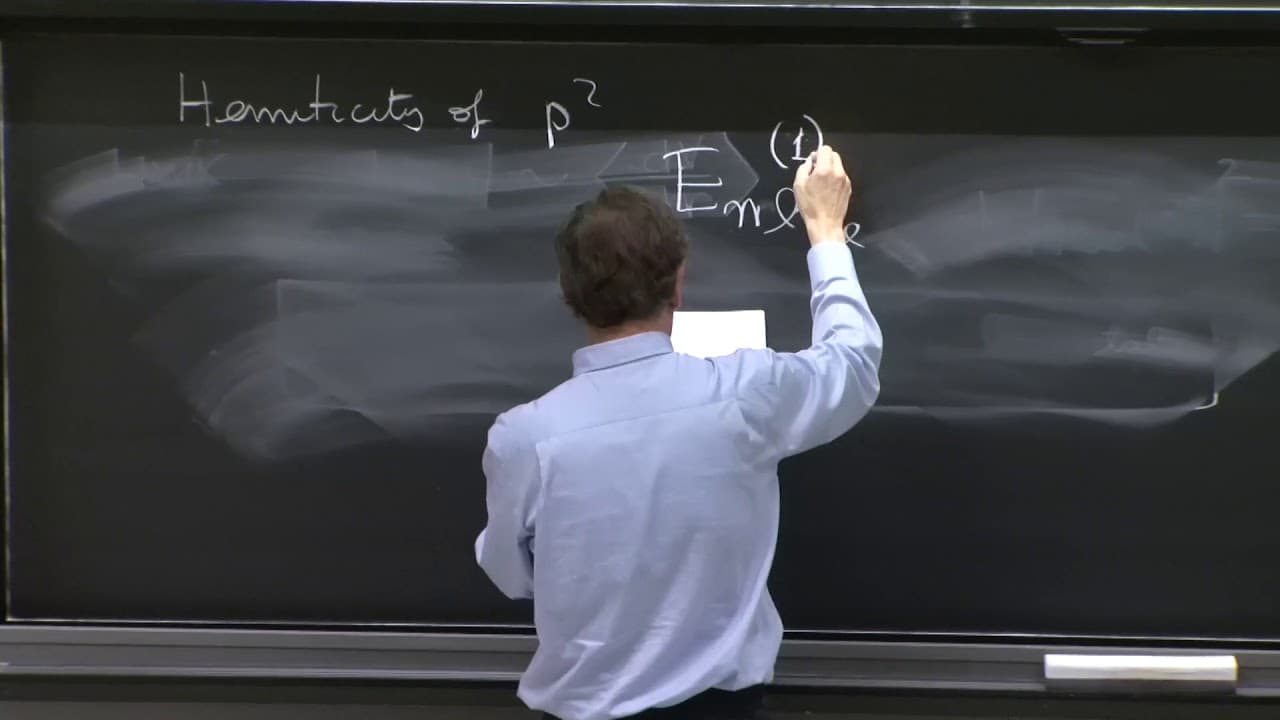
PROFESSOR: So we'll do the relativistic corrections. And all the corrections that I'll do today, I'll skip the easy but sometimes a little tedious algebra. It's not very tedious. Nothing that is pages and pages of algebra. It's lines of algebra. But why would I do it in lecture? No point for that. So let's see what we can do. This is the relativist... Read More
Key Insights
- 🫀 Relativistic corrections in the hydrogen atom require addressing the challenge of degeneracy, which is an inherent feature of the system.
- 🫤 The commutation properties of the perturbation operator with angular momentum operators are crucial in determining the diagonal nature of the correction in the subspace.
- 👫 The results obtained in the uncoupled basis for the correction are equivalent to those in the coupled basis, as both describe the same states.
Install to Summarize YouTube Videos and Get Transcripts
Explore YouTube Video Summarizer or Get YouTube Transcript Extractor
Questions & Answers
Q: Why is degeneracy a challenge in calculating the relativistic correction for the hydrogen atom?
Degeneracy poses a challenge because the formula for energy shift applies for nondegenerate perturbation theory, and the hydrogen atom has a large number of degenerate states.
Q: How is the issue of degeneracy addressed in the calculations?
By showing that the perturbation operator, P^4, commutes with angular momentum operators and is diagonal in the relevant subspace, it is established that the correction is diagonal in the degenerate states.
Q: Can the correction be calculated using a coupled basis instead of an uncoupled basis?
The correction in the uncoupled basis is equivalent to the correction in the coupled basis, as both describe the same states. The answer does not depend on the specific values of ml and ms.
Q: Why is it important to understand fine structure in the hydrogen atom?
Fine structure is an essential aspect of understanding the energy levels and properties of the hydrogen atom. It provides insights into relativistic effects and the splitting of degenerate energy levels.
Summary & Key Takeaways
-
The content explores the relativistic correction in the hydrogen atom. It introduces the formula for the first-order correction and discusses the challenge of degeneracy in the system.
-
The professor explains that degeneracy is an issue in hydrogen atom calculations and questions whether the formula for energy shift applies in this case.
-
A student suggests that the correction may not mix the states due to rotational symmetry and provides an argument for why the basis is appropriate.
-
The professor demonstrates through commutation relations that the perturbation, P^4, is diagonal in the subspace of interest, addressing the degeneracy problem.
-
The professor then proceeds to calculate the relativistic correction for the energy levels in the hydrogen atom and discusses the importance of understanding fine structure.
Read in Other Languages (beta)
Share This Summary 📚
Summarize YouTube Videos and Get Video Transcripts with 1-Click
Try YouTube Summary with ChatGPT & Claude or YouTube Transcript Generator
Explore More Summaries from MIT OpenCourseWare 📚



Summarize YouTube Videos and Get Video Transcripts with 1-Click
Try YouTube Summary with ChatGPT & Claude or YouTube Transcript Generator