A Hard Limit With L'Hospital's Rule 3 Times
TL;DR
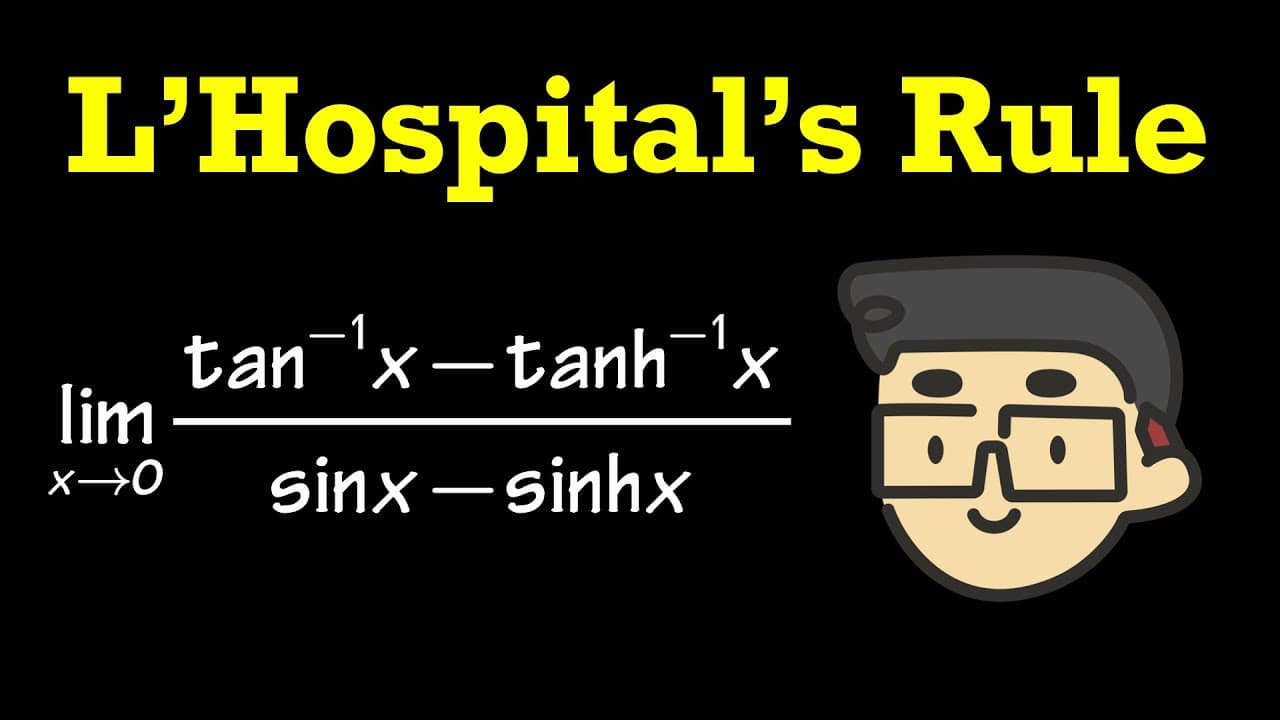
This video explains how to calculate a limit using L'Hopital's Rule and discusses the derivatives of trigonometric and hyperbolic trigonometric functions.
Transcript
all right I met this is for you we're going to calculate this limit right here and notice we have a regular trig a hyperbolic trig and a regular interest rate and also the hyperbolic inverse trig everything's here Wow well we'll see first if you push you right into all the x windows true over zero so we can go ahead and just use l'hopital's rule so... Read More
Key Insights
- 😒 The video demonstrates the use of L'Hopital's Rule to evaluate limits involving a combination of trigonometric and hyperbolic trigonometric functions.
- ❓ It explains the derivatives of inverse trigonometric functions, such as inverse tangent, and inverse hyperbolic trigonometric functions, such as inverse hyperbolic tangent.
- 😑 The application of the quotient rule is shown when differentiating expressions involving division.
Install to Summarize YouTube Videos and Get Transcripts
Explore YouTube Video Summarizer or Get YouTube Transcript Extractor
Questions & Answers
Q: What is L'Hopital's Rule and when is it used?
L'Hopital's Rule is a mathematical tool used to evaluate limits that result in an indeterminate form (0/0 or ∞/∞). It involves finding the derivative of the numerator and denominator separately and then evaluating the limit again.
Q: How do you differentiate inverse trigonometric functions?
When differentiating inverse trigonometric functions, such as inverse tangent or inverse hyperbolic tangent, the derivative can be calculated using the formula 1/(1+x^2) or 1/(1-x^2), respectively.
Q: What is the quotient rule and when is it used?
The quotient rule is a method for differentiating functions that involve division. It states that the derivative of a quotient is equal to (denominator * derivative of numerator - numerator * derivative of denominator)/(denominator)^2. The quotient rule is used when differentiating expressions like f(x)/g(x).
Q: How do you differentiate hyperbolic trigonometric functions?
When differentiating hyperbolic trigonometric functions, such as cosh(x) or sinh(x), the derivatives can be calculated using the formulas cosh'(x) = sinh(x) and sinh'(x) = cosh(x), respectively.
Summary & Key Takeaways
-
The video discusses the process of calculating a limit using L'Hopital's Rule, specifically focusing on a limit involving a combination of regular trigonometric, hyperbolic trigonometric, and inverse trigonometric functions.
-
It demonstrates how to differentiate each function to find the derivative and then substitute the value of x into the derivative to calculate the limit.
-
The video also explains the application of the quotient rule when differentiating an expression involving division.
Read in Other Languages (beta)
Share This Summary 📚
Summarize YouTube Videos and Get Video Transcripts with 1-Click
Try YouTube Summary with ChatGPT & Claude or YouTube Transcript Generator
Explore More Summaries from blackpenredpen 📚
Summarize YouTube Videos and Get Video Transcripts with 1-Click
Try YouTube Summary with ChatGPT & Claude or YouTube Transcript Generator