K - Map | 3- variable | SOP | Example | STLD | Lec-36
TL;DR
This video explains reducing three-variable Boolean expressions with Karnaugh maps (K-maps).
Transcript
hi everyone in this video I'm going to explain the reduction of Boolean expression if you are having a three variable in it using Kap okay uh for as it is becoming a lengthy video so I'm just making uh sum of products for one separate video and POS as a separate video okay if you want to reduce the product of sums in terms of product of sums then y... Read More
Key Insights
- 😑 Karnaugh maps provide a visual approach to reducing Boolean expressions, simplifying the minimization process significantly compared to algebraic methods.
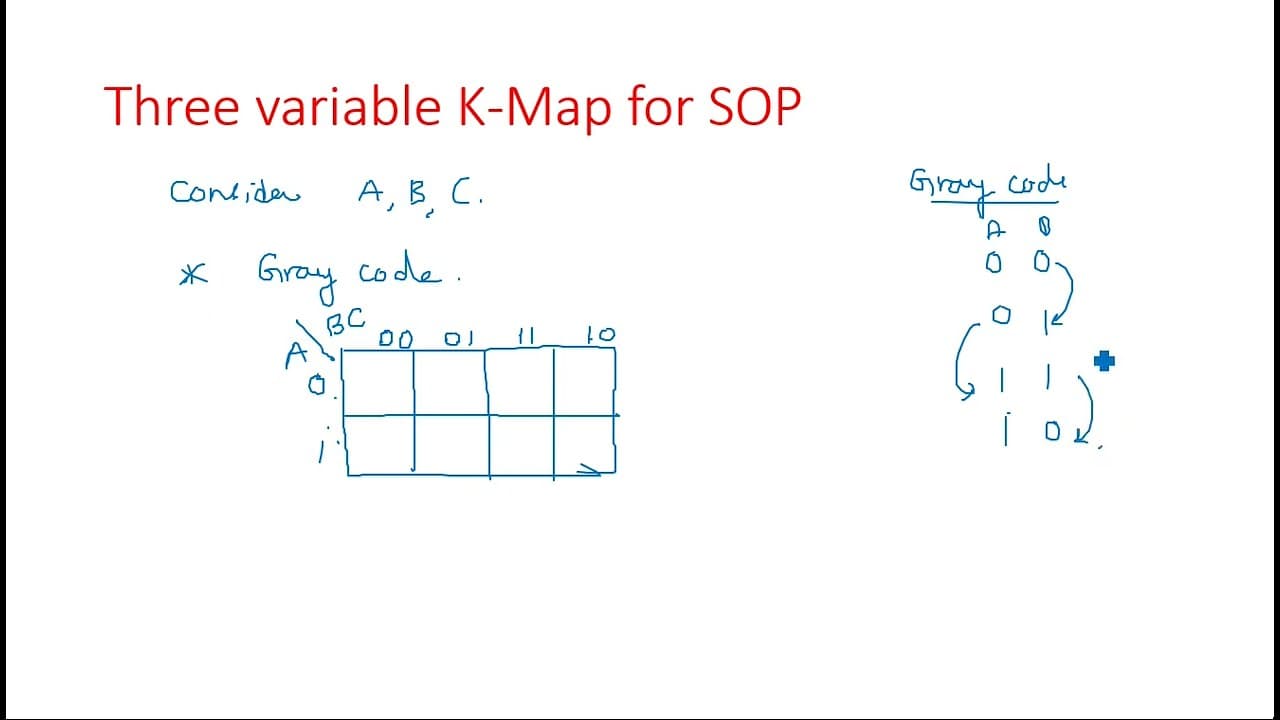
- 😉 Gray code ensures that adjacent cells on the K-map differ by a single variable, which is essential for accurate representations and simplifications.
- 🤩 Understanding the correct mapping and grouping of terms is key to producing simpler and more efficient Boolean expressions.
- 🎃 The flexibility in mapping groups highlights the creative aspect of K-map simplification, allowing for multiple valid configurations to achieve the correct minimization.
- 😑 K-maps are effective for two or three variables but become unwieldy for more, necessitating other methods for higher-order expressions.
- 👔 Learning to identify common patterns in K-maps enhances the ability to quickly reduce Boolean expressions without heavy reliance on formal laws.
- 🥅 The tutorial clarifies that both SOP and POS methods can achieve valid results, with the choice depending on specific application requirements or simplification goals.
Install to Summarize YouTube Videos and Get Transcripts
Explore YouTube Video Summarizer or Get YouTube Transcript Extractor
Questions & Answers
Q: What is the purpose of using Karnaugh maps in Boolean expression reduction?
Karnaugh maps help simplify complex Boolean expressions by allowing the visualization of variable combinations. They facilitate the minimization of terms in expressions simply by grouping together adjacent cells representing '1's, making the process more intuitive than traditional algebraic methods.
Q: Why is Gray code important in the representation of K-maps?
Gray code is crucial when constructing K-maps because it ensures that adjacent cells in the map differ by only one variable. This unit distance coding minimizes errors in mapping variable changes and is especially significant for higher numbers of variables, as it maintains the integrity of the representation.
Q: How do you express a Boolean function in sum of products (SOP) form using K-maps?
To express a function in SOP form, you first identify which squares on the K-map contain '1's. Each '1' corresponds to a product term based on the variable values, and these product terms are then summed together. The grouping of pertinent '1's helps in reducing redundant terms.
Q: Can you map non-adjacent '1's in a Karnaugh map?
Yes, while K-maps typically require grouping adjacent '1's for simplification, K-maps also allow wrapping around edges. This means non-adjacent '1's that are at the ends of the map can be grouped if they are connected by the map’s edges, facilitating the creation of simplified terms.
Q: Is there a restriction on how to group '1's in K-maps?
While K-maps encourage grouping in powers of two (1, 2, 4, 8, etc.), there are no strict rules on the exact mapping configuration. Different groupings can yield equivalent expressions, allowing flexibility in how one chooses to visually represent and simplify the Boolean function.
Q: What is the significance of keeping track of which form (SOP or POS) is being used during simplification?
Maintaining clarity between sum of products (SOP) and product of sums (POS) forms is crucial because the processes for simplification differ. Confusing the two can lead to incorrect expressions and outcomes, as they rely on different combinations of the variable states to achieve the desired minimization effect.
Summary & Key Takeaways
-
The video introduces the use of Karnaugh maps for minimizing Boolean expressions involving three variables (A, B, C) through sum of products (SOP) and product of sums (POS) techniques.
-
It emphasizes the importance of using Gray code when mapping combinations in K-maps to ensure correctness in representing variable changes with minimal distance.
-
The tutorial provides step-by-step examples of how to create and simplify expressions, showcasing the advantages of K-maps in making the process efficient without relying on Boolean laws.
Read in Other Languages (beta)
Share This Summary 📚
Summarize YouTube Videos and Get Video Transcripts with 1-Click
Try YouTube Summary with ChatGPT & Claude or YouTube Transcript Generator