Bootstrap time base generator | Transistor | Part-2/2 | PDC | Lec-87
TL;DR
This video explains the functioning of a transistor bootstrap time-based generator, focusing on gating pulses and voltage behavior.
Transcript
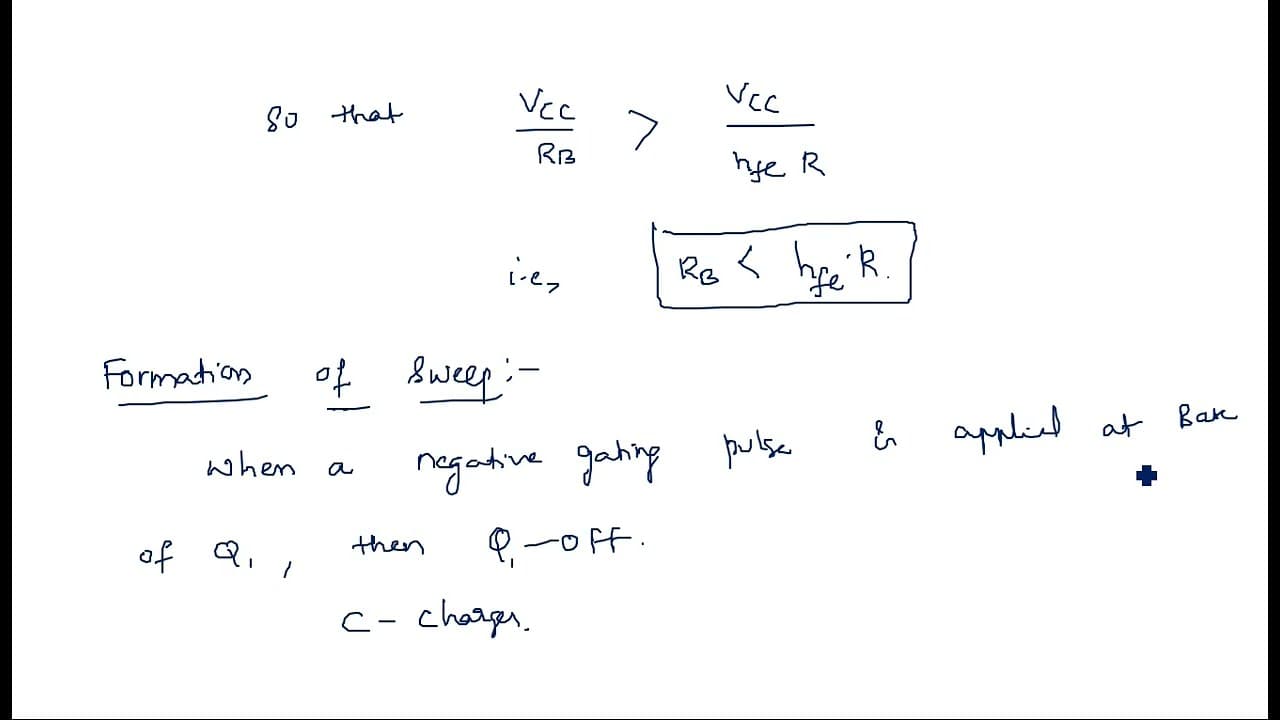
hi everyone in the previous video I have started this transistor bootstrap time based generator and this is the circuit we have seen how the transistors are acting before the gating pulse and after the application of getting belts also we have seen and when the gating pulse is not applied E1 is in saturation after the application of a negative gati... Read More
Key Insights
- ⚾ The transistor bootstrap time-based generator operates based on precise control of gating pulses affecting transistor states and voltage levels.
- ⚡ Capacitors function as energy storage elements within the circuit, discharging through transistors and directly determining output voltage trends.
- ⚡ The emitter follower configuration is key in providing unity gain, ensuring that input voltage and output voltage remain consistent during operation.
- ❓ A stable charging and discharging behavior relies on appropriately chosen resistance and capacitance, impacting overall circuit performance.
- ⚡ The discharging current from the capacitor produces linear output voltage changes, highlighting the relationship between current flow and voltage behavior.
- 💨 Recovery times, detailed by the relationships between charge loss and gain, are crucial for determining how fast a capacitor returns to its original value.
- 🥺 Circuit performance can be optimized by fine-tuning resistance values, although lowering them excessively can lead to excessive transistor dissipation.
Install to Summarize YouTube Videos and Get Transcripts
Explore YouTube Video Summarizer or Get YouTube Transcript Extractor
Questions & Answers
Q: What is the role of the gating pulse in the transistor bootstrap time-based generator?
The gating pulse serves a crucial function in controlling transistor Q1's state. When the gating pulse is applied, it turns off Q1, allowing the capacitor to charge towards VCC. The management of the gating pulse directly affects the performance and charging behavior of the circuit, determining how voltage levels change throughout each cycle.
Q: How does the capacitor discharge in the circuit, and what is the impact on the output voltage?
Once the gating pulse is removed, the capacitor discharges through transistor Q1, affecting the output voltage at Q2, which acts as an emitter follower. The output voltage decreases in sync with the capacitor's discharging rate, showcasing a linear relationship influenced by the constant current during this discharge period, ultimately regulating the output voltage's responsiveness to the input changes.
Q: What effects do resistance and capacitance values have in the circuit configuration?
The resistance and capacitance values in the circuit are fundamental for obtaining the maximum voltage amplitude (VCC) within a specific period. If carefully selected, they determine the charging capabilities of the capacitor and, consequently, the retrace period. Improper values may hinder performance or exceed transistor dissipation limits, leading to inefficiencies or circuit failures.
Q: How can the retrace period (TR) be calculated, and what factors influence its duration?
The retrace period (TR) is calculated based on the charge lost from the capacitor during the discharging phase. The formula involves assessing the current flowing through the circuit and the voltage characteristics of the capacitor. Factors that influence its duration include resistance values and the applied voltage, impacting how quickly the capacitor can discharge and subsequently recharge.
Summary & Key Takeaways
-
The video discusses how a transistor bootstrap time-based generator operates, detailing the relationships between transistors, gating pulses, and voltage levels during charging and discharging periods.
-
It explains the behavior of a capacitor within the circuit, emphasizing the significance of resistance and capacitance values in achieving the desired voltage across the capacitor, influencing the retrace period.
-
The circuitry configurations, including emitter follower setups, are covered, illustrating how the circuit maintains consistent voltage output despite changes in input gating pulses and capacitor discharging dynamics.
Read in Other Languages (beta)
Share This Summary 📚
Summarize YouTube Videos and Get Video Transcripts with 1-Click
Try YouTube Summary with ChatGPT & Claude or YouTube Transcript Generator