3: Resistor Capacitor Neuron Model - Intro to Neural Computation
TL;DR
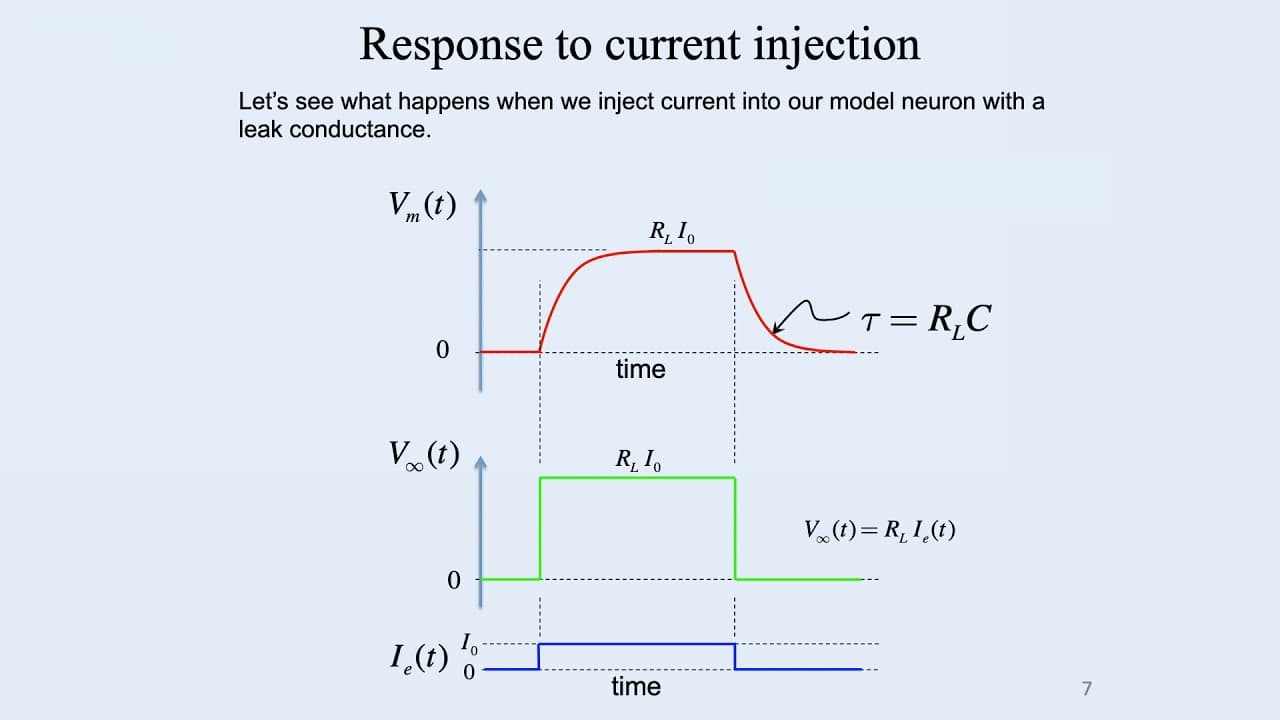
This content discusses the role of voltage and time-dependent ion conductances in neurons and their ability to generate action potentials.
Transcript
MICHALE FEE: Good morning, everybody. So we're going to continue today developing our model of a neuron. Again, this is called the "Equivalent Circuit Model," and it was developed by Alan Hodgkin and Andrew Huxley in the '40s and '50s. Let me just give a brief recap of what we've covered in the last couple of lectures. So we've been analyzing a neu... Read More
Key Insights
- 😑 The equivalent circuit model allows researchers to study the behavior of neurons by analyzing voltage and ion conductances.
- 😑 Ion channels play a crucial role in determining the membrane potential of a neuron by facilitating the movement of ions across the cell membrane.
- ❤️🔥 The integrate and fire model simplifies the behavior of neurons by focusing on threshold voltages and the generation of action potentials as discrete events.
- 😑 The Hodgkin-Huxley model provides a detailed understanding of how voltage and time-dependent ion conductances contribute to action potential generation in neurons.
Install to Summarize YouTube Videos and Get Transcripts
Explore YouTube Video Summarizer or Get YouTube Transcript Extractor
Questions & Answers
Q: What is the significance of the equivalent circuit model in neuroscience?
The equivalent circuit model provides a framework to analyze the behavior of neurons, specifically in relation to voltage and ion conductances. It helps us understand how the flow of ions across the cell membrane affects the membrane potential and ultimately leads to action potentials.
Q: How do ion channels contribute to the membrane potential?
Ion channels are specialized pores in the cell membrane that allow ions to pass through. This movement of ions causes changes in the membrane potential by creating an imbalance of charges across the membrane. Different ion channels have specific properties and contribute to the overall membrane potential of the neuron.
Q: What is the difference between the integrate and fire model and the Hodgkin-Huxley model?
The integrate and fire model simplifies the behavior of a spiking neuron by considering a threshold voltage and the generation of action potentials as discrete events. The Hodgkin-Huxley model, on the other hand, describes the biophysical mechanisms underlying the generation of action potentials and includes voltage and time-dependent ion conductances.
Q: How do conductances in the Hodgkin-Huxley model control the voltage in a neuron?
Conductances act as knobs that regulate the flow of ions in and out of the neuron, thereby controlling the voltage. By adjusting the conductance values, the neuron can be dragged towards the equilibrium potential of specific ions, affecting the overall membrane potential.
Summary & Key Takeaways
-
The content introduces the equivalent circuit model, developed by Alan Hodgkin and Andrew Huxley, to understand the behavior of neurons.
-
It explains the concept of ion channels and how they contribute to the flow of ions across the cell membrane, thereby affecting the membrane potential.
-
The integrate and fire model is presented as a simplified version of a spiking neuron, while the Hodgkin-Huxley model delves into the biophysical details of action potential generation.
Read in Other Languages (beta)
Share This Summary 📚
Summarize YouTube Videos and Get Video Transcripts with 1-Click
Try YouTube Summary with ChatGPT & Claude or YouTube Transcript Generator
Explore More Summaries from MIT OpenCourseWare 📚
Summarize YouTube Videos and Get Video Transcripts with 1-Click
Try YouTube Summary with ChatGPT & Claude or YouTube Transcript Generator