Parity generator | checker | Even | STLD | Lec-81
TL;DR
This video explains how to design an even parity generator for error detection in data transmission.
Transcript
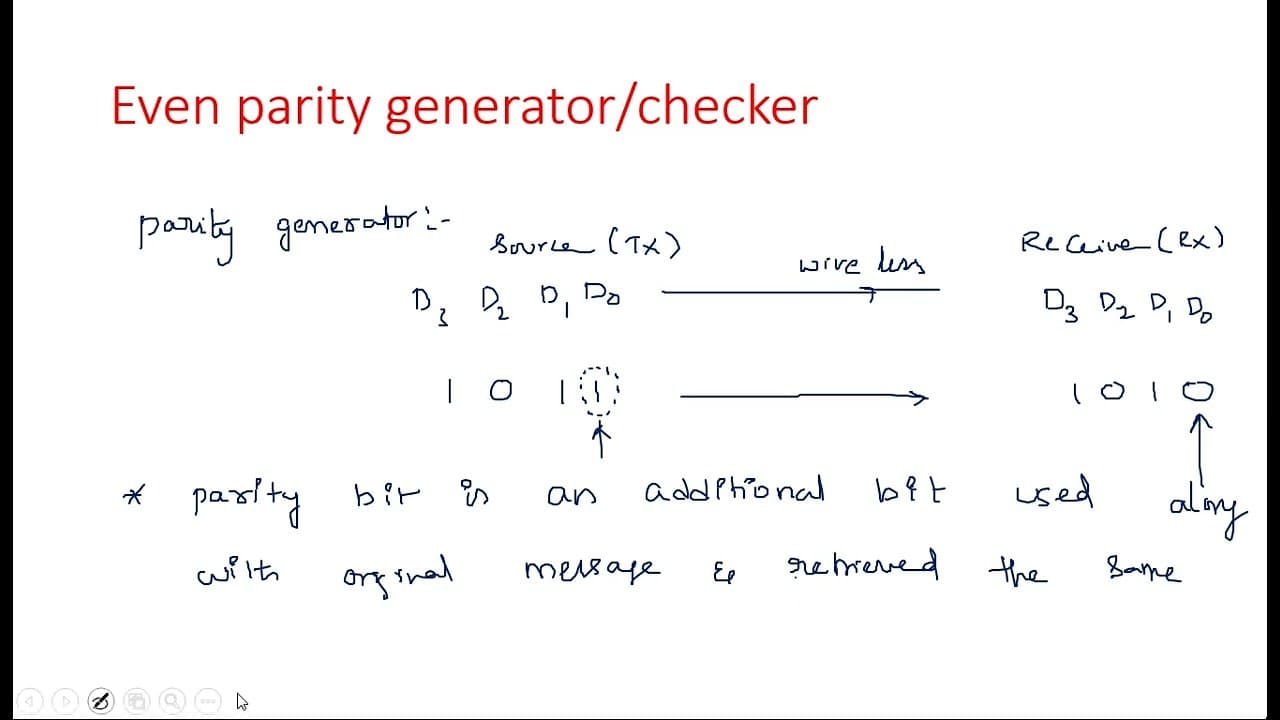
hi everyone in this video I'm going to explain about parity generator ler I'm going to tell you how to design even parity generator so before going to even parity Generator First Let Me Explain what do you mean by parity generator or Checker so parity generator parity generator the main purpose of pattery generator is to introduce a new bit into th... Read More
Key Insights
- ❓ A parity generator is vital for enhancing data integrity during transmission by enabling error detection.
- 🫦 An even parity generator specifically adjusts the parity bit to ensure an even count of '1's in the data stream.
- 🫦 Exclusive OR gates are integral to constructing even parity generators, simplifying parity bit calculations.
- 😉 The K-map and truth table methods provide systematic approaches to designing logical circuits based on binary data conditions.
- 👻 Error identification via parity bits allows for prompt corrections in digital communication systems, minimizing the impact of transmission errors.
- 🦕 Parity generators can be categorized into even and odd types, each serving distinct purposes based on the transmission requirements.
- 💨 Including a parity bit is a straightforward yet effective way to facilitate error checking without necessitating additional complex protocols.
Install to Summarize YouTube Videos and Get Transcripts
Explore YouTube Video Summarizer or Get YouTube Transcript Extractor
Questions & Answers
Q: What is the main purpose of a parity generator in digital communications?
The main purpose of a parity generator is to add an additional bit, the parity bit, to the data being transmitted. This parity bit allows the receiver to check if the data has been altered or corrupted during transmission. By ensuring that the total number of '1's is even (in the case of an even parity generator), the receiver can detect errors effectively.
Q: How does an even parity generator differ from an odd parity generator?
An even parity generator ensures that the total count of '1's in the combined message and the parity bit remains even. In contrast, an odd parity generator aims for an odd count of '1's. The choice between the two depends on the specific error detection requirements of the communication system being utilized.
Q: Why is it important to identify errors during data transmission?
Identifying errors during data transmission is critical because it ensures the integrity and reliability of the data. Without effective error detection, erroneous data can lead to incorrect information being processed, resulting in potential system failures or incorrect outputs in various applications like communications, computing, and control systems.
Q: Can you explain how a parity bit is calculated for a given data set?
Calculating a parity bit involves counting the number of '1's in the data. For an even parity system, if the count of '1's is odd, the parity bit is set to '1' to make the total count even. If the count is already even, the parity bit is '0'. This calculated parity bit is appended to the original data for transmission.
Q: What tools are used to design the parity generator circuit?
The design of a parity generator circuit primarily uses exclusive OR (XOR) gates for even parity generators. The proposed circuit refers to binary logic principles, employing truth tables and Karnaugh Maps (K-maps) to simplify and derive the necessary logical expressions for circuit implementation.
Q: How is the truth table utilized in developing a parity generator?
The truth table for a parity generator outlines all possible input combinations of the data bits and the corresponding required parity bit. By examining the input combinations, the truth table helps in determining the conditions that dictate whether the parity bit should be '0' or '1', thereby aiding in the design of the overall circuit logic.
Summary & Key Takeaways
-
The video begins by defining what a parity generator is, explaining its role in adding a parity bit to data to enable error detection during transmission. This bit can help identify and correct transmission errors that might occur.
-
The presenter details the functioning of even and odd parity generators. An even parity generator ensures the total number of '1's in the message, including the parity bit, is even, facilitating error detection.
-
The video also includes a practical demonstration of deriving a truth table and a Karnaugh Map (K-map) for a 4-bit even parity generator. The presenter explains how to design the circuit using exclusive gates, particularly emphasizing the XOR gate for generating the parity bit.
Read in Other Languages (beta)
Share This Summary 📚
Summarize YouTube Videos and Get Video Transcripts with 1-Click
Try YouTube Summary with ChatGPT & Claude or YouTube Transcript Generator