What Is Phyllotaxis and How to Create It with Code?
TL;DR
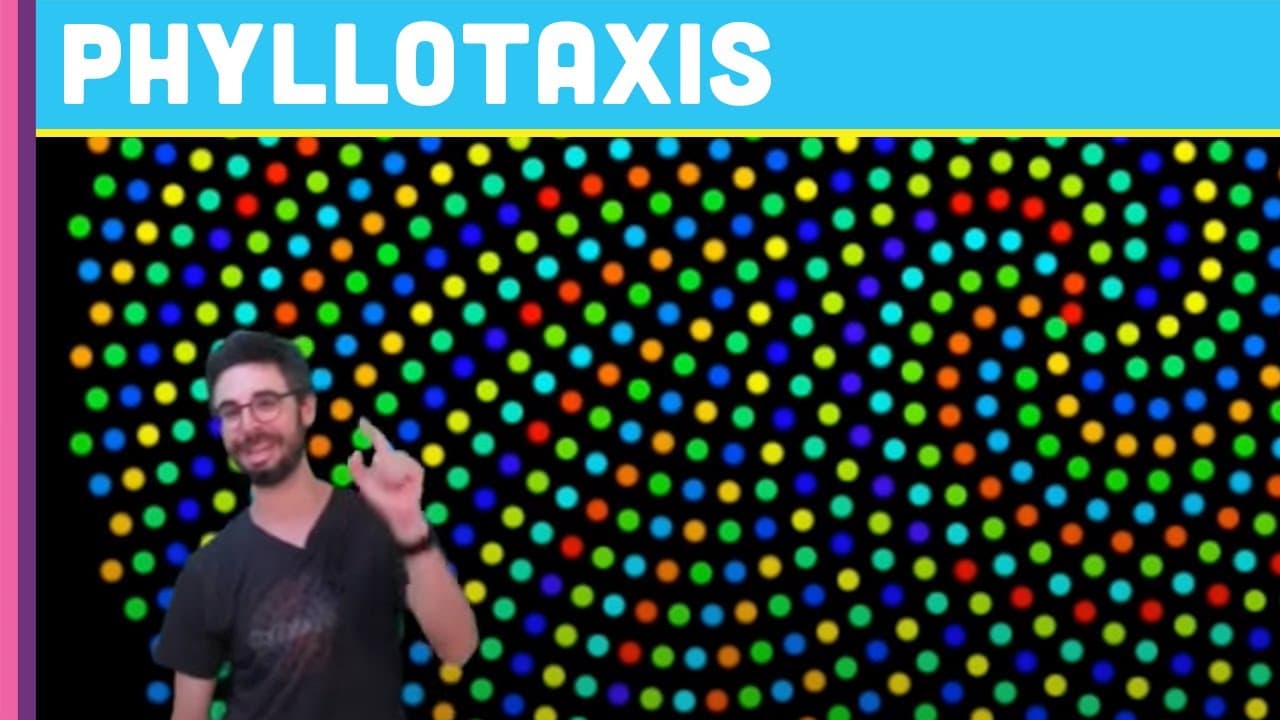
Phyllotaxis is a spiral pattern in nature, closely related to the Fibonacci sequence and the golden ratio. It can be created using code by converting polar coordinates into Cartesian coordinates, allowing for dynamic and colorful visual representations. Experimenting with scaling factors and angles can produce diverse and visually appealing arrangements.
Transcript
hello and welcome to another coding challenge in this coding challenge I am going to continue a series that I've been doing about algorithmic botany one of my favorite topics I'm here to tell you that if you like sunflowers and likes of flowers then this is the video for you to watch because what I want to talk about is a topic called Philo Texas a... Read More
Key Insights
- 😵💫 Phyllotaxis exhibits a spiral pattern found in sunflowers and various plants, linked to mathematical sequences.
- 🐻❄️ The conversion of polar to Cartesian coordinates is crucial for plotting phyllotaxis patterns accurately.
- 👨💻 Code can be used to create dynamic phyllotaxis patterns with changing colors, sizes, and angles.
- 🌻 Experimentation with phyllotaxis patterns, such as creating sunflower-like designs, offers creative opportunities.
- 👨💻 Understanding mathematical concepts like phyllotaxis enhances coding skills in areas like graphics and visualization.
- 🥰 Phyllotaxis involves geometric principles and can be a fun way to explore math through art.
- 🥺 Exploring different scaling factors and angles in phyllotaxis can lead to diverse and visually appealing patterns.
Install to Summarize YouTube Videos and Get Transcripts
Explore YouTube Video Summarizer or Get YouTube Transcript Extractor
Questions & Answers
Q: What is phyllotaxis and how is it related to the Fibonacci sequence?
Phyllotaxis is a spiral pattern seen in nature, often connected to the Fibonacci sequence, where each number is the sum of the two preceding ones.
Q: How is phyllotaxis math applied to create patterns?
By converting polar coordinates (radius and angle) to Cartesian coordinates (x and y), one can plot points in a spiral pattern following specific mathematical formulas.
Q: What role does the angle play in phyllotaxis patterns?
The angle determines the direction of growth in the spiral pattern, calculated based on a specific angle formula, usually involving degrees.
Q: How can colors and sizes be incorporated into phyllotaxis patterns?
By using code and color modes, one can assign different hues to points based on angles or numbers, and vary circle sizes based on position in the pattern.
Summary & Key Takeaways
-
Phyllotaxis is a spiral pattern in nature based on the Fibonacci sequence and golden ratio.
-
Understanding phyllotaxis involves converting polar coordinates to Cartesian coordinates.
-
Using code, one can create phyllotaxis patterns with changing colors and sizes.
Read in Other Languages (beta)
Share This Summary 📚
Summarize YouTube Videos and Get Video Transcripts with 1-Click
Try YouTube Summary with ChatGPT & Claude or YouTube Transcript Generator
Explore More Summaries from The Coding Train 📚





Summarize YouTube Videos and Get Video Transcripts with 1-Click
Try YouTube Summary with ChatGPT & Claude or YouTube Transcript Generator