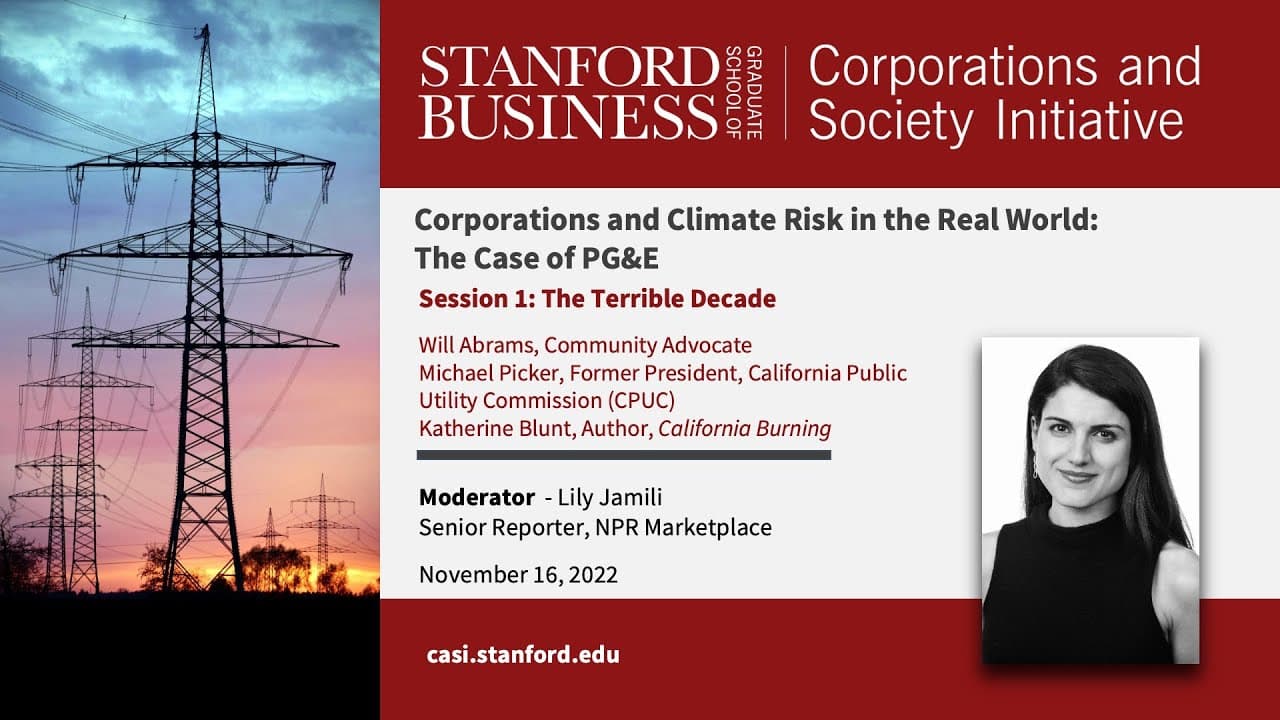
Corporations & Climate Risk: The Case of PG&E — Panel 1: The Terrible Decade
TL;DR
The discussion focuses on how corporate governance, regulations, and ownership models affect the accountability and responsibility of PG&E for the wildfires in California. The panel explores the history of the company, the challenges faced by regulatory bodies like the CPUC, and the need for aligning incentives and strategies to address climate change and wildfire risk.
Transcript
[MUSIC] The simple question I really want us to get at today is how did we get here? Why I'm so thrilled that we're sitting here at the business school as an MBA is because it matters that we think about the role that corporations play in society. And what responsibility do they have to us, whether we are ratepayers or residents of a community that... Read More
Key Insights
- ⌛ Systemic breakdown within PG&E resulted from incremental decisions over time and the shift from an engineering-focused culture to a profit-driven one.
- 😀 The challenges faced by regulatory bodies like the CPUC to effectively regulate PG&E and balance investor interests and public safety.
- 🙃 AB 1054's passage aimed to stabilize the financial health of California's investor-owned utilities, but there are concerns about accountability and the burden of proof on intervenors.
- ❓ Municipalization can offer an alternative ownership model, but operational challenges and resource constraints must be considered.
Install to Summarize YouTube Videos and Get Transcripts
Explore YouTube Video Summarizer or Get YouTube Transcript Extractor
Questions & Answers
Q: Can a public utility be investor-owned while serving stakeholder needs adequately? Can the SMUD model be a solution?
While public utilities can align the needs of stakeholders, investor-owned utilities like PG&E must balance investor expectations and public safety. Municipalization, like SMUD, could be a potential solution, but governance and financial challenges need to be considered.
Q: How can we redesign our systems to meet climate change demands when infrastructure, financial institutions, and thinking are outdated?
Reimagining our systems requires alignment of goals, strategies, and incentives across various sectors. Corporate governance, regulations, and diverse representation on corporate boards are vital to address climate change and sustainability effectively.
Summary & Key Takeaways
-
The panel discusses the history of PG&E and its role in the California wildfires, highlighting the challenges of corporate governance, regulations, and accountability.
-
They emphasize the need for a comprehensive understanding of the 100-year history of PG&E, the past 20 years of challenges, and the impact of climate change on infrastructure failure.
-
The discussion sheds light on the role of the CPUC and its limitations in regulating PG&E, including the balance between investor interests and public safety.
-
The passage of AB 1054, a legislation that establishes a wildfire fund for California's investor-owned utilities, is examined as a key factor in the bankruptcy proceedings and the accountability of PG&E.
Read in Other Languages (beta)
Share This Summary 📚
Summarize YouTube Videos and Get Video Transcripts with 1-Click
Try YouTube Summary with ChatGPT & Claude or YouTube Transcript Generator
Explore More Summaries from Stanford Graduate School of Business 📚




Summarize YouTube Videos and Get Video Transcripts with 1-Click
Try YouTube Summary with ChatGPT & Claude or YouTube Transcript Generator