How evolutionary computation works | Risto Miikkulainen and Lex Fridman
TL;DR
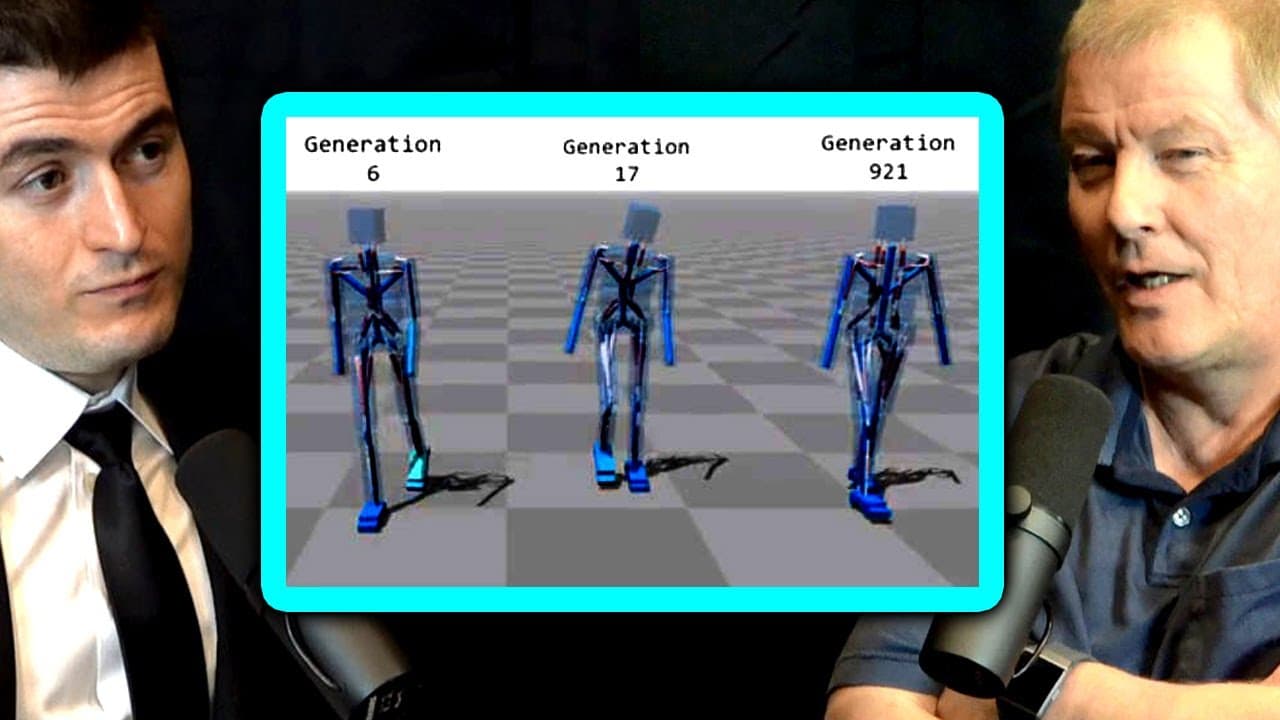
Evolutionary computation algorithms create variation and use selection to improve performance, taking inspiration from biology.
Transcript
can you at a high level say what are the basic uh mechanisms of evolutionary computation algorithms that use something that could be called an evolutionary approach like how does it work uh what are the connections to the it's what are the echoes of the connection to is biological a lot of these algorithms really do take motivation from biology but... Read More
Key Insights
- ❓ Evolutionary computation algorithms emphasize the creation of variation and selection for improvement.
- 🌲 Digital representations are used in evolutionary computation, varying from strings of numbers to tree structures.
- 🚱 Biological evolution includes non-essential elements and processes, which are not yet fully understood or captured in evolutionary computation.
- ❓ Major transitions in biology, such as the shift to multicellular organisms, have not been replicated in evolutionary computation.
- 🌥️ Evolutionary computation algorithms can benefit from incorporating weaker selection, more crossover, larger populations, and increased patience.
- 🥺 Biological evolution allows for multiple ways of being successful, leading to creativity and exploration.
- ❓ The encoding and decoding of individuals in evolutionary computation is an ongoing challenge.
Install to Summarize YouTube Videos and Get Transcripts
Explore YouTube Video Summarizer or Get YouTube Transcript Extractor
Questions & Answers
Q: What are the basic mechanisms of evolutionary computation algorithms?
Evolutionary computation algorithms create variation by generating new individuals and use selection to choose the ones that perform well. This process is motivated by biology but simplified to focus on essential elements.
Q: How are individuals encoded in evolutionary computation algorithms?
Individuals are encoded using a genotype, which represents the genetic information, and a decoding mechanism that generates the phenotype, the actual individual. Common encodings in computer programs are strings of numbers or tree structures.
Q: What is the difference between biological evolution and evolutionary computation in terms of representation?
While biological evolution considers various aspects of DNA, such as folding and interactions, evolutionary computation typically focuses on simplified representations using strings or trees. Evolutionary computation is limited in capturing the complexity of biological processes.
Q: Are major transitions in biology captured in evolutionary computation?
No, major transitions like the shift from single-cell to multicellular organisms and eventually societies have not been fully captured in evolutionary computation. Representations would need to expand dramatically to include such transitions.
Q: How does selection and mutation play a role in evolutionary computation?
Selection in evolutionary computation involves evaluating individuals based on performance, while mutation introduces random changes in the representation. Recent advancements in evolutionary computation have incorporated statistical methods to guide mutations based on performance correlations.
Summary & Key Takeaways
-
Evolutionary computation algorithms use a creative process of creating new individuals and selecting the best ones.
-
These algorithms rely on digital representations of individuals that can be modified and evaluated.
-
The encoding of individuals is typically done using strings of numbers or tree structures.
Read in Other Languages (beta)
Share This Summary 📚
Summarize YouTube Videos and Get Video Transcripts with 1-Click
Try YouTube Summary with ChatGPT & Claude or YouTube Transcript Generator
Explore More Summaries from Lex Clips 📚



Summarize YouTube Videos and Get Video Transcripts with 1-Click
Try YouTube Summary with ChatGPT & Claude or YouTube Transcript Generator