What Is Fermat's Last Theorem and Its Proof Journey?
TL;DR
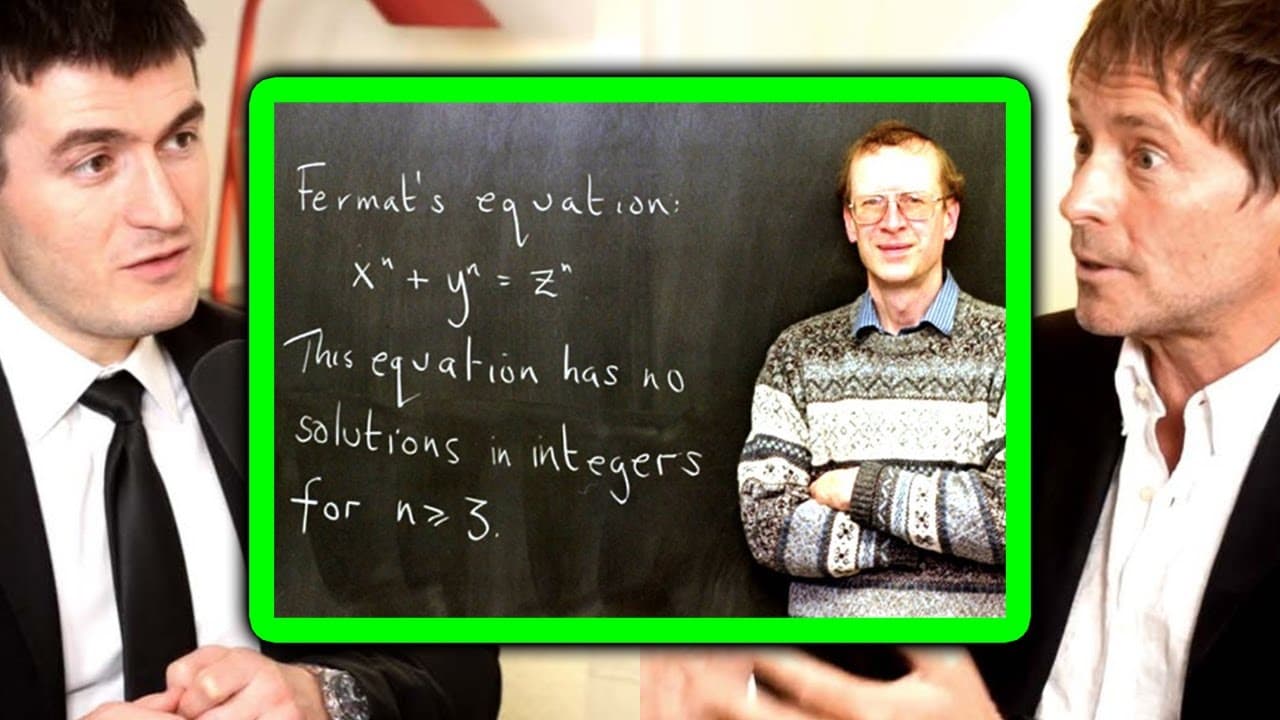
Fermat's Last Theorem asserts that no whole numbers can satisfy equations involving cubes, fourth powers, and higher degrees, a mystery unsolved for 350 years. Andrew Wiles claimed a proof in 1993 but encountered a gap, which he later closed with Richard Taylor's help, culminating in a successful publication in 1995.
Transcript
would it be useful to maybe try to explain from Oz Last Theorem sure it's easy to do [Laughter] I'm an optimist I think I always think that everything can be explained you know even though I say that not everything can be explained but in in mathematics you know in within this particular framework I think that I always feel optimistic when people a... Read More
Key Insights
- ✋ Fermat's Last Theorem posed a question about whole number solutions for equations involving higher powers, and it remained unproved for 350 years.
- 📢 Andrew Wiles announced a proof for Fermat's Last Theorem in 1993 but later discovered a gap in the proof, highlighting the complexity of mathematical proofs.
- 😚 The collaboration between Wiles and Richard Taylor was instrumental in closing the gap and finally proving Fermat's Last Theorem in 1995.
- 👍 The journey to proving Fermat's Last Theorem showcases the drama, excitement, and dedication involved in mathematical research.
- ❓ Mathematicians often approach problems with optimism, believing that everything can be explained or solved within their respective frameworks.
- ❓ The process of developing a proof can involve solitude, perseverance, and the excitement of discovering a solution that no one else has.
- 🥺 Mathematics relies on building connections between different problems and statements, leading to complex and deep connections within the subject.
Install to Summarize YouTube Videos and Get Transcripts
Explore YouTube Video Summarizer or Get YouTube Transcript Extractor
Questions & Answers
Q: What is Fermat's Last Theorem?
Fermat's Last Theorem states that there are no whole number solutions for equations involving powers greater than two, such as cubes, fourth powers, and so on.
Q: Who announced the proof for Fermat's Last Theorem in 1993?
Andrew Wiles, a mathematician from Princeton University, announced a proof for Fermat's Last Theorem in 1993.
Q: What happened after Andrew Wiles announced the proof?
A gap was discovered in Wiles' proof a year later, which invalidated the entire proof.
Q: How was the gap in the proof of Fermat's Last Theorem closed?
Andrew Wiles and his former student Richard Taylor worked together to close the gap and successfully published the proof in 1995.
Q: How long did it take to prove Fermat's Last Theorem?
It took approximately 350 years from the initial proposal of Fermat's Last Theorem in the 17th century to the publication of the proof by Andrew Wiles and Richard Taylor in 1995.
Summary & Key Takeaways
-
Fermat's Last Theorem, initially proposed by Pierre de Fermat in the 17th century, poses the question of whether there are whole number solutions to equations involving cubes, fourth powers, and higher powers.
-
Andrew Wiles, a mathematician from Princeton University, announced a proof for Fermat's Last Theorem in 1993 but later discovered a gap in the proof.
-
Wiles and his former student Richard Taylor worked together to close the gap and successfully published the proof of Fermat's Last Theorem in 1995.
Read in Other Languages (beta)
Share This Summary 📚
Summarize YouTube Videos and Get Video Transcripts with 1-Click
Try YouTube Summary with ChatGPT & Claude or YouTube Transcript Generator
Explore More Summaries from Lex Clips 📚

Summarize YouTube Videos and Get Video Transcripts with 1-Click
Try YouTube Summary with ChatGPT & Claude or YouTube Transcript Generator