S09.1 Buffon's Needle & Monte Carlo Simulation
TL;DR
Buffon's Needle Problem is used as an example to demonstrate the concept of geometric probability, where the probability of a needle crossing lines on an infinite plane is calculated.
Transcript
PROFESSOR: In this segment, we will look at the famous example, which was posed by Comte de Buffon-- a French naturalist-- back in the 18th century. And it marks the beginning of a subject that is known as the subject of geometric probability. The problem is pretty simple. We have the infinite plane, and we draw lines that are parallel to each othe... Read More
Key Insights
- ❓ Buffon's Needle Problem is used as an example to demonstrate the calculation of probabilities in geometric situations.
- ☺️ Random variables, such as x and theta, are used to model the experiment and describe the outcome.
- 🥋 The assumptions made in the probability model, including uniform distributions, help simplify the calculations.
Install to Summarize YouTube Videos and Get Transcripts
Explore YouTube Video Summarizer or Get YouTube Transcript Extractor
Questions & Answers
Q: How is Buffon's Needle Problem related to geometric probability?
Buffon's Needle Problem serves as an example to illustrate the concept of geometric probability, where the probability of an event involving geometric shapes is calculated.
Q: How are the random variables x and theta defined in the needle problem?
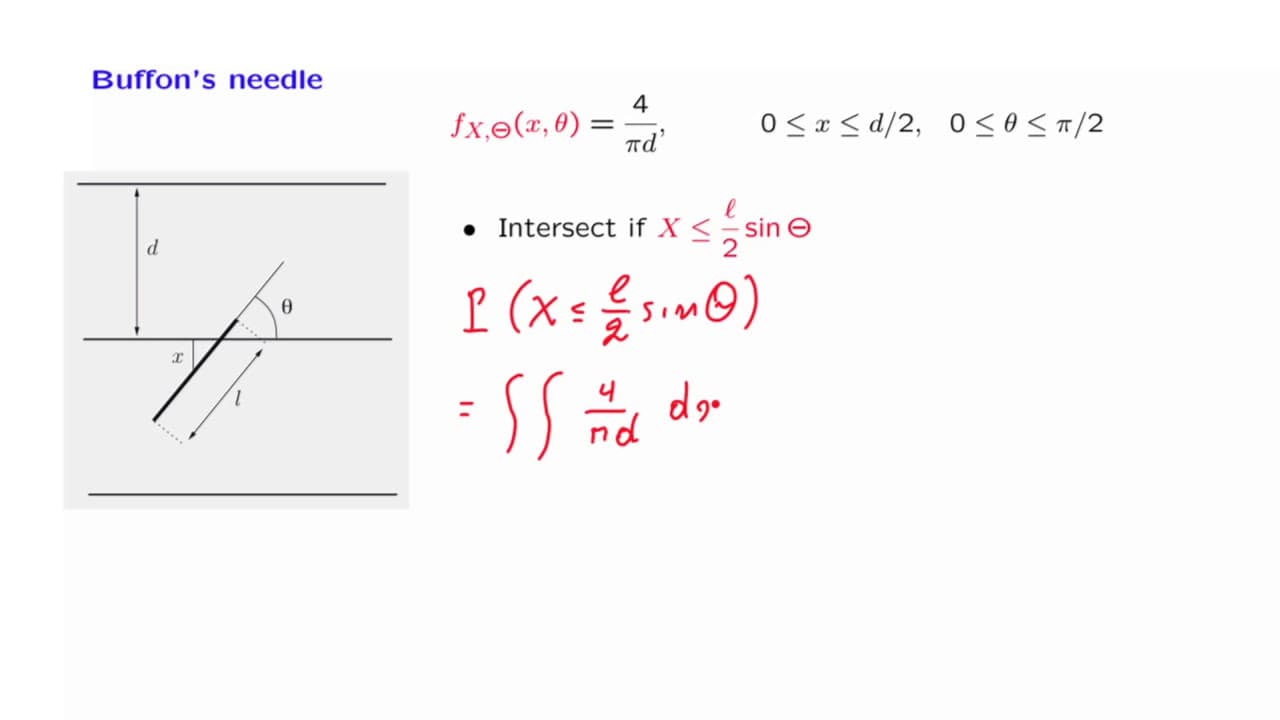
The random variable x represents the distance between the needle and the nearest line, ranging from 0 to d/2. Theta represents the acute angle that the needle's direction makes with the lines, ranging from 0 to pi/2.
Q: What assumptions are made in the probability model for the needle problem?
The assumptions made include the uniform distribution of x and theta, indicating that all values are equally likely. Additionally, the independence of x and theta is assumed, leading to their joint probability distribution.
Q: How is the probability of the needle intersecting a line calculated?
The probability is calculated by integrating the joint probability distribution over the range of x and theta pairs where the condition x ≤ l/2 sin(theta) is satisfied.
Summary & Key Takeaways
-
Buffon's Needle Problem involves throwing a needle of length "l" onto an infinite plane with parallel lines spaced apart by "d" units.
-
The probability of the needle intersecting one of the lines is determined by the vertical distance "x" between the nearest line and the needle's center.
-
To model the experiment mathematically, two random variables, x and theta, are defined to describe the distance and angle of the needle.
-
The joint probability distribution is obtained by assuming independence between x and theta.
Read in Other Languages (beta)
Share This Summary 📚
Summarize YouTube Videos and Get Video Transcripts with 1-Click
Try YouTube Summary with ChatGPT & Claude or YouTube Transcript Generator
Explore More Summaries from MIT OpenCourseWare 📚



Summarize YouTube Videos and Get Video Transcripts with 1-Click
Try YouTube Summary with ChatGPT & Claude or YouTube Transcript Generator