Why's a Meter a Meter?
TL;DR
The meter, the official unit of length, has evolved from arbitrary measurements like the forearm length to being defined by wavelengths of light emitted by krypton-86.
Transcript
A meter is about… about this long. It is the official unit of length in the International System of Units, the standard used by scientists and most countries around the world. The meter might seem kind of arbitrary, and of course it is, but its definition was carefully chosen and made more precise over the past few centuries. For a long time, count... Read More
Key Insights
- 🙂 The meter was initially defined as a fraction of the Earth's circumference, but it was later redefined based on more precise measurements using light.
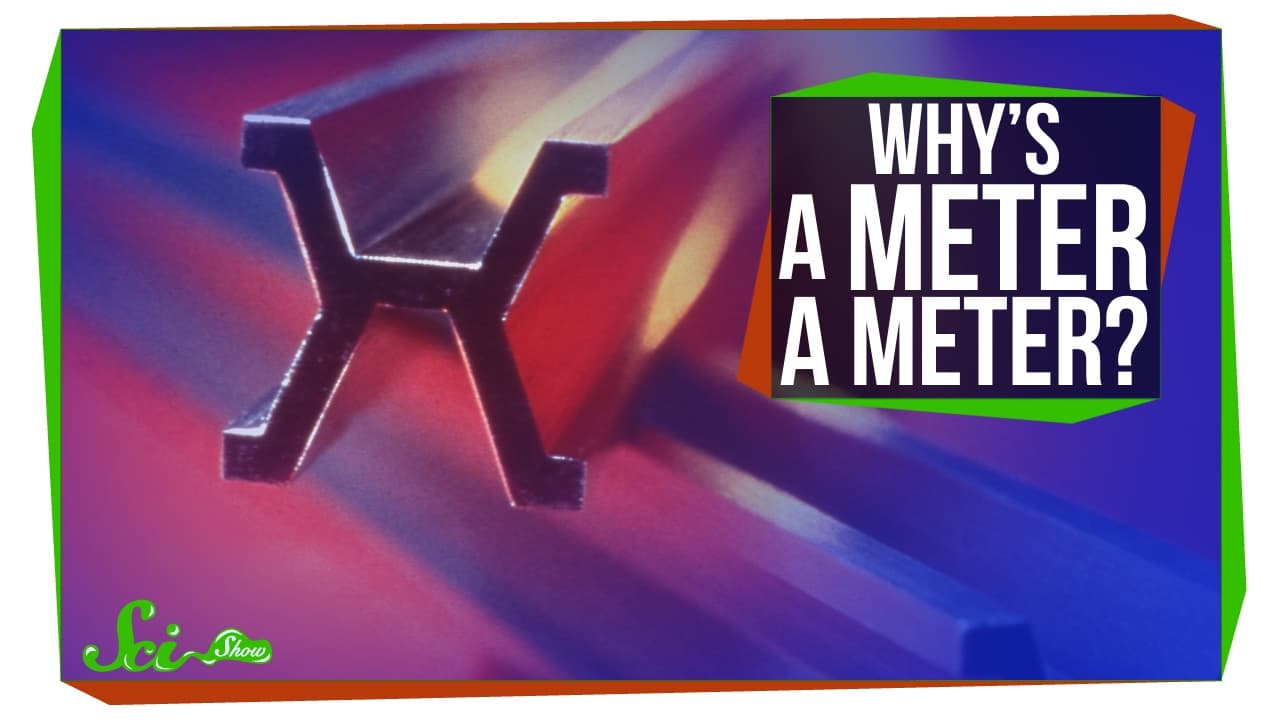
- 🤒 The Meter of the Archives, made of platinum, was the first official meter.
- 🙂 The wavelength of light emitted by krypton-86 was chosen as the basis for the redefinition of the meter in 1960.
- 🙂 The meter was further redefined in 1983 based on the speed of light in a vacuum, which is considered one of the most fundamental quantities in the universe.
Install to Summarize YouTube Videos and Get Transcripts
Explore YouTube Video Summarizer or Get YouTube Transcript Extractor
Questions & Answers
Q: How did the French Academy of Sciences decide to define the meter?
The French Academy of Sciences decided to define the meter as a fraction of the Earth's circumference, specifically the distance from the Equator to the North Pole passing through Paris, divided by 10 million.
Q: Why was the Meter of the Archives made of platinum?
The Meter of the Archives was made of platinum because it is resistant to corrosion and does not change composition over time like iron would.
Q: Why was the meter redefined using krypton-86?
Scientists wanted a more universal and fundamental definition of the meter, so they chose the wavelength of light emitted by krypton-86, which has minimal variation.
Q: What is the current definition of the meter?
The current definition of the meter is based on the speed of light in a vacuum, specifically the distance that light travels in 1/299,792,458 of a second.
Summary & Key Takeaways
-
The meter was standardized in the 18th century by the French Academy of Sciences as a fraction of the Earth's circumference.
-
The first official meter, the Meter of the Archives, was made of platinum and established in 1799.
-
In 1960, the meter was redefined using the wavelength of light emitted by krypton-86, and in 1983 it was redefined again based on the speed of light in a vacuum.
Read in Other Languages (beta)
Share This Summary 📚
Summarize YouTube Videos and Get Video Transcripts with 1-Click
Try YouTube Summary with ChatGPT & Claude or YouTube Transcript Generator
Explore More Summaries from SciShow 📚


Summarize YouTube Videos and Get Video Transcripts with 1-Click
Try YouTube Summary with ChatGPT & Claude or YouTube Transcript Generator