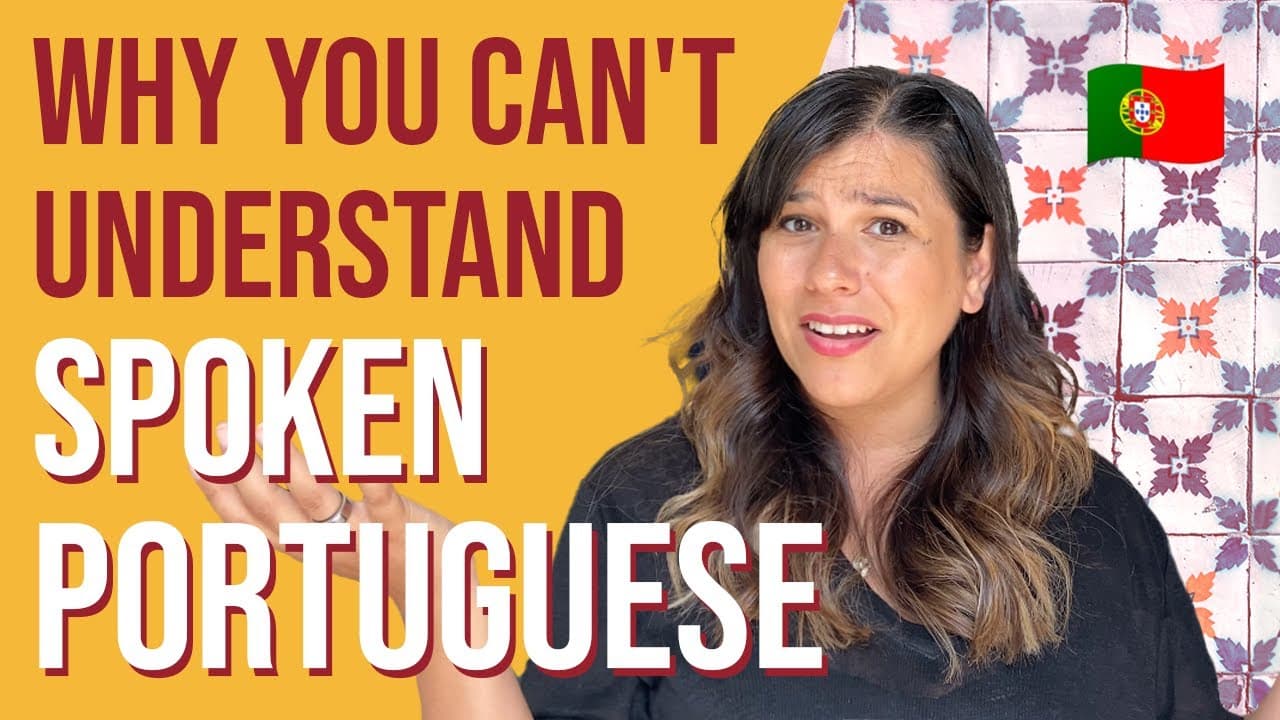
European Portuguese - Why You Can’t Understand Spoken Portuguese!
TL;DR
Learn why understanding spoken Portuguese is challenging and how to improve.
Transcript
does spoken Portuguese still sound like a blur to you? even if you've been working on your Portuguese for a while it's very common to still struggle with listening comprehension maybe you've memorized a few phrases but as soon as something comes back to you you're lost and that's where two-way conversations go to die I know this can be super fr... Read More
Key Insights
- Portuguese is a stress-timed language, unlike syllable-timed languages like Spanish, which affects how words are pronounced and perceived.
- Expecting spoken Portuguese to sound like its written form leads to misunderstandings due to omitted vowels and syllables.
- Stephen Krashen's theory suggests learners need comprehensible input slightly above their current level for effective learning.
- Active listening, involving focused attention on short audio clips, is more effective than extensive listening for language comprehension.
- Understanding frequent words in Portuguese can significantly improve comprehension, covering 50-75% of everyday conversations.
- Finding appropriate audio input in European Portuguese is challenging, but practical dialogues in real-life situations can help.
- Active listening involves repeatedly listening to short clips, identifying keywords, and comparing with transcripts for deeper understanding.
- Resources like flashcards of frequent words and free lessons can aid beginners in overcoming comprehension barriers in Portuguese.
Install to Summarize YouTube Videos and Get Transcripts
Explore YouTube Video Summarizer or Get YouTube Transcript Extractor
Questions & Answers
Q: Why is spoken Portuguese difficult to understand for learners?
Spoken Portuguese is challenging for learners because it is a stress-timed language, meaning not all syllables are stressed equally, leading to a different rhythm and pronunciation compared to its written form. Learners often expect to hear exactly what they read, causing confusion when vowels and syllables are omitted in speech.
Q: What is the difference between stress-timed and syllable-timed languages?
Stress-timed languages, like Portuguese, have variable intervals between stressed syllables, leading to the omission or reduction of some syllables. In contrast, syllable-timed languages, like Spanish, stress each syllable evenly, making them easier to follow for learners familiar with written forms.
Q: How does Stephen Krashen's theory apply to learning Portuguese?
Stephen Krashen's theory of second language acquisition suggests that learners progress when they receive input slightly above their current level of competence. For Portuguese learners, this means engaging with audio content where they understand about 60% of the material, allowing the remaining 40% to stretch their abilities and facilitate learning.
Q: What is the role of active listening in language learning?
Active listening involves focused attention on short audio clips, aiming to understand as much as possible. Unlike extensive listening, which involves passive absorption of audio, active listening requires repeated engagement with the material, identifying keywords, and comparing with transcripts to enhance comprehension and retention.
Q: How can learners find suitable audio input for Portuguese practice?
Finding suitable audio input in European Portuguese can be challenging. Learners are advised to engage with practical dialogues in real-life situations, such as interactions at a supermarket or café. These scenarios provide comprehensible input that stretches the learner's understanding without overwhelming them.
Q: Why is learning frequent words important in language acquisition?
Learning frequent words is crucial because it enables learners to understand a significant portion of everyday conversations. With just a few hundred frequent words, learners can comprehend 50-75% of spoken interactions, making it an efficient strategy to improve language skills and build confidence.
Q: What resources are available to aid in learning spoken Portuguese?
The video provides several resources to aid learners, including flashcards of the 100 most frequent Portuguese words and free lessons designed to improve pronunciation and comprehension. These resources offer practical tools for beginners to enhance their understanding of spoken Portuguese effectively.
Q: What common mistakes do learners make when trying to understand Portuguese?
Common mistakes include expecting spoken Portuguese to match its written form, using audio input that is too advanced, relying solely on extensive listening, and not focusing on frequent words. These errors hinder comprehension and progress, but can be addressed with targeted strategies and resources.
Summary & Key Takeaways
-
The video highlights common challenges faced by learners of European Portuguese, focusing on the difference between written and spoken language. It emphasizes the importance of understanding stress-timed language patterns and adjusting expectations.
-
Active listening, as opposed to extensive listening, is recommended for improving comprehension. This involves engaging with short audio clips and using transcripts to identify keywords and understand context.
-
The video also discusses the significance of learning frequent words to improve comprehension and provides resources like flashcards and free lessons to aid learners in their journey to understand spoken Portuguese.
Read in Other Languages (beta)
Share This Summary 📚
Summarize YouTube Videos and Get Video Transcripts with 1-Click
Try YouTube Summary with ChatGPT & Claude or YouTube Transcript Generator
Explore More Summaries from Talk the Streets 📚


![Practice Portuguese with Mixologist Fábio Guerreiro! [English & Portuguese Subtitles] thumbnail](/_next/image?url=https%3A%2F%2Fi.ytimg.com%2Fvi%2F1-T2PNWuiWY%2Fhqdefault.jpg&w=750&q=75)


Summarize YouTube Videos and Get Video Transcripts with 1-Click
Try YouTube Summary with ChatGPT & Claude or YouTube Transcript Generator