E Plane T - junction | Construction & Working | Microwave Engineering | Lec-62
TL;DR
An explanation of the e-plane T Junction and its properties.
Transcript
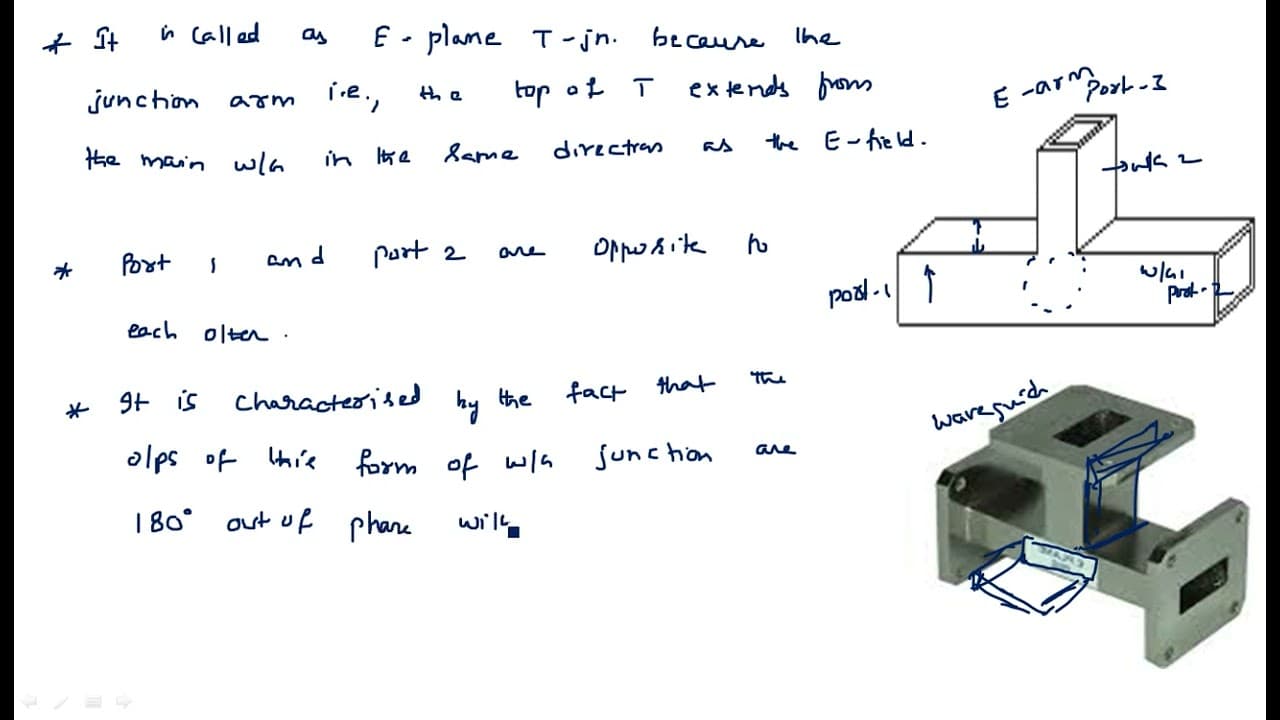
hi everyone in this video I am going to explain about e-plainty Junction this is the second type of tree Junctions in the microwaved T Junctions first we have seen H plate D Junction see this is the construction of e-plane D Junction which is also having three ports this is the port one and this is Port 2 and this is port 3. Port 1 and 4 2 are oppo... Read More
Key Insights
- 👻 The e-plane T Junction consists of multiple waveguides, which allows for efficient signal distribution and manipulation.
- 🥺 Ports 1 and 2 are in opposite phases, leading to unique signal processing properties not seen in other junction types.
- ✈️ Understanding the shape and cut of the waveguide is essential in distinguishing between e-plane and H-plane types.
- 🏑 The interaction and bending of electric fields at the junction are crucial to grasping how the junction processes signals.
- 👻 When different phases are fed into Ports 1 and 2, constructive interference occurs, allowing for signal enhancement at Port 3.
- 🦖 The output characteristics of the e-plane T Junction are vital for applications requiring precise phase control in microwave circuits.
- 🫥 Observing electric field lines can provide valuable insights into how signals behave when traversing the junction.
Install to Summarize YouTube Videos and Get Transcripts
Explore YouTube Video Summarizer or Get YouTube Transcript Extractor
Questions & Answers
Q: What is the primary function of the e-plane T Junction?
The e-plane T Junction serves as a critical component in microwave engineering, enabling the combination or splitting of microwave signals across its three ports. It allows for efficient signal handling while ensuring that the output signals maintain specific phase relationships, which is essential for applications requiring precise signal manipulation.
Q: How does the orientation of the e-arm affect signal propagation?
The e-arm's orientation, aligned with the electric field direction, influences how the signals are processed. When signals enter from Ports 1 and 2, they interact with the e-arm, which causes bending and distortion of the electric field lines. This interaction results in output signals that are 180 degrees out of phase, a crucial aspect for maintaining signal integrity.
Q: What happens when both input ports have the same phase?
If Ports 1 and 2 are supplied with input signals of the same phase, the output from Port 3 will be zero, as the signals will cancel each other out due to being out of phase. This property emphasizes the importance of phase alignment when dealing with input signals in systems that utilize the e-plane T Junction.
Q: Can the e-plane T Junction be identified visually in a lab setting?
Yes, the e-plane T Junction can be visually identified by examining its structure. The junction has a distinctive cut along the broader side of the waveguide, distinguishing it from the H-plane T Junction, which exhibits a cut along the narrow dimension. Observing these characteristics helps in correctly identifying the type of junction in practical applications.
Summary & Key Takeaways
-
The e-plane T Junction is a structure with three ports, created by combining two waveguides, with the third port oriented along the electric field direction.
-
Ports 1 and 2 are out of phase, producing a 180-degree phase difference in the output signal when compared to the input signals.
-
The electric field bends and distorts at the junction, demonstrating the conversion of input signals into out-of-phase outputs depending on their propagation directions.
Read in Other Languages (beta)
Share This Summary 📚
Summarize YouTube Videos and Get Video Transcripts with 1-Click
Try YouTube Summary with ChatGPT & Claude or YouTube Transcript Generator