How Does Game Theory Apply to Oligopolies in Pricing?
TL;DR
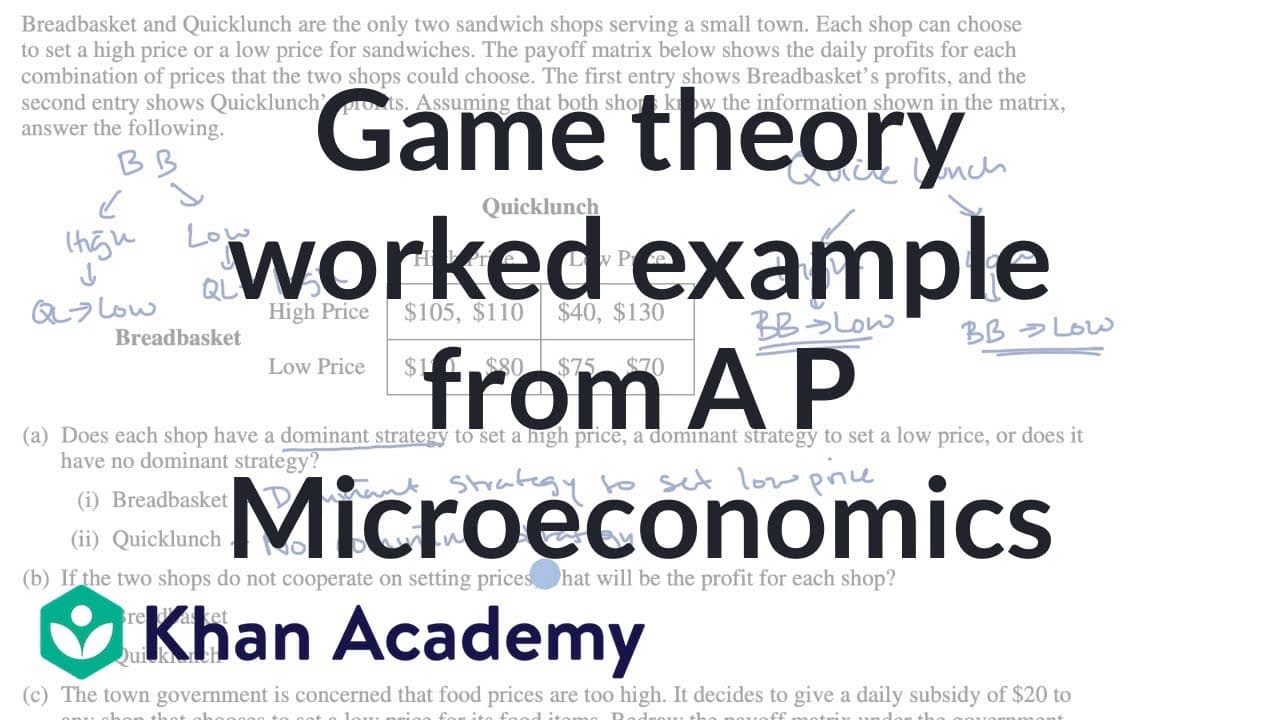
In an oligopoly with two sandwich shops, game theory demonstrates that Breadbasket has a dominant strategy to set low prices, while Quicklunch does not. When the government introduces a subsidy for low pricing, both shops will likely choose to lower their prices, resulting in changed profit margins — Breadbasket's profit decreases from $120 to $95.
Transcript
- [Instructor] What we have here is a free response question that you might see on an AP microeconomics type exam that deals with game theory, and it tells us Breadbasket and Quicklunch are the only two sandwich shops serving a small town. So, we're in an oligopoly situation where we only have a few firms. Each shop can choose to set a high price, ... Read More
Key Insights
- 👾 In an oligopoly situation, where there are only a few firms, game theory can be applied to analyze their strategic decisions.
- ❓ A dominant strategy is a strategy that a player would choose regardless of what the other player chooses.
- ❓ The introduction of a government subsidy can affect the profitability and strategic decisions of firms in an oligopoly.
Install to Summarize YouTube Videos and Get Transcripts
Explore YouTube Video Summarizer or Get YouTube Transcript Extractor
Questions & Answers
Q: What is a dominant strategy, and does each sandwich shop have one in this scenario?
A dominant strategy is a strategy that a player would choose regardless of the other player's choices. In this scenario, Breadbasket has a dominant strategy to set a low price, while Quicklunch does not have a dominant strategy.
Q: If the two shops do not cooperate on setting prices, what will be the profit for each shop?
If the two shops do not cooperate on setting prices, Breadbasket will make a profit of $120 per day, while Quicklunch will make a profit of $80 per day.
Q: How does the introduction of a daily subsidy of $20 for shops that set low prices affect the profitability of the sandwich shops?
After the introduction of the subsidy, both Breadbasket and Quicklunch have a dominant strategy to set a low price. As a result, Breadbasket's profit decreases from $120 to $95 per day.
Q: What is a Nash equilibrium in this context?
A Nash equilibrium is a situation where no firm can change its decision to optimize its prices further because the other firm's decision remains unchanged. In this scenario, the Nash equilibrium is when both shops set a low price, leading to Breadbasket making $95 per day and Quicklunch making $90 per day.
Summary & Key Takeaways
-
The video discusses a scenario where Breadbasket and Quicklunch are the only two sandwich shops in a small town and can choose to set high or low prices for sandwiches.
-
The payoff matrix shows the daily profits for each combination of prices that the two shops could choose.
-
After analyzing each shop's dominant strategy, it is determined that Breadbasket has a dominant strategy to set a low price, while Quicklunch has no dominant strategy.
Read in Other Languages (beta)
Share This Summary 📚
Summarize YouTube Videos and Get Video Transcripts with 1-Click
Try YouTube Summary with ChatGPT & Claude or YouTube Transcript Generator
Explore More Summaries from Khan Academy 📚





Summarize YouTube Videos and Get Video Transcripts with 1-Click
Try YouTube Summary with ChatGPT & Claude or YouTube Transcript Generator