L17.5 LLMS Example
TL;DR
This content explains the process of linear least mean squares estimation and provides an example to illustrate it.
Transcript
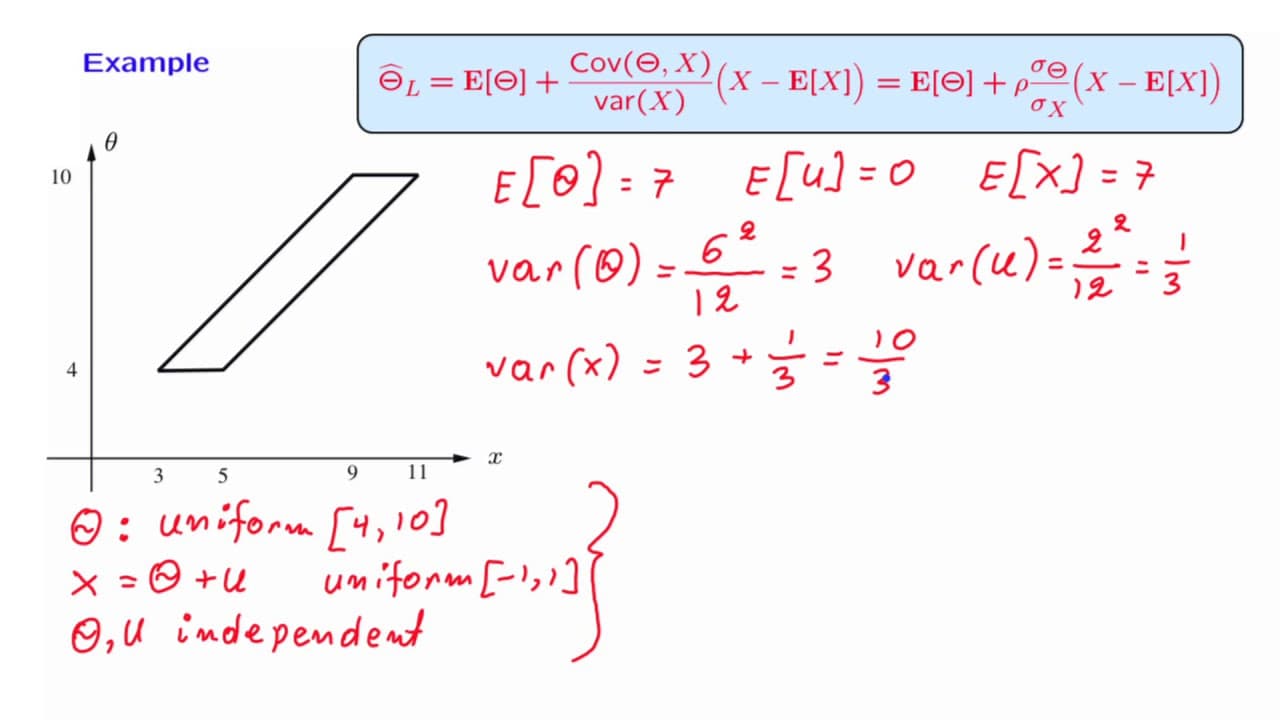
Let us now illustrate the linear least mean squares estimation methodology in the context of an example. And we're going to revisit our familiar example that we considered earlier in the context of general least mean squares estimation. Let us remind ourselves what were the assumptions behind this example. There is an unknown random variable that w... Read More
Key Insights
- ❎ Linear least mean squares estimation is a method to estimate unknown variables using linear functions.
- 🖐️ Expected values, variances, and covariances play a crucial role in determining the form of the linear estimator.
- 🎭 The linear estimator is an approximation of the optimal non-linear estimator and performs well within the constraint of linearity.
Install to Summarize YouTube Videos and Get Transcripts
Explore YouTube Video Summarizer or Get YouTube Transcript Extractor
Questions & Answers
Q: What is the purpose of linear least mean squares estimation?
The purpose of linear least mean squares estimation is to estimate an unknown variable using linear functions, considering the expected values, variances, and covariances of the variables involved.
Q: How are the means and variances calculated in the example?
In the example, the mean of Theta is calculated by taking the midpoint of its range (7), and the expected value of U is 0. The variances are calculated using the formulas applicable to uniform distributions.
Q: What does the form of the optimal linear estimator look like?
The optimal linear estimator, in the example, is a linear function of X and is represented by the equation: 9/10*(X - 7).
Q: How does the linear estimator compare to the optimal non-linear estimator?
The linear estimator is a close approximation of the optimal non-linear estimator. While it is limited by the constraint of being a linear function, it does a good job, especially considering the positive correlation between X and Theta.
Summary & Key Takeaways
-
Linear least mean squares estimation is demonstrated using a specific example.
-
The example involves estimating an unknown random variable that is uniform on the range from 4 to 10.
-
Observations are made of a random variable X, which is the sum of Theta (the unknown variable) and a noise term.
Read in Other Languages (beta)
Share This Summary 📚
Summarize YouTube Videos and Get Video Transcripts with 1-Click
Try YouTube Summary with ChatGPT & Claude or YouTube Transcript Generator
Explore More Summaries from MIT OpenCourseWare 📚


Summarize YouTube Videos and Get Video Transcripts with 1-Click
Try YouTube Summary with ChatGPT & Claude or YouTube Transcript Generator