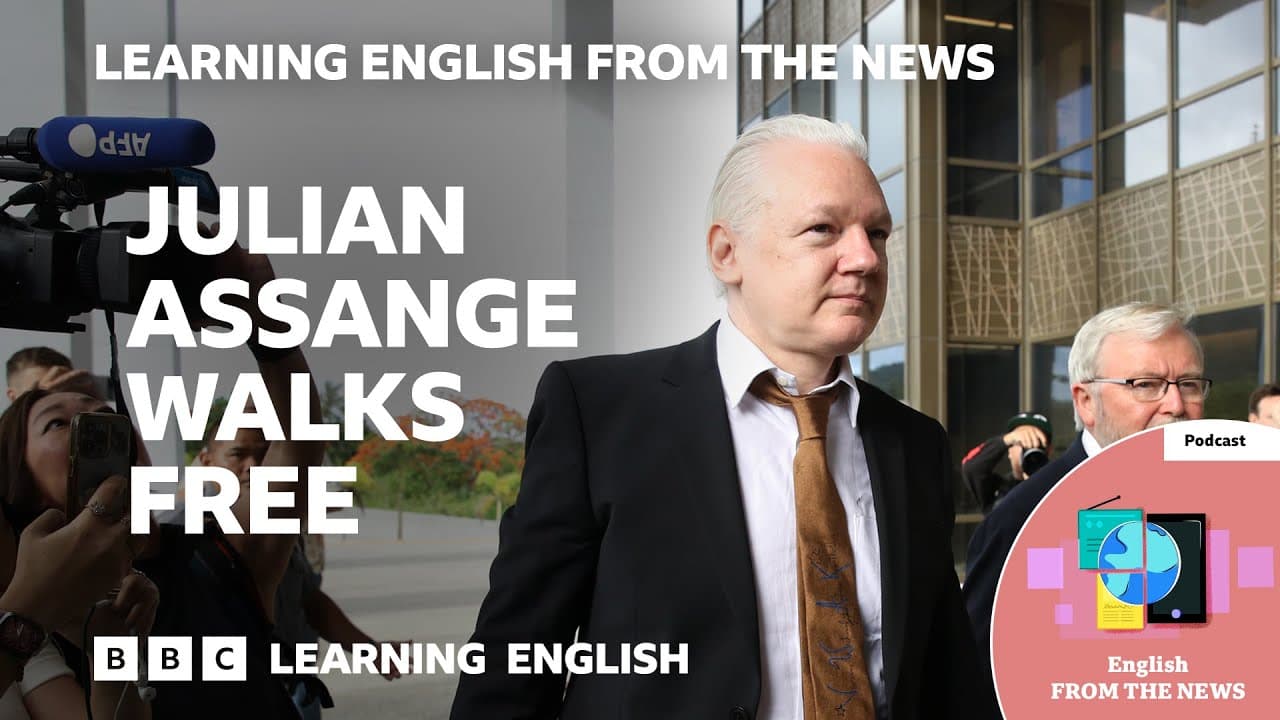
Julian Assange walks free: BBC Learning English from the News
TL;DR
Julian Assange released after US plea deal.
Transcript
From BBC Learning English, this is Learning English from the News, our podcast about the news headlines. In this programme – Wikileaks founder Julian Assange walks free. Hello. I'm Neil. And I'm Beth. In this programme, we look at one big news story and the vocabulary in the headlines that will help you understand it. You can find all the vocabular... Read More
Key Insights
- Julian Assange, founder of Wikileaks, has been released from a UK prison after striking a plea deal with the US, ending a lengthy legal battle.
- The plea deal involved Assange pleading guilty to a charge related to espionage, allowing him to avoid further imprisonment in the US.
- Wikileaks, founded by Assange, is known for publishing secret US military records in 2010, sparking global controversy and debate.
- The expression 'strike a deal' means to make an official arrangement, applicable in various contexts beyond legal matters.
- The term 'dump' in a digital context refers to the release of a large amount of data, such as Wikileaks' release of secret documents.
- Assange's legal journey has been marked by numerous twists and turns, including asylum in Ecuador's embassy and subsequent UK imprisonment.
- The story of Assange highlights the complex interplay between journalism, espionage, and international law.
- The phrase 'twists and turns' describes the unpredictable changes in Assange's legal saga, reflecting broader themes of uncertainty and intrigue.
Install to Summarize YouTube Videos and Get Transcripts
Explore YouTube Video Summarizer or Get YouTube Transcript Extractor
Questions & Answers
Q: What led to Julian Assange's release from prison?
Julian Assange was released from a UK prison after striking a plea deal with the US. This deal involved him pleading guilty to a charge related to espionage, which allowed him to avoid further imprisonment in the US and return to his home country of Australia.
Q: What is the significance of Wikileaks in Assange's story?
Wikileaks, founded by Julian Assange, is significant because it published secret US military records in 2010, which led to global controversy and debate. This act brought Assange into the spotlight, resulting in a series of legal battles and discussions about journalism, espionage, and international law.
Q: How is the expression 'strike a deal' used in the podcast?
In the podcast, 'strike a deal' refers to making an official arrangement, specifically in the context of Julian Assange's plea deal with the US. The expression is explained as applicable beyond legal matters, such as in political, business, and personal agreements, emphasizing its versatility.
Q: What does the term 'dump' mean in a digital context?
In a digital context, 'dump' refers to the release of a large amount of data. The podcast discusses this in relation to Wikileaks' publication of secret documents. This term is also used in social media to describe posting a large number of photos at once without careful selection.
Q: What challenges has Julian Assange faced over the years?
Julian Assange has faced numerous legal challenges, including accusations of espionage and extradition attempts by the US. He spent seven years in Ecuador's embassy in London to avoid arrest, followed by five years in a UK prison, highlighting the complex and prolonged nature of his legal battles.
Q: How does the podcast describe Assange's legal journey?
The podcast describes Julian Assange's legal journey as full of 'twists and turns,' indicating the unpredictable and complex nature of his situation. This journey included seeking asylum, facing extradition attempts, and ultimately striking a plea deal, reflecting broader themes of uncertainty and intrigue.
Q: What broader themes does Assange's story highlight?
Assange's story highlights broader themes such as the tension between journalism and espionage, the complexities of international law, and the impact of digital information dissemination. It raises questions about freedom of the press, government transparency, and the rights of whistleblowers in the digital age.
Q: How does the podcast use the phrase 'twists and turns'?
The podcast uses the phrase 'twists and turns' to describe the unpredictable changes in Julian Assange's legal saga. This metaphorical expression reflects the numerous unexpected developments in his story, such as seeking asylum, facing extradition, and ultimately negotiating a plea deal with the US.
Summary & Key Takeaways
-
Julian Assange, the founder of Wikileaks, has been released from a UK prison after a plea deal with the US. This deal involved pleading guilty to a charge related to espionage, allowing him to return to Australia without facing further imprisonment in the US.
-
Wikileaks gained notoriety in 2010 for publishing secret US military documents, sparking global debate. Assange's legal battles have been marked by twists and turns, including asylum in Ecuador's embassy and imprisonment in the UK.
-
The podcast explores the expression 'strike a deal' and its broader applications, as well as the digital term 'dump' in the context of releasing large amounts of data. The story emphasizes the complex interplay between journalism, espionage, and international law.
Read in Other Languages (beta)
Share This Summary 📚
Summarize YouTube Videos and Get Video Transcripts with 1-Click
Try YouTube Summary with ChatGPT & Claude or YouTube Transcript Generator
Explore More Summaries from BBC Learning English 📚
Summarize YouTube Videos and Get Video Transcripts with 1-Click
Try YouTube Summary with ChatGPT & Claude or YouTube Transcript Generator