AXILLARY ARTERY ANATOMY ANIMATED LECTURE
TL;DR
The axillary artery is divided into three parts, each with distinct branches.
Transcript
in today's class of gross anatomy after the completion of the altering of the opim that is the subclavian artery we are into the next artery that is called as the axillary artery the auxiliary artery is the main artery of the Upper Limb it begins from the outer border of the first trpe as the continuation of the subclavian artery and ends u... Read More
Key Insights
- The axillary artery is a continuation of the subclavian artery and is the main artery of the upper limb, transitioning into the brachial artery.
- It is divided into three parts based on its relation to the pectoralis minor muscle: the first part is proximal, the second part is posterior, and the third part is distal.
- Each part of the axillary artery has specific branches: the first part gives one branch, the second part gives two branches, and the third part gives three branches.
- The first part of the axillary artery is related anteriorly to the pectoralis major muscle and a nerve loop, posteriorly to the brachial plexus, and medially to the axillary vein.
- The second part is significant due to its relation to the brachial plexus cords, with anterior, posterior, medial, and lateral relations to various muscles and nerves.
- The third part of the axillary artery is related anteriorly to the median nerve, posteriorly to the axillary and radial nerves, and medially to the axillary vein.
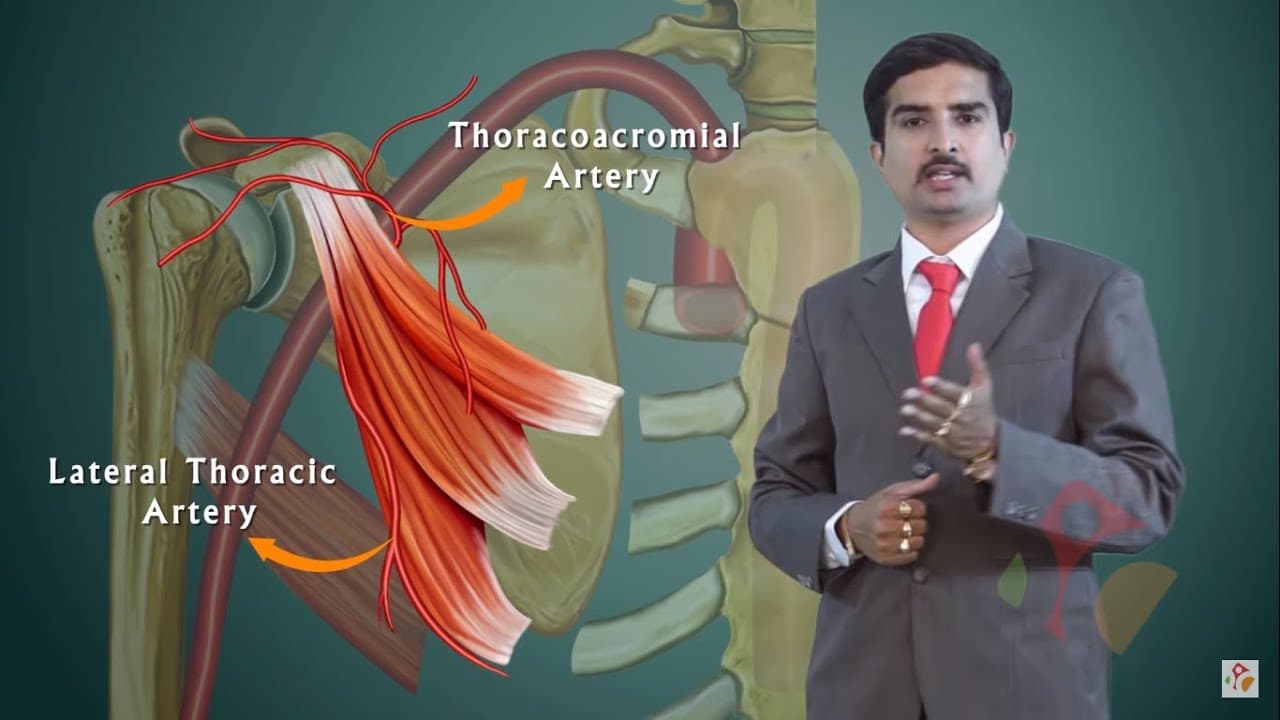
- Branches of the axillary artery include the superior thoracic artery, thoracoacromial artery, lateral thoracic artery, subscapular artery, anterior circumflex humeral artery, and posterior circumflex humeral artery.
- The subscapular artery is the largest branch, supplying the scapula and forming arterial anastomoses around it, while the circumflex humeral arteries supply the shoulder joint.
Install to Summarize YouTube Videos and Get Transcripts
Explore YouTube Video Summarizer or Get YouTube Transcript Extractor
Questions & Answers
Q: What is the axillary artery and its significance?
The axillary artery is the continuation of the subclavian artery and serves as the main artery of the upper limb. It is significant because it supplies blood to the upper limb and is closely related to the cords of the brachial plexus, which are named based on their relation to the second part of the axillary artery.
Q: How is the axillary artery divided and what are the branches of each part?
The axillary artery is divided into three parts by the pectoralis minor muscle. The first part gives off the superior thoracic artery, the second part gives off the thoracoacromial and lateral thoracic arteries, and the third part gives off the subscapular, anterior circumflex humeral, and posterior circumflex humeral arteries.
Q: What are the anatomical relations of the first part of the axillary artery?
The first part of the axillary artery is related anteriorly to the pectoralis major muscle and a nerve loop, posteriorly to the medial cord of the brachial plexus and the long thoracic nerve, and medially to the axillary vein. These relations are crucial for understanding its anatomical context.
Q: What is the significance of the second part of the axillary artery?
The second part of the axillary artery is significant because it is related to the cords of the brachial plexus, with the posterior cord lying posterior, the medial cord lying medial, and the lateral cord lying lateral to it. This part gives off the thoracoacromial and lateral thoracic arteries.
Q: What are the branches of the third part of the axillary artery and their functions?
The third part of the axillary artery gives off the subscapular artery, which supplies the scapula, the anterior circumflex humeral artery, which supplies the shoulder joint, and the posterior circumflex humeral artery, which supplies the deltoid muscle and shoulder joint. These branches are vital for the vascular supply of the upper limb.
Q: How does the axillary artery relate to the brachial plexus?
The axillary artery is closely related to the brachial plexus, with its second part serving as a reference point for naming the cords of the plexus. The posterior cord lies posterior, the medial cord lies medial, and the lateral cord lies lateral to the second part of the axillary artery.
Q: What is the function of the subscapular artery?
The subscapular artery, the largest branch of the axillary artery, supplies blood to the scapula and forms arterial anastomoses around it. It arises from the lower border of the subscapularis muscle and is crucial for the vascular supply of the scapular region.
Q: What are the differences between the anterior and posterior circumflex humeral arteries?
The anterior circumflex humeral artery is smaller than the posterior circumflex humeral artery. It supplies the shoulder joint and head of the humerus, forming anastomoses around the shoulder joint. The posterior circumflex humeral artery supplies the deltoid muscle and shoulder joint, passing through the quadrangular space to reach the posterior aspect of the humerus.
Summary & Key Takeaways
-
The axillary artery is an extension of the subclavian artery that serves as the main artery of the upper limb. It is divided into three parts by the pectoralis minor muscle, each with specific branches and anatomical relations.
-
The first part of the axillary artery gives off the superior thoracic artery, while the second part gives off the thoracoacromial and lateral thoracic arteries. The third part gives off the subscapular, anterior circumflex humeral, and posterior circumflex humeral arteries.
-
Each part of the axillary artery has distinct anatomical relations with surrounding muscles, nerves, and veins. These relations are essential for understanding the anatomy and function of the upper limb's vascular and nervous systems.
Read in Other Languages (beta)
Share This Summary 📚
Summarize YouTube Videos and Get Video Transcripts with 1-Click
Try YouTube Summary with ChatGPT & Claude or YouTube Transcript Generator
Explore More Summaries from Dr.G Bhanu Prakash Animated Medical Videos 📚



Summarize YouTube Videos and Get Video Transcripts with 1-Click
Try YouTube Summary with ChatGPT & Claude or YouTube Transcript Generator