Evolution in Finite Populations
TL;DR
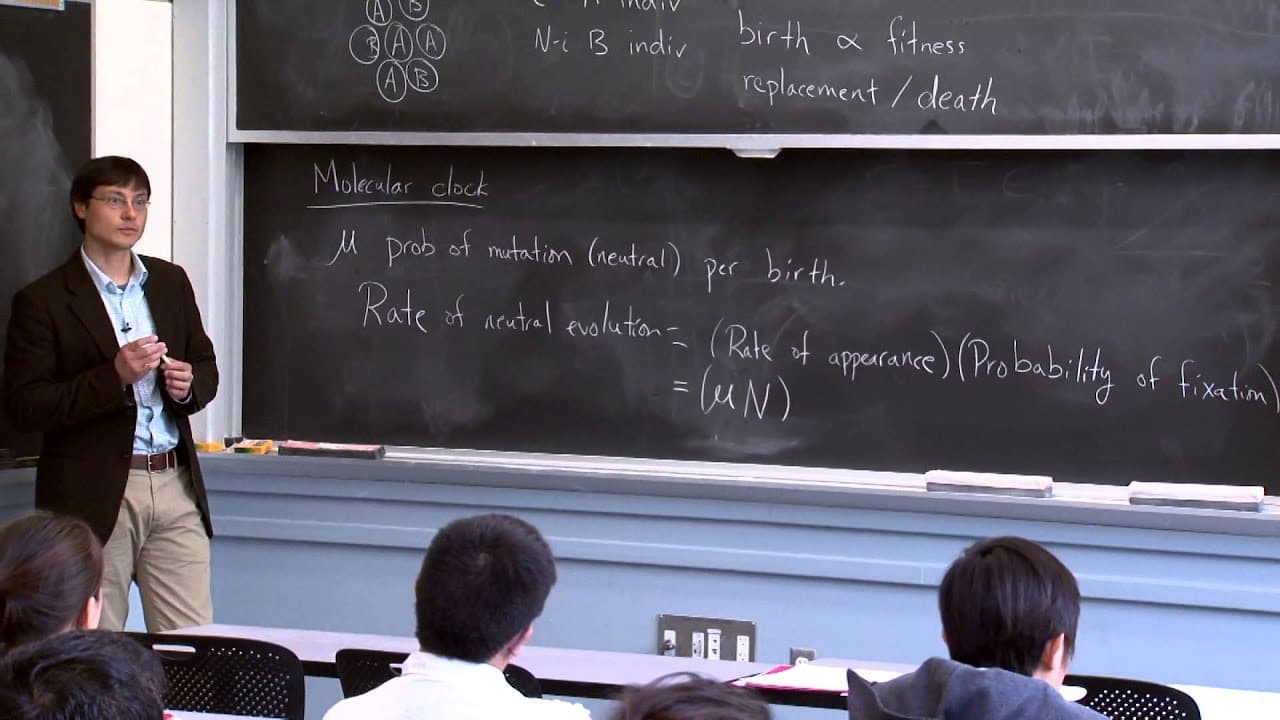
The Moran process, a model that fixes population size, is used to study evolution in finite populations and understand the dynamics of neutral and non-neutral evolution.
Transcript
The following content is provided under a Creative Commons license. Your support will help MIT OpenCourseWare continue to offer high quality educational resources for free. To make a donation or view additional materials from hundreds of MIT courses, visit MIT OpenCourseWare at ocw.mit.edu. PROFESSOR: All right, why don't we go ahead and get starte... Read More
Key Insights
- 🛩️ Evolution in finite populations requires understanding stochastic dynamics and considering small numbers.
- 😐 The Moran process is a model that fixes population size and is used to analyze both neutral and non-neutral evolution.
- ❓ Even beneficial mutants can go extinct due to the dominance of randomness in the process of evolution.
Install to Summarize YouTube Videos and Get Transcripts
Explore YouTube Video Summarizer or Get YouTube Transcript Extractor
Questions & Answers
Q: What is the Moran process and why is it important in studying evolution?
The Moran process is a model that fixes population size and tracks the composition of a population over time. It is important in studying evolution because it allows for the analysis of both neutral and non-neutral dynamics in a population.
Q: Why is stochastic dynamics significant in studying evolution?
Stochastic dynamics is significant in studying evolution because it takes into account the role of chance in the process. It helps understand how new mutants arise and the effects of randomness on the fitness of individuals.
Q: How does the Moran process handle neutral and non-neutral evolution?
The Moran process considers both neutral and non-neutral evolution. It analyzes the composition of a population when the fitness of individuals is equal or nearly equal (neutral) and when new mutants have different fitness (non-neutral).
Q: Why do beneficial mutants typically go extinct even if they have an advantage?
Beneficial mutants typically go extinct because randomness heavily influences the survival and proliferation of individuals, even if they have an advantage. The key factor is stochastic dynamics, as it is constantly shaping the life of mutants in a population.
Q: What is Muller's ratchet and how does it affect the fitness of a population over time?
Muller's ratchet is a phenomenon wherein deleterious mutations accumulate in a population and can eventually lead to a decrease in fitness. It is particularly strong in small populations that are less effective in filtering out these deleterious mutations, causing the fitness of the population to decline over time.
Summary & Key Takeaways
-
The Moran process models evolution in populations where stochastic dynamics and small numbers are important factors.
-
It considers the situation where there is neutral dynamics and tracks the composition of a population when the fitness of individuals is equal or nearly equal.
-
The process also examines non-neutral evolution and the effects of deleterious mutations in small populations.
Read in Other Languages (beta)
Share This Summary 📚
Summarize YouTube Videos and Get Video Transcripts with 1-Click
Try YouTube Summary with ChatGPT & Claude or YouTube Transcript Generator
Explore More Summaries from MIT OpenCourseWare 📚



Summarize YouTube Videos and Get Video Transcripts with 1-Click
Try YouTube Summary with ChatGPT & Claude or YouTube Transcript Generator