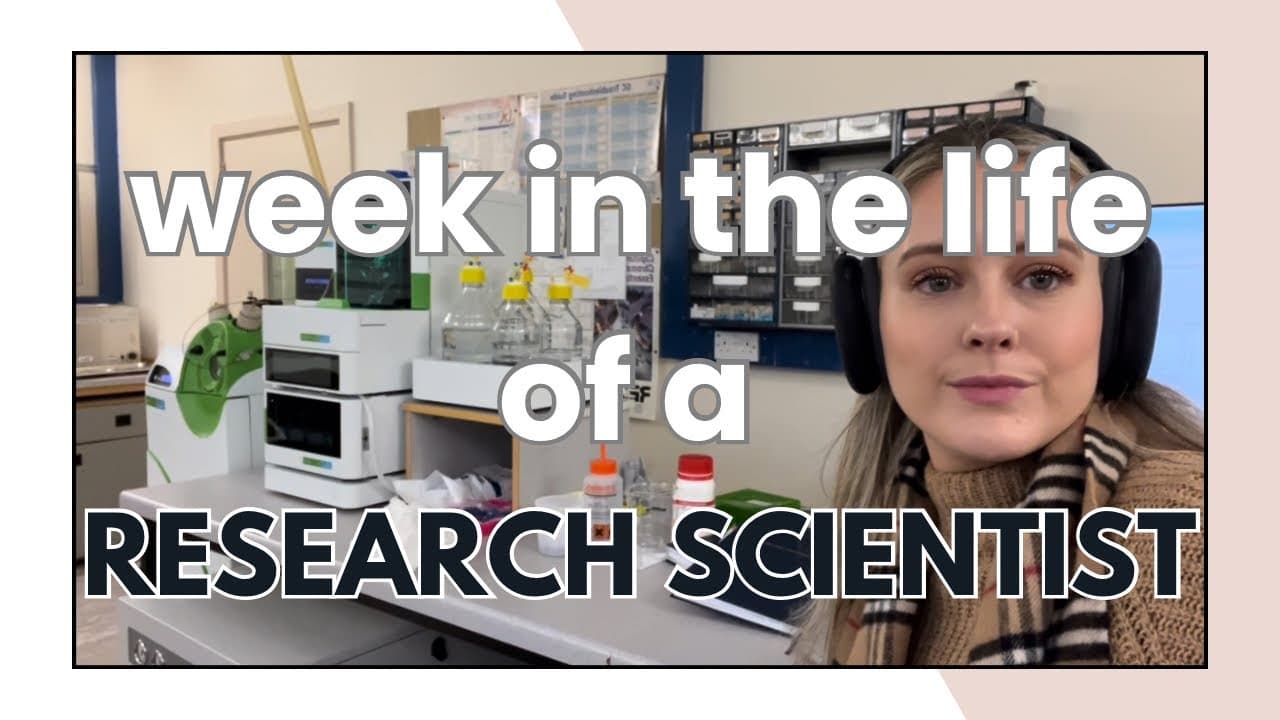
2024 IS OFF TO A BAD START | week in the life of a research scientist vlog #2
TL;DR
This video follows a scientist's week in the lab as they filter water samples, spike them with different concentrations of standards, and work on a grant application.
Transcript
Hello friends and welcome back to my channel I am going to show you what I'm getting up to at work and I in this little room that is honestly so cold it has been snowing the last 2 days I'll show you out the window but it's likeus 2 it's snowing work is very quiet because a lot of people are working from home cuz they don't want to travel in becaus... Read More
Key Insights
- 💦 The scientist's work involves filtering water samples, spiking them with standards, and analyzing them using LC-MS analysis.
- 🖐️ Grant applications, such as the seed corn grant, play an essential role in securing funding and developing methods or gathering initial data for future research projects.
- ⌛ Troubleshooting instrument issues, such as retention time changes, requires patience and careful analysis of calibration curves and experimental data.
- 💦 The scientist's interests extend beyond their lab work, as they mention attending conferences, pursuing a beekeeping course, and taking on a role as an associate lecturer.
Install to Summarize YouTube Videos and Get Transcripts
Explore YouTube Video Summarizer or Get YouTube Transcript Extractor
Questions & Answers
Q: What is the purpose of spiking water samples with different concentrations of standards?
By spiking the water samples with standards, the scientist can test the recovery rate of the spiked compounds using a cleanup method and LC-MS analysis. This helps validate the effectiveness of the method and determine if the compounds can be accurately detected and quantified.
Q: What is the significance of the seed corn grant the scientist is applying for?
The seed corn grant is a smaller grant that allows the scientist to conduct a proof-of-concept pilot study or develop a method. It provides initial funding and data that can be used to apply for larger grants in the future. It is an important opportunity to gain support and validation for their research.
Q: How does the scientist handle instrument issues, such as retention time changes?
The scientist troubleshoots the instrument issues by checking the calibration curves and analyzing the data. They rerun samples and standards, making adjustments to the method if necessary. They also seek feedback from colleagues and continue to monitor the instrument's performance until desired results are obtained.
Q: What other activities does the scientist mention outside of the lab work?
The scientist mentions attending a conference or workshop to network and discuss strategies for pollutants in the environment. They also mention signing up for a beekeeping course to support a future research project. Additionally, they share their excitement about becoming an associate lecturer and planning a holiday to Malta.
Summary & Key Takeaways
-
The scientist filters water samples and spikes them with standards to test their recovery using a cleanup method and LC-MS analysis.
-
They work on a grant application, specifically for a seed corn grant, which is a smaller grant to develop methods or gain initial data for a larger grant application.
-
The scientist deals with instrument issues, such as retention time changes, and continues to troubleshoot and rerun experiments.
Read in Other Languages (beta)
Share This Summary 📚
Summarize YouTube Videos and Get Video Transcripts with 1-Click
Try YouTube Summary with ChatGPT & Claude or YouTube Transcript Generator
Explore More Summaries from Dr Jessica Gomez 📚

Summarize YouTube Videos and Get Video Transcripts with 1-Click
Try YouTube Summary with ChatGPT & Claude or YouTube Transcript Generator