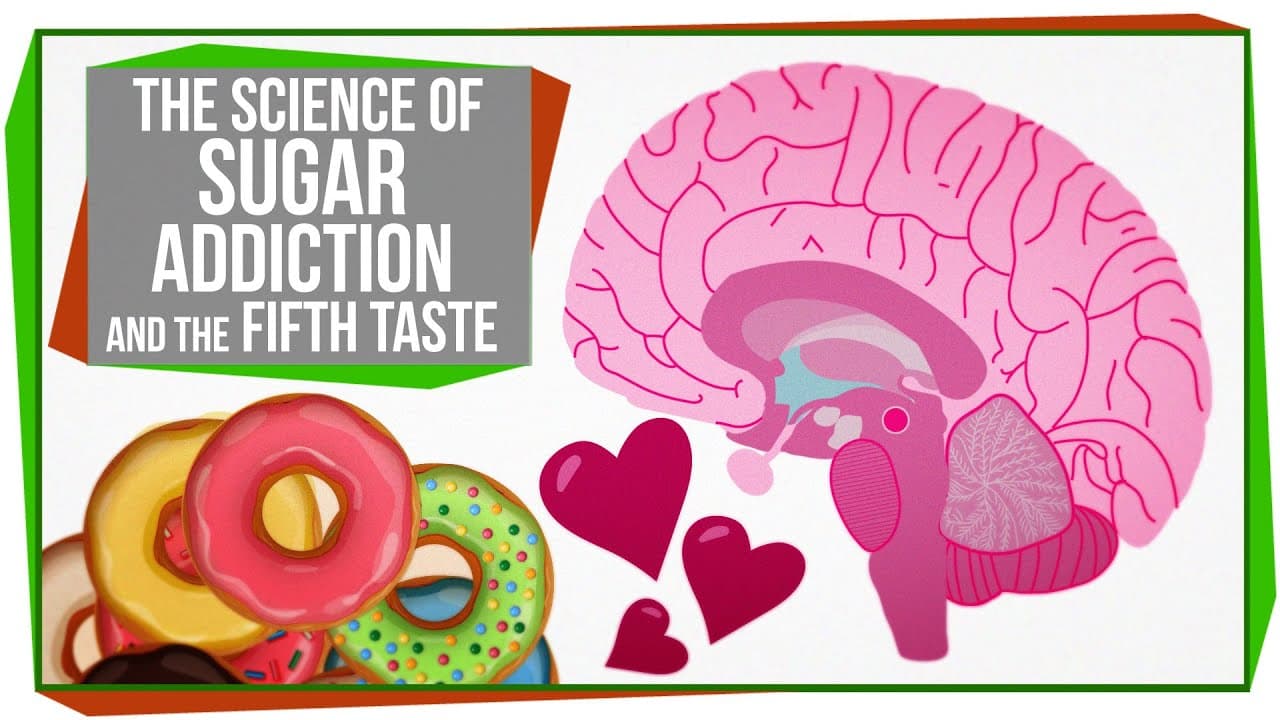
The Science of Sugar Addiction & The Fifth Taste
TL;DR
New research shows that our brains are wired to love sugary foods and that umami taste is important for our health.
Transcript
We’re a month into 2015, and a lot of us are probably struggling with our New Years diet resolutions. But if you find yourself staring at the half-eaten donut in your hand saying, “why can’t I quit you?”, don’t beat yourself up too much. New research out this week suggests that our brains are hardwired to love that donut. Writing in the publication... Read More
Key Insights
- 😋 The LH-VTA Loop in our brains controls sugar and food addictions, activating our reward circuit and increasing cravings.
- 👅 Umami taste, the 'fifth' taste, is important for our health and can be deficient in individuals with hyposalivation.
- 🌸 Elderly patients with hyposalivation and low umami taste thresholds have loss of appetite and weight loss, but increasing umami intake can improve their appetite.
- 😋 The desire for sugar and high-energy food evolved as a reward system when food was scarce but can be problematic in today's world with abundant junk food options.
Install to Summarize YouTube Videos and Get Transcripts
Explore YouTube Video Summarizer or Get YouTube Transcript Extractor
Questions & Answers
Q: How does the LH-VTA Loop control sugar and food addictions?
The LH-VTA Loop is a neural highway between the lateral hypothalamus and the ventral tegmental area, which controls our hunger and the brain's reward circuit. Activation of this loop leads to increased eating behavior and cravings for sugar.
Q: How did scientists study the LH-VTA Loop in mice?
Scientists used optogenetics to genetically modify neurons in the mice's brains. They could turn on or off these neurons by exposing them to light, allowing them to observe the effects on eating behavior.
Q: Why do humans have a taste for junk food?
Scientists believe that our taste for high-energy, palatable food evolved as a reward system when food was scarce. However, in today's world with abundant junk food options, this desire for sugar has become more of a hindrance than a help.
Q: How does umami taste affect our health?
Umami taste, which is described as savory and comes from high levels of glutamate, is important for our health. A study found that elderly patients with hyposalivation and low umami taste thresholds had loss of appetite and weight loss. By increasing umami intake, their saliva production and appetite improved.
Summary & Key Takeaways
-
Scientists at MIT have discovered the neural circuit that controls sugar and food addictions, known as the LH-VTA Loop.
-
By using optogenetics on mice, they were able to activate or deactivate this loop and observe the mice's eating behavior.
-
Umami taste, the 'fifth' taste, is important for our health, and a study in Japan found that elderly patients with hyposalivation had loss of appetite and weight loss.
Read in Other Languages (beta)
Share This Summary 📚
Summarize YouTube Videos and Get Video Transcripts with 1-Click
Try YouTube Summary with ChatGPT & Claude or YouTube Transcript Generator
Explore More Summaries from SciShow 📚


Summarize YouTube Videos and Get Video Transcripts with 1-Click
Try YouTube Summary with ChatGPT & Claude or YouTube Transcript Generator