Goodie Bag 2: Electronic Transitions (Intro to Solid-State Chemistry)
TL;DR
This video explains the concept of electronic transitions, demonstrating how electrons absorb and emit photons of different wavelengths using a spectrometer.
Transcript
[SQUEAKING] [RUSTLING] [CLICKING] VIVIAN SONG: In this video, we will be going over a Goodie Bag number two which is about electronic transitions. What you'll need are four LEDs-- white, blue, green, and red-- and one spectrometer. The objectives in this video are to understand photon absorption and emission, apply the Bohr Model, and use the spect... Read More
Key Insights
- ❓ Electronic transitions involve the absorption and emission of photons of different wavelengths.
- 🫀 The Bohr Model is a useful tool for modeling electronic transitions, assuming a single electron in an atom.
- 👻 Spectroscopy allows for the characterization of materials by analyzing the wavelengths of absorbed and emitted photons.
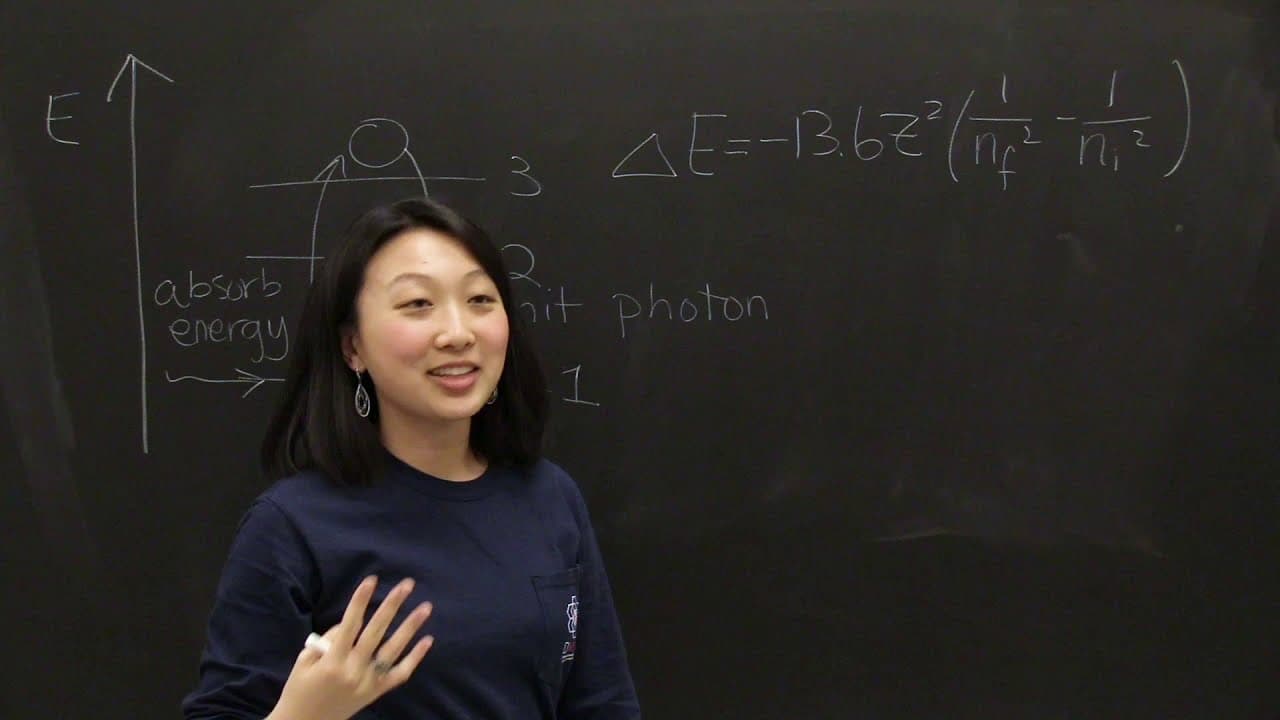
- 👣 The equation ΔE = -13.6z^2[(1/nf^2) - (1/ni^2)] can be used to track electronic transitions.
- 💁 The spectrometer is an essential tool in studying electronic transitions and can provide valuable information about the composition of materials.
- 😫 The energy levels of electrons in atoms are quantized, resulting in specific sets of wavelengths for emitted photons.
- 🙂 Different light sources, such as LEDs and ceiling lights, produce distinct spectra that can be observed and analyzed using a spectrometer.
Install to Summarize YouTube Videos and Get Transcripts
Explore YouTube Video Summarizer or Get YouTube Transcript Extractor
Questions & Answers
Q: How do electrons transition to different energy levels?
Electrons transition to different energy levels by absorbing energy and moving to higher energy levels, which are less stable. Eventually, they emit energy in the form of a photon and return to a more stable state.
Q: Why is spectroscopy a method of material characterization?
Spectroscopy is a method of material characterization because it allows scientists to analyze the wavelengths of photons absorbed and emitted by electrons. This information provides valuable insights into the composition and properties of materials.
Q: What equation can be used to track electronic transitions?
The equation ΔE = -13.6z^2[(1/nf^2) - (1/ni^2)] is used to track electronic transitions, where ΔE is the change in energy, z is the atomic number, nf is the final state of the electron, and ni is the initial state of the electron.
Q: Why are electronic transitions quantized?
Electronic transitions are quantized because energy levels in atoms are discrete and not continuous. Electrons can only transition between specific energy levels, resulting in the emission of photons with specific wavelengths.
Summary & Key Takeaways
-
The video discusses the objectives of understanding photon absorption, applying the Bohr Model, and using a spectrometer to analyze sample spectra.
-
It explains how electrons transition to different energy levels and why spectroscopy is used as a method of material characterization.
-
The Bohr Model is introduced as a way to model electronic transitions, assuming there is only one electron in the atom.
Read in Other Languages (beta)
Share This Summary 📚
Summarize YouTube Videos and Get Video Transcripts with 1-Click
Try YouTube Summary with ChatGPT & Claude or YouTube Transcript Generator
Explore More Summaries from MIT OpenCourseWare 📚



Summarize YouTube Videos and Get Video Transcripts with 1-Click
Try YouTube Summary with ChatGPT & Claude or YouTube Transcript Generator