3. Regular Pumping Lemma, Conversion of FA to Regular Expressions
TL;DR
Finite automata and regular expressions are equivalent in the class of languages they can describe. The pumping lemma is a method for proving certain languages are not regular.
Transcript
[SQUEAKING] [RUSTLING] [CLICKING] MICHAEL SIPSER: OK, folks. Here we are again. Welcome back for another episode of theory of computation. This is lecture number 3. I'm going to review what we've been doing. We've been looking at finite automata and regular languages. Those are the languages that finite automata can recognize. And we talked about n... Read More
Key Insights
- 😑 Finite automata, regular expressions, and context-free grammars are all models of computation that can describe different classes of languages.
- ⛽ The pumping lemma is a powerful tool for proving that certain languages are not regular by showing that they cannot be pumped in a way that stays within the language.
Install to Summarize YouTube Videos and Get Transcripts
Explore YouTube Video Summarizer or Get YouTube Transcript Extractor
Questions & Answers
Q: How are finite automata and regular expressions related?
Finite automata and regular expressions are equivalent because they can both recognize the same class of languages, known as regular languages.
Q: What is the pumping lemma used for?
The pumping lemma is used to prove that certain languages are not regular. It states that for every regular language, there exists a pumping length such that all long enough strings in the language can be "pumped" to generate other strings still in the language.
Q: Can you provide an example of using the pumping lemma to prove a language is not regular?
One example is the language B, consisting of strings with an equal number of zeros and ones. By assuming B is regular and applying the pumping lemma, we find a contradiction by pumping a string and resulting in a string that no longer has an equal number of zeros and ones.
Q: What are context-free grammars used for?
Context-free grammars are a more powerful model of computation than finite automata and regular expressions. They are used to generate strings in a language by applying substitution rules based on variables and terminals.
Summary & Key Takeaways
-
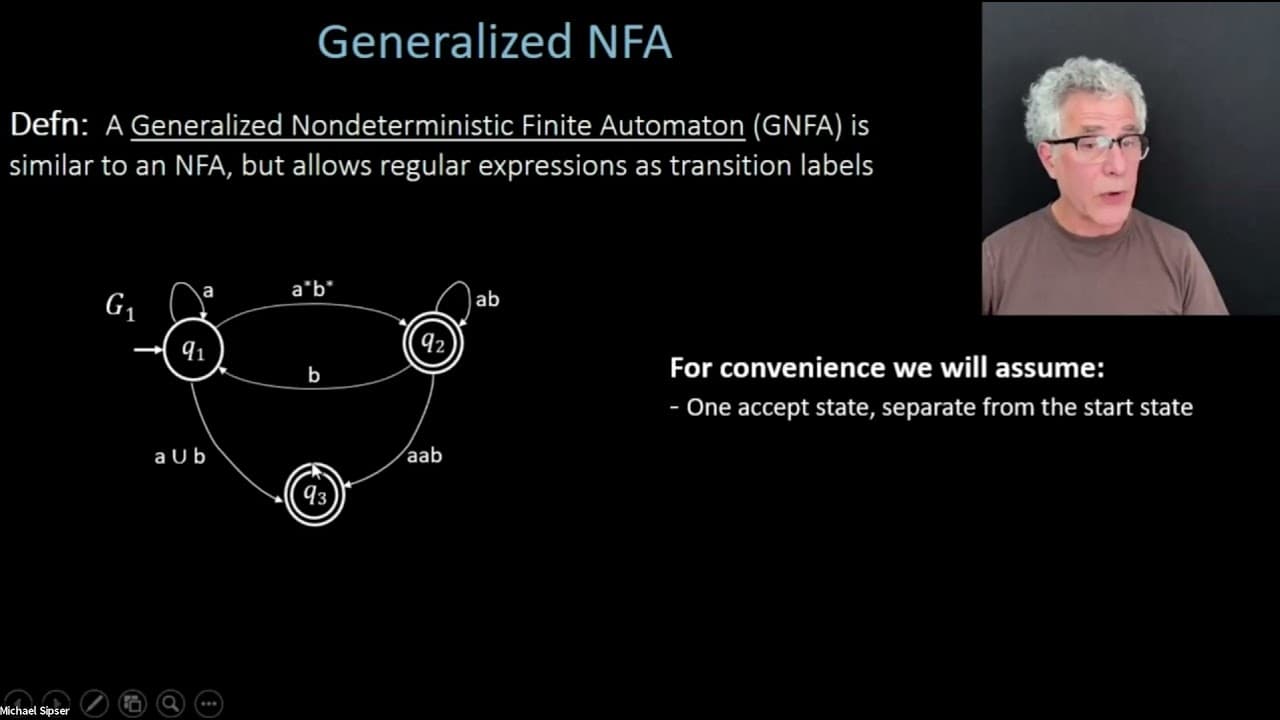
Finite automata (DFAs, NFAs, and GNFAs) and regular expressions are all equivalent in terms of the languages they can describe.
-
The pumping lemma is a method for proving that certain languages are not regular, by showing that long strings in the language can be "pumped" in a way that results in a string not in the language.
-
Context-free grammars introduce a more powerful model of computation than finite automata, which will be explored further in the next lecture.
Read in Other Languages (beta)
Share This Summary 📚
Summarize YouTube Videos and Get Video Transcripts with 1-Click
Try YouTube Summary with ChatGPT & Claude or YouTube Transcript Generator
Explore More Summaries from MIT OpenCourseWare 📚



Summarize YouTube Videos and Get Video Transcripts with 1-Click
Try YouTube Summary with ChatGPT & Claude or YouTube Transcript Generator