NAND Gate | DTL & RTL Realization | PDC | Lec-98
TL;DR
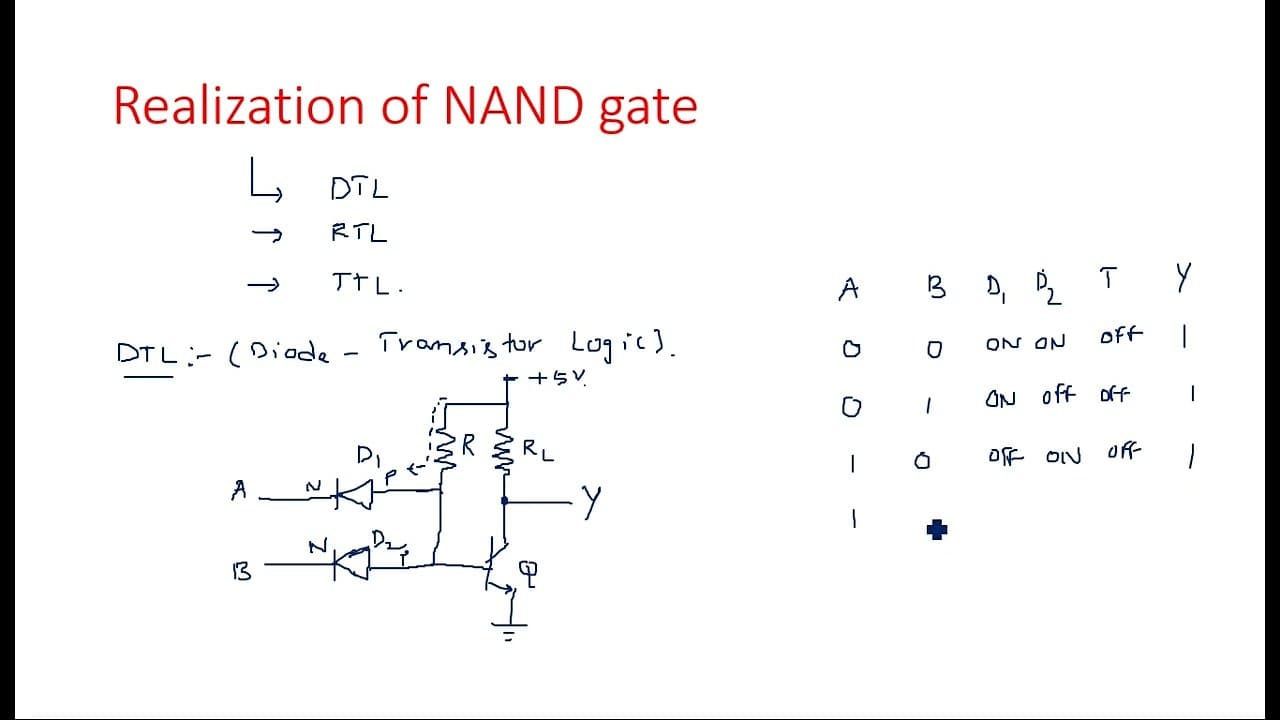
The video explains nand gate design using diode, resistor, and transistor logic.
Transcript
hi everyone in this video I am going to explain about the realization of nand gate using diotransistor logic resistor transistor logic if time permits I will also explain about the transistor transistor logic so as I said there are three different Logics we can design the nand gate one is diode transistor logic second one resistor transistor logic ... Read More
Key Insights
- 🔬 Diode transistor logic (DTL) effectively utilizes the characteristics of diodes and transistors to create foundational logic gates.
- 💐 The current flow through diodes determines the operational state of transistors, affecting output logic significantly in DTL configurations.
- 👻 Resistor transistor logic (RTL) employs resistors to manage input states with series transistors, allowing for a straightforward nand gate design.
- 🎨 Understanding the operations and interactions of these logic types is essential in digital electronics and integrated circuit design.
- 🔬 Logic gates can be repurposed; for instance, nand gates can function as NOT gates under specific input conditions.
- 🛟 The truth table serves as an essential tool for visualizing and predicting logic gate outputs based on various input combinations.
- ⚾ Controlled inverters utilize fixed inputs to redirect and manipulate output based on varying operational conditions.
Install to Summarize YouTube Videos and Get Transcripts
Explore YouTube Video Summarizer or Get YouTube Transcript Extractor
Questions & Answers
Q: What is diode transistor logic (DTL) and how does it work in creating a nand gate?
Diode transistor logic (DTL) combines diodes and transistors to implement a nand gate operation. In DTL, the diodes are configured in reverse bias, allowing for distinct voltage levels depending on input states that influence whether the transistor switches on or off, ultimately affecting the output logic according to the nand truth table.
Q: How does the behavior of diodes in reverse bias contribute to logic operations in DTL?
In DTL, when input signals are low (0), the diodes become forward biased, allowing current to flow, which causes the transistor to be off and results in a logic one output. Conversely, when inputs are high (1), both diodes are reverse biased, preventing current flow, which switches the transistor on and leads to a logic zero output.
Q: Explain the role of resistor transistor logic (RTL) in nand gate realization.
Resistor transistor logic (RTL) utilizes series-connected transistors and resistors to realize nand gate functionality. Transistors T1 and T2 control the output based on the input states, where if both transistors are on (inputs 1), the output is low (0), whereas if any transistors are off, the output is high (1).
Q: Can nand gates be used to create NOT gates, and if so, how?
Yes, nand gates can be configured to act as NOT gates. By short-circuiting the inputs of a nand gate, the output will reflect the negated state of the input. For instance, if both inputs are 0, the output is 1; if both are 1, the output is 0, thus performing a NOT operation.
Q: What is the significance of the truth table in digital logic circuits?
The truth table is crucial in digital logic circuits as it defines how the output will behave based on varying combinations of input states. With a clear understanding of truth tables, engineers can design complex circuits by predicting their behavior and ensuring accurate logic functionality.
Q: How do controlled inverters operate within the context of nand gates?
Controlled inverters employ nand gates where one input is fixed at a logic high. This allows the second input to control the output, functioning as an inverter. When the control input is high, the output reflects the negated value of the other input, effectively turning a nand gate into an inverter based on input status.
Summary & Key Takeaways
-
The video outlines three techniques for building nand gates: diode transistor logic (DTL), resistor transistor logic (RTL), and transistor transistor logic (TTL).
-
DTL entails implementing the nand operation with diodes and transistors, highlighting how diode states affect transistor behavior and output logic.
-
RTL focuses on organizing transistors in series and using resistors to manage input states, demonstrating the resultant logic outputs based on the conditions of input transistors.
Read in Other Languages (beta)
Share This Summary 📚
Summarize YouTube Videos and Get Video Transcripts with 1-Click
Try YouTube Summary with ChatGPT & Claude or YouTube Transcript Generator