AC Through Pure Resistance in AC Circuit - AC Circuits - Basic Electrical Engineering
TL;DR
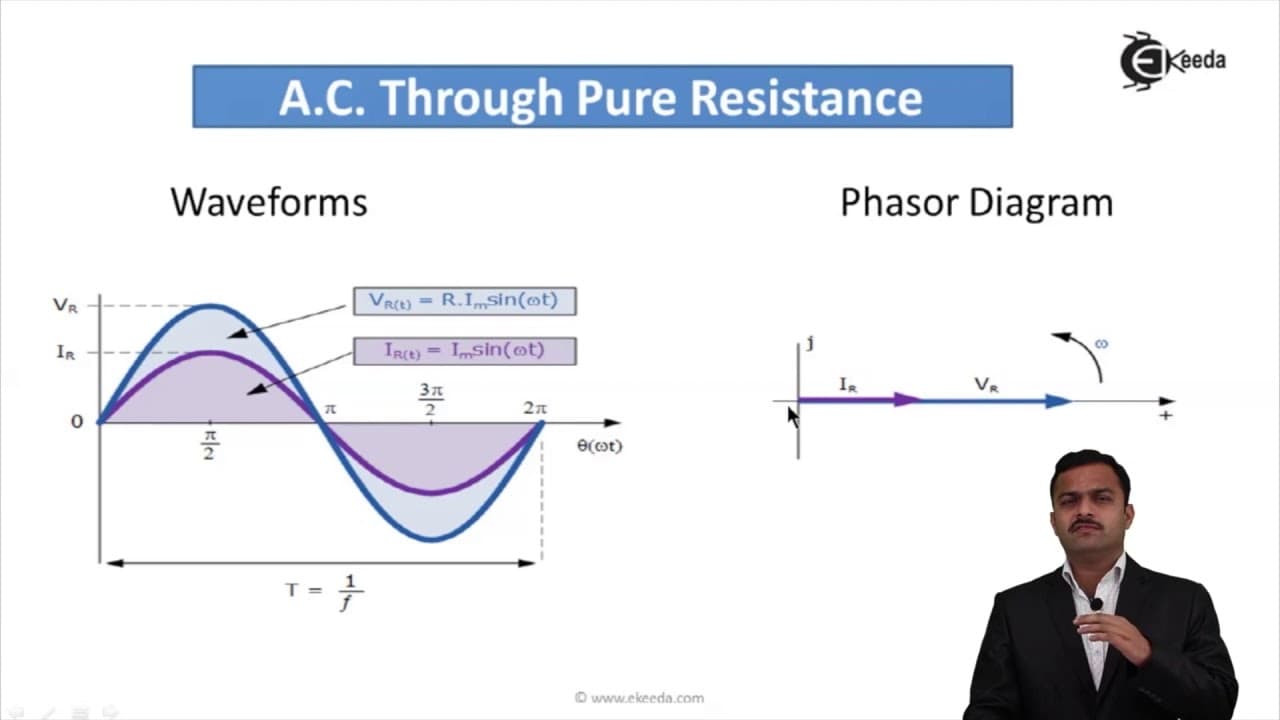
AC current passing through a pure resistance results in in-phase voltage and current, and the power is equal to the product of voltage RMS and current RMS.
Transcript
hi friends now all ac fundamentals we have already seen along with concept of phase and phase difference now let's see the application of ac now what we are going to see over here if this ac supply is pass through all the passive elements how the ac will act so the first element we are going to see is a pure resistance so this is a circuit ac suppl... Read More
Key Insights
- 🧭 When AC current passes through a pure resistance, the voltage and current are in phase.
- ✊ The power in a pure resistive circuit is given by the product of the RMS voltage and current.
- ✊ The average power delivered to the resistance in a pure resistive circuit is zero.
- ✊ The power waveform in a pure resistive circuit consists of a DC component and a sinusoidal component.
- ✊ AC power calculations involve considering the RMS values of voltage and current.
- ✊ The average power over a complete cycle in a pure resistive circuit is equal to the product of the RMS voltage and current.
- ⚡ The phase angle between the voltage and current in a pure resistive circuit is zero degrees.
Install to Summarize YouTube Videos and Get Transcripts
Explore YouTube Video Summarizer or Get YouTube Transcript Extractor
Questions & Answers
Q: What happens when AC current passes through a pure resistance?
When AC current passes through a pure resistance, the voltage and current are in phase with each other. The voltage across the resistance is equal to the current flowing through it multiplied by the resistance value.
Q: How can the power in a pure resistive circuit be calculated?
The power in a pure resistive circuit can be calculated by multiplying the RMS voltage across the resistance by the RMS current flowing through it. This gives the average power delivered to the resistance over a complete cycle.
Q: Why is the average power delivered to the resistance zero in a pure resistive circuit?
The average power delivered to the resistance is zero in a pure resistive circuit because, over a complete cycle, the positive and negative half cycles of the power cancel each other out. Therefore, the average power is equal to zero.
Q: What is the relationship between the power and the RMS values of voltage and current in a pure resistive circuit?
The power in a pure resistive circuit is equal to the square of the RMS current multiplied by the resistance. Alternatively, it can also be calculated by multiplying the RMS voltage across the resistance by the RMS current flowing through it.
Summary & Key Takeaways
-
When AC current passes through a pure resistance, the voltage and current are in phase with each other.
-
The power in a pure resistive circuit is equal to the RMS voltage multiplied by the RMS current.
-
The average power delivered to the resistance is zero over a complete cycle due to the positive and negative half cycles canceling each other out.
Read in Other Languages (beta)
Share This Summary 📚
Summarize YouTube Videos and Get Video Transcripts with 1-Click
Try YouTube Summary with ChatGPT & Claude or YouTube Transcript Generator
Explore More Summaries from Ekeeda 📚



Summarize YouTube Videos and Get Video Transcripts with 1-Click
Try YouTube Summary with ChatGPT & Claude or YouTube Transcript Generator